

Product-Led Content Is Redefining SaaS Marketing.
And if you’ve been in the SaaS space for a while, you understand the hype around it.
Customers have heard “seamless integration” and “fast growth” too many times. They no longer want promises. They want to see how your product works in real case scenarios and how it fits into their workflow even before talking to sales.
Product-led content is your unfair advantage here. It helps you demonstrate the value of your product without hard selling.
However, most SaaS brands don’t understand that product-led content is not a single tactic. It exists in 6 different types, and the real power lies in understanding which type to create, the stage it fits into, and when to use each one to drive real business impact.
With insights from a buyer enablement expert and organic growth marketer, this piece breaks down the different types of product-led content and how to use them at the right stage of the buyer’s decision journey for high impact.
Let’s dive in.
Methodology

This article was written by an amazing guest contributor. The piece was edited and prepared for publication by Masroor Ahmad, founder of h1copy.
TL;DR: Types of product-led content (quick overview)
| Type | What it is | Why it matters |
| Case studies | Real customer stories explaining how the product was used to achieve a specific result | Builds trust, drives organic traffic, and proves the product works in real scenarios |
| Product-led how-to articles | Instructional pieces that position the product as the tool to achieve the outcome | Supports SEO and moves readers toward solution awareness |
| Product-led tutorials | Explanatory guides that teach how to achieve value within the product | Creates good onboarding experience, drives feature adoption, and shortens time-to-value |
| Comparison & versus content | Content that demonstrates side-by-side workflows and outcomes between your product and alternatives | Helps buyers confidently choose your product and fastens buying decisions |
| Product-led social media content | Short explanations, micro-workflows, and user stories used in posts on social platforms | Creates early product understanding, relevance, and trust at scale |
| Objection-handling content | Pages or resources that answer buying concerns (security, integrations, pricing, setup, migration) using real product context | Removes last-minute friction, reduces perceived risk, and directly improves conversions |
1. Case study product-led content
Jordan Dzierwa, founder of SKYDOG jewelry, was losing leads due to task overload and poor order tracking. But, after using Calendly and Typeform, he was able to save 8-10 hours weekly, convert 85-90% of booked calls, and record a 15-20% increase in revenue. This was a product-led case study written by Calendly to show how the product was positioned as the solution — and that’s a key element of a product-led case study.
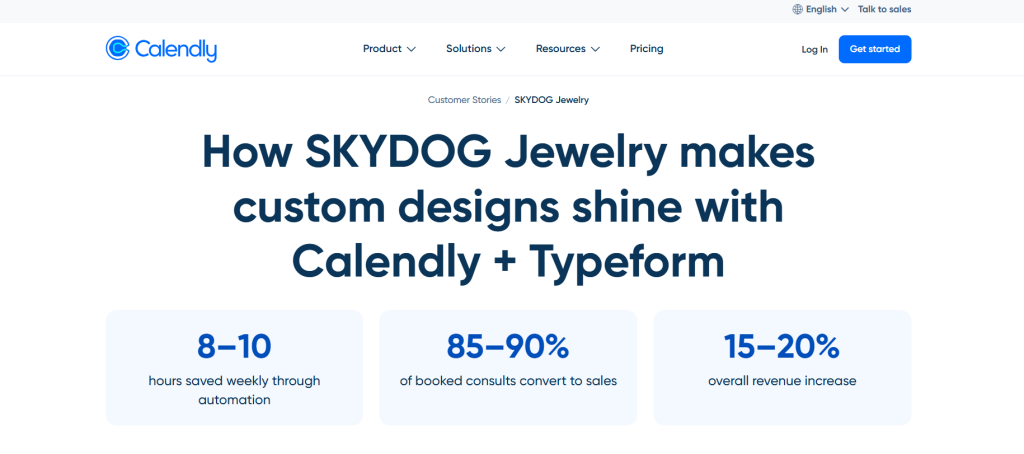
A product-led case study is a story-driven piece that showcases a customer’s success after using your product. It infuses your product directly into the story’s narrative as the solution to their problem.
Case studies are one of the most effective ways to create awareness for your product and drive results for your business.
“Use-case-driven content has driven the most signups and product adoption for me by a wide margin. We consistently saw strong results from case studies built around how customers were using the product, not just that they were using it.”
— Charu Mitra Dubey, organic growth marketer
With a case study, you sell without selling.
“Case studies are like testimonials with really big muscles that do the job of selling for you.”
— Erin Ollila, Founder, EO Copy Co.
Why are product-led case studies important?
- They build credibility and trust through real stories and quantifiable results
- They increase product adoption and satisfaction by showing how users achieve their goals using your product
- Product-led content case studies drive organic growth by attracting customers looking for solutions and guiding them to your product as the answer
- They highlight the value of your product beyond just features, focusing on outcomes
A good product-led case study highlights the “before your product” (problem) and “after your product” (solution), just like we do it at h1copy. We create your product-led case study by turning features into outcomes and showing what changed in workflow and revenue to demonstrate impact.
2. Product-led how-to articles
A product-led how-to article is an instructional piece that teaches users step-by-step how to use your product to accomplish a specific goal. Just like this piece I wrote on how to use Trello as a content writer
It showed how the product (Trello) can be applied in daily writing tasks, making it the core of the solution which is where the value lives.
A good product-led how-to content addresses the jobs to be done directly rather than generic insights. Instead of teaching what a product is, they teach what a user wants to achieve.
The best ones follow this structure:
“How to do X with Y tool to achieve Z outcome,” where:
- X = the user’s task
- Y = the product
- Z = the real result they care about
Here’s a rule of thumb: if the topic can work without mentioning the product, it’s not product-led yet. Product-led how-to guides make the tool part of the solution, not just a mention.
Importance of how-to articles
- They support SEO and organic traffic by targeting “how to” queries
- They build trust and authority by providing genuine and actionable value
- They improve customer retention by showing existing customers how to use new features and get more value from the product
Also read: How To Write Long-Form Blogs
3. Product-led tutorial guides
A product-led tutorial is an explanatory guide that uses tooltips, walkthroughs, and images to teach users how to achieve value within the product itself. It doesn’t just explain features in isolation; it shows users exactly what to click, what to set up, and what outcome to expect — helping them move from first interaction to real results faster and with less confusion.
The difference between a weak tutorial and one that converts is: a weak tutorial guide explains just features, a product drives outcomes. It shows how you get results.
“One of the strongest product-led formats is explainer-style guides and blogs. These look like educational content on the surface, but they also show how the product works. Many of these end up reading like a help center article”
— Lakshmi Padmanaban, content marketer
At h1copy, we believe that product-led content works best when it blends “why this problem matters” with “how the product helps.” Instead of describing just features, we show how your product will be applied in the daily lives of your customers.
Why are product-led tutorials important?
- Tutorials guide users to experience the core value of the product as quickly as possible, reducing time-to-value
- They give users room to experience self-serving onboarding
- Product-led tutorials help your business scale faster when users learn the product without increasing human resources
- Product-led tutorials help users learn your product to solve their problems, which leads to higher customer satisfaction
4. Comparison & versus product-led content
Your prospects are not just browsing your products; they are also comparing your products to competitors.
A comparison product-led content demonstrates how your product solves specific problems when placed side-by-side with other products. It follows a “show, don’t tell” approach, unlike traditional articles that use generic marketing jargon.
Here is a simple principle: comparison content doesn’t always have to look like a traditional “Product A vs. Product B” table. Sometimes, the comparison is between two ways of working.
For example, h1copy published a piece comparing content velocity vs. content quality not to declare a winner, but to show how different content systems produce different outcomes.
It’s the same logic buyers use when they compare tools. They ask: Which approach gets me results faster? Which one fits my team’s workflow? What trade-offs am I making?
By showing how your product works in real use cases, features, and business impact, it helps buyers evaluate and choose your product over other options.
Also read: Saas Marketers Share What Not To Use AI For
Why are comparison product-led articles important?
- They target customers who are ready to buy and convert them
- Comparison content that educates customers on features, use cases, and pricing upfront allows users to make faster decisions
- Comparison articles lower customer acquisition costs by drawing in organic search traffic and converting them
- Through screenshots and practical examples, comparison articles fasten time-to-value
5. Objection-handling product-led content
Objection-handling content is product-led content created to remove fear, doubt, or perceived risk just at the moment buyers are deciding whether to move forward or walk away.
Its job isn’t to introduce your product. It’s to answer the silent questions buyers are already asking:
- Will this actually work for us?
- Will switching be painful?
- How do I justify this decision to my team?
Objection-handling content is best understood as an intent, not just a format.
“This type of content works well because it shows up when buyers are already interested but are stuck on a specific concern like integrations, security, or the risk of switching. When those concerns are answered clearly, perceived risk drops, and buyers gain the confidence they need to move the decision forward”.
— Ayomide Joseph, buyer enablement strategist
Examples of objection-handling content (product-led)
A migration guide
- Example: “How to move from Trello to Asana in 48 hours (without losing data)” — it handles the fear: “Will this be painful to set up?”
A security page
- Example: “How we protect customer data at Stripe” — it handles the fear: “Is this safe enough for our company?”
Why is objection-handling content important?
- It removes buying friction and answers the questions that delay buying decisions
- It increases signups and conversions
- It supports internal buying discussions
- One page can handle the same objections hundreds of times
When to use to use each type of product-led content for maximum impact
Now that you know the types of product-led content you need to create, how and when do you use these articles to see real business impact?
A Better way to use product-led content is to align it to buyer uncertainty (not just funnels or calendars)
“the biggest mistake teams make is treating product-led content like a blog calendar problem, when in reality each content type only works when it shows up at the right buying moment”.
— Ayomide Joseph, buyer enablement strategist
Most teams plan product-led content based on blog calendars or generic funnel stages, which look like: publish tutorials in January, case studies in February, comparisons in March.
However, high-performing SaaS teams do something different.
They map content to buyer uncertainty. Intent now plays a huge part in search and buying decisions, so instead of asking, “What should we publish this month?” they ask:
- What is the buyer confused about right now?
- What fear is slowing them down?
- What question, if answered clearly, would move them forward?
These are the questions you need to ask before mapping out your content calendar.
When product-led content is timed to uncertainty, it ceases to be just content. Tutorials start to feel like guidance, case studies like proof, comparison pages like decision tools, social content feels like validation, and objection-handling pages quietly remove the final barriers to adoption.
The three buyer uncertainty states (before the decision is made)
In SaaS, buyers don’t move through neat funnel boxes. They move through different states of uncertainty. However, these uncertainties change as they get closer to a decision.
1. Early uncertainty — “Is this for someone like me?”
At this stage, buyers know they have a problem, but they’re unsure what type of solution fits or whether your product is relevant to their role, team, or workflow.
“The early stage is where product-led content has the highest leverage. When your product isn’t well known, you can’t rely on brand trust or social proof. You have to educate your ICP on a better way of working.”
— Charu Mitra Dubey, organic growth marketer
At this stage, users are not looking for deep features yet. They’re looking for recognition. They want to know if the tool understands their situation.
Here, you can use simple use cases, light tutorials, and relatable examples to help buyers see themselves in the product before asking them to evaluate it.
2. Mid uncertainty — “How would this actually work for us?”
At this stage, the buyer already believes a solution like yours could help. But they’re stuck on the operational details:
- How it fits into their existing workflows
- What setup and onboarding look like
- How their team would use it day-to-day
- Whether it will disrupt or align with their current tools and processes
They’re no longer evaluating ideas; they’re evaluating implementation risk.
So instead of high-level benefits, they need to see the product in action. This is where demos, walkthroughs, case studies, and process-driven content become most persuasive.
3. Late uncertainty – “Is this a safe decision?”
At this stage, the buyer is emotionally ready to say yes, but logically cautious. They’re no longer judging features, they’re judging risk: “If this goes wrong, what happens to me?”
As Joseph notes, when someone reaches an objection-handling page, they’re already interested. They’re just stuck on one fear. This is where product-led objection-handling content comes in to remove friction, or you risk losing the deal.
Matching buyer uncertainty to product-led content types
Here’s how your six content types fit naturally into these uncertainty stages:
| Buyer uncertainty state | What the buyer is thinking | Best product-led content type |
| Early uncertainty | “Is this tool for someone like me or my team?” | Social media content (use cases, short demos, user stories) |
| Early uncertainty | “How do people like me solve this problem?” | Tutorials & how-to content |
| Mid uncertainty | “How would this work in our actual workflow?” | Tutorials & how-to content |
| Mid uncertainty | “Has this worked for teams like ours?” | Case studies (operational, not just results) |
| Late uncertainty | “Which tool should we choose?” | Comparison / vs content |
| Late uncertainty | “Is this safe? Will this backfire?” | Objection-handling content |
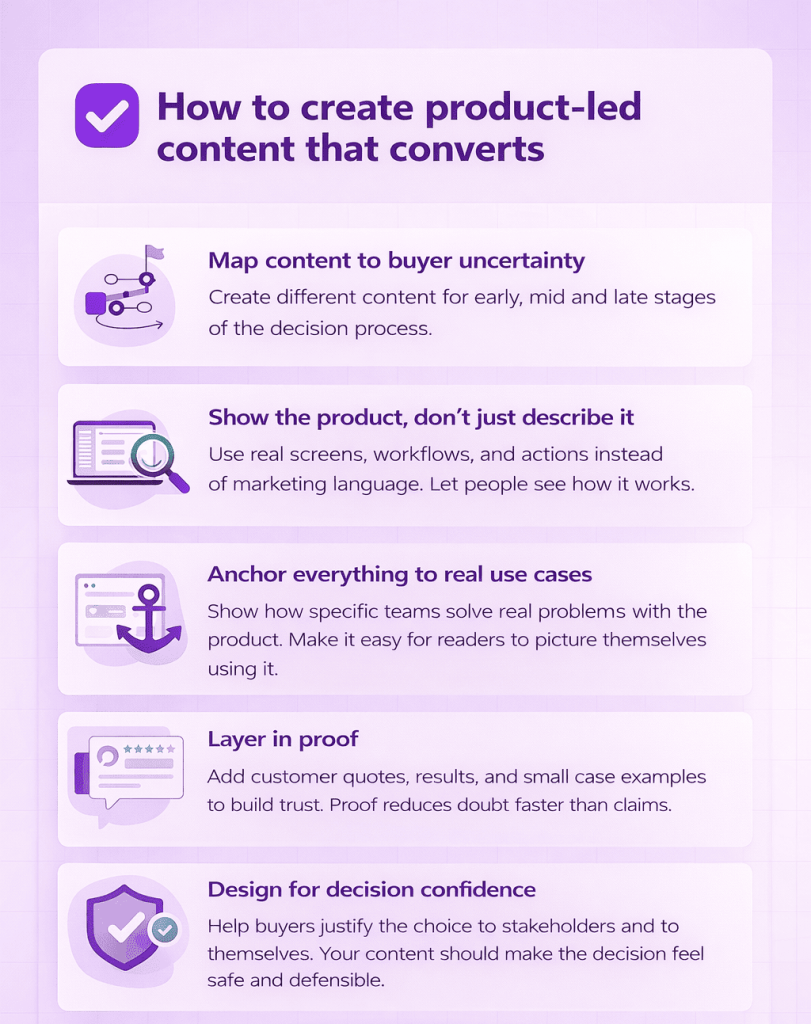
How to create product-led content that converts
Creating product-led content isn’t about mentioning your tool more often. It’s about structuring your content so the product becomes the natural bridge between the problem and the outcome.
Here’s how to do it right.
1. Map content to buyer uncertainty
Most SaaS teams map content to a calendar. High-performing teams map it to uncertainty.
Instead of asking, “What should we publish next?”, ask:
- What is the buyer unsure about right now?
- What fear is slowing them down?
- What question, if answered clearly, would move them forward?
Early-stage buyers need recognition.
Mid-stage buyers need operational clarity.
Late-stage buyers need risk reduction.
When content aligns with uncertainty, it stops feeling like marketing and starts feeling like guidance. Tutorials become implementation support. Case studies become proof. Objection-handling pages become decision enablers.
Conversion improves not because you “optimized for CTA,” but because you reduced friction at the right moment.
2. Show the product, don’t just describe it
Most SaaS content describes benefits. Converting product-led content demonstrates workflow.
Instead of saying:
“Automate your reporting in minutes.”
Show:
- The dashboard
- The setup process
- The automation trigger
- The output
Screenshots, real examples, and mini walkthroughs are not decoration. They are evidence.
When buyers can see how the product fits into their daily tasks, mental resistance drops. They stop imagining complexity and start imagining usage.
Description creates interest.
Demonstration creates confidence.
3. Anchor everything to real use cases
Generic advice does not convert. Context does.
“Improve team collaboration” is abstract.
“Here’s how RevOps teams use this workflow to shorten their weekly reporting time by 40%” is specific.
When content is anchored in real teams, real roles, and real workflows, buyers can picture themselves using the product.
That mental visualization is critical.
People don’t buy features.
They buy improved versions of their current workflow.
If your content makes it easy for someone to say, “That’s exactly how we work,” you’ve already moved them closer to yes.
4. Layer in proof
Claims create curiosity.
Proof creates conviction.
Product-led content should consistently layer in:
- Customer quotes
- Before/after results
- Small operational case examples
- Measurable outcomes
- Screens from real implementations
Even subtle proof signals matter.
A short quote from a user inside a tutorial.
A micro-case embedded inside a how-to.
A stat pulled from an implementation story.
Every layer of proof reduces doubt. And in SaaS, doubt is the real conversion killer.
5. Design for decision confidence
At the final stage, buyers aren’t evaluating features. They’re evaluating risk.
They’re asking:
- Will this backfire?
- Can I defend this choice internally?
- What happens if implementation fails?
Your content should help them justify the decision to stakeholders — and to themselves.
This is where comparison pages, security content, migration guides, and objection-handling articles quietly increase conversion rates.
The best product-led content doesn’t just explain how the product works.
It makes choosing the product feel safe, logical, and defensible.
When content reduces perceived risk, the product becomes the obvious choice.
The bottom line: product-led content is how you win in SaaS today
Product-led content is the new way of selling without friction, and it works because it matches how people actually buy.
However, without understanding the different types and intent behind them, you’ll miss the sweet spot.
Customers don’t wake up ready to purchase all of a sudden. They move through different stages, and at each stage, they need different evidence.
When your content educates early, demonstrates clearly in the middle, and removes fear at the end, your product becomes the obvious choice.
Product-led content, when written well at the exact time it’s needed, stops being marketing and starts becoming part of the product experience itself.
Turn your product into the clearest answer to your buyer’s uncertainty
If you’re a SaaS company investing in product-led content that drives real results, we can help.
h1copy creates product-led content built for buyers — and built to rank.
Work with us at h1copy. Wanna talk to the founder? Reachout to Masroor Ahmad.
Frequently asked questions (FAQs)
What is product-led content in SaaS marketing?
Product-led content showcases your SaaS product directly in action through real workflows, outcomes, and use cases, rather than generic promises. It builds trust by letting prospects experience value before sales contact, redefining marketing from hype to proof, like case studies or tutorials that integrate your tool as the hero.
What are the 6 types of product-led content?
The six types include: (1) Case studies with customer stories; (2) How-to articles teaching tasks with your product; (3) Tutorials with screenshots and walkthroughs; (4) Comparison content vs. competitors; (5) Social media demos and micro-workflows; (6) Objection-handling resources for concerns like security or migration.
How does product-led content drive SaaS growth?
It accelerates growth by matching buyer stages: early content builds relevance via social and how-tos, mid-stage demos reduce implementation fears through tutorials and cases, and late-stage pieces like comparisons and objection handlers boost conversions by cutting risk and speeding decisions.
What’s the difference between product-led tutorials and how-to articles?
How-to articles focus on step-by-step goals using your product (e.g., “How to set up a content calendar in Trello”), targeting SEO for broad queries. Tutorials dive deeper with visuals, tooltips, and in-product navigation to shorten onboarding and time-to-value.
When should I use comparison product-led content?
Deploy it in late buyer uncertainty (“Which tool to choose?”) for prospects comparing options. Use side-by-side workflows, screenshots, and outcomes—not just tables—to highlight your product’s edge, drawing organic traffic from “Tool A vs. Tool B” searches and fast-tracking purchases.