


Most startups default to a content strategy without questioning whether it fits their product or growth stage. This guide breaks down product-led, sales-led, and marketing-led content strategies — and how to choose the one that’s right for you.
But before that, here’s a simple comparison between all types of “led” content strategy.
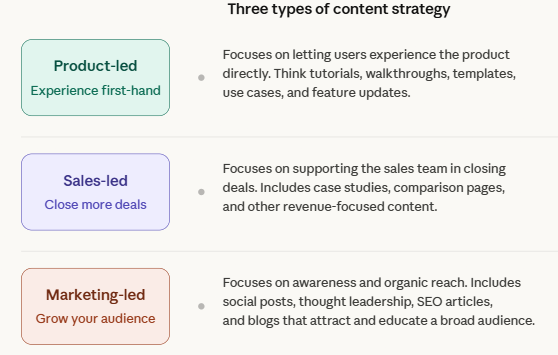
- Product-led content focuses on letting users experience the product first-hand. Think of tutorials, walkthroughs, templates, use cases, and feature updates. This gives prospects a clear sense of how the product works before they sign up.
- Sales-led content focuses on case studies, comparison pages, and revenue-focused content. This supports the sales team in closing deals instead of generating general awareness.
- Marketing-led content focuses on awareness and organic reach. For example, social posts, thought leadership, SEO articles, and long-form blogs that revolve around attracting and educating a broad audience.
Understanding product-led content strategy
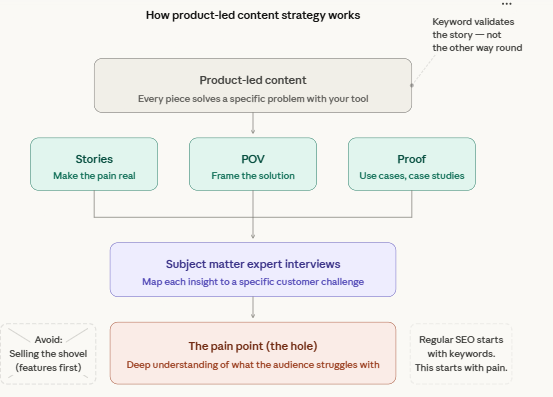
A product-led content strategy means every piece of content helps the reader solve a specific problem using your product, using a mix of storytelling, POVs, and proof like use cases and case studies.
However, there’s a high level of awareness of which specific problem your audience is facing, coupled with your strategy to solve their problems. This revolves around interviewing subject matter experts, mapping each one to specific customer challenges, and repurposing them in your content.
A common content marketing mistake most startups make with this type of content is selling the shovel (features) instead of the hole (the solution to the pain point).
What separates product-led content strategy from regular SEO content strategy is that it starts with a deep understanding of the pain point, developing stories and content that validate the keyword. Unlike your regular SEO content strategy, which focuses on keyword research, competitor analysis, and topics for traffic.
Also read: Which Social Media Metrics Actually Signal Demand for Early-stage SaaS
Benefits of using a product-led content strategy
Doubles sales enablement: Product-led content connects marketing and sales by focusing on your customer’s real problems. It helps them understand those challenges clearly and shows, in a practical way, how your product can solve them.
Generate leads through authentic content: Most SaaS content speaks to readers, rather than buyers — hence, it drives traffic from people who may never sign up or even try your product. Product-led content, on the other hand, attracts people who want to solve a problem and are willing to try the product themselves.
Leads to demo requests and downloadable assets: The average free trial to paid conversion rate is 25%. When your ideal prospects test your product for free, it increases the chance for them to check out other valuable resources on your website.
Example of companies using a product-led strategy
Ahrefs: Ahrefs achieved $100M ARR without a sales team by leveraging a product-led content strategy. They focus on specific problems that their product solves without sounding salesy. Also, their new marketing hires work in the customer support team for three months to understand their product and customers’ pain points. 50% of their traffic comes from free tools they have built around their main product.
Wix: Wix built their content library by including practical website examples, design tips, online courses, video tutorials, and customer stories of clients who have grown using their product. Their education hub helps to reduce activity challenges and also helps prospects who feel intimidated about how to build a website get educated and inspired by seeing what others have created.
Notion: Notion prioritized real stories of people using their product instead of listing their features. You would see how a startup organized their company with it or how a freelancer managed clients with it. Their messaging is always tailored to their ideal customers rather than speaking to everyone at once.
What product-led is not
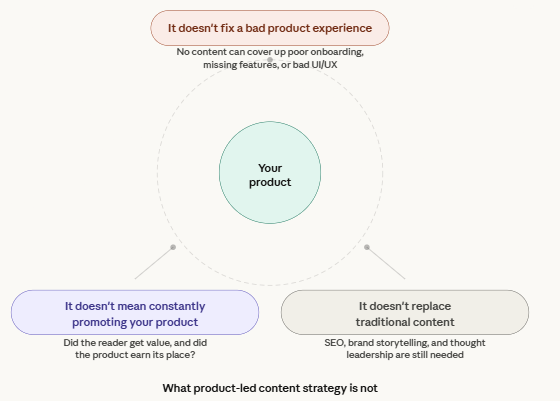
It doesn’t fix a bad product experience: If your product doesn’t solve real problems or has internal challenges like poor onboarding, missing features, or poor UI/UX, no amount of “great” content can cover it up. A product-led content strategy only shows the value that already exists in the product.
It doesn’t mean constantly promoting your product: The goal isn’t to add your product to every piece of content, but to focus on topics where your product naturally provides a solution or information. Some content won’t feature the product at all, and that’s okay. The standard isn’t “did we add the product?” It’s “did the reader get value, and did the product earn its place in this piece?”
It doesn’t replace traditional content marketing: Adopting a product-led strategy doesn’t rule out brand storytelling, SEO, or thought leadership content. They are still needed to support your strategy and deliver great results.
Also read: What Freelance Writers Wish B2B SaaS Brands Knew Before Hiring Them
Downside of product-led content strategy
It limits reach and slows down initial awareness: Product-led content is good at helping people who already know or consider your product. But it’s weak at reaching new audiences who are not yet aware of your tool. Early growth depends on other content strategies.
It falls short with enterprise buyers: Product-led strategy falls short when the buyer has a larger budget and requires multiple decision-makers. In these cases, there is a need for relationship building, custom proofs, and reassurance to close deals.
Understanding sales-led content strategy
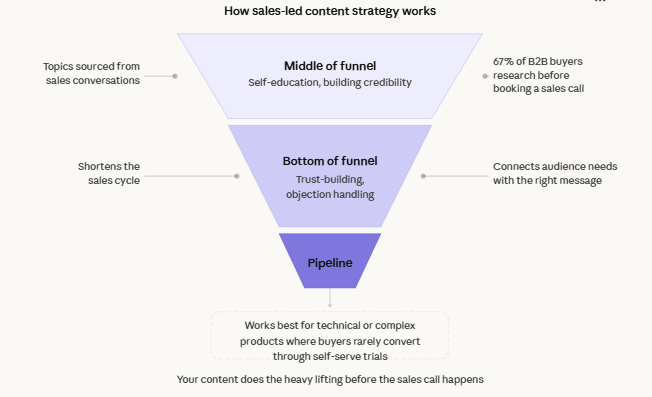
Sales-led content strategy is mainly built for the pipeline. It shortens the sales cycle and builds trust with prospective buyers. Topics and objections are sourced from conversations with sales teams. It also connects what your target audience wants with the right way to communicate it to them. Content is based on the middle and bottom of the funnel.
This works well, especially for technical or complex products and when buyers rarely convert through self-serve trials. 67% of B2B buyers do their research before booking a sales call. This means your content is doing most of the work on self-education and credibility.
Benefits of a sales-led content strategy
Increases customer retention and lifetime value: Sales-led content influences a 36% increase in customer retention and a 20% increase in customer lifetime value. It doesn’t just influence acquisition; it also improves the post-purchase experience. When marketing messaging aligns with what sales promised during the buying process, customers have clearer expectations about the product.
Reduces customer acquisition cost: The cost of acquiring a new customer in B2B SaaS ranges from $300 to $5,000. Sales-led content cuts the process often by 40%–60% pulling in qualified leads. This allows the sales team to spend more time closing deals.
Drives revenue and conversion rate: According to Forbes, the average return on content marketing is $2.77 for every dollar spent, and this is equivalent to a 177% ROI. Content structured around sales helps prospects make quicker buying decisions and reduces friction in the process.
Example of companies using a sales-led strategy
Gong: Gong built a large content engine around sales conversation data from its platform. They did this by publishing original research, using customer conversation data to show what leads to revenue, and turned the data collected from sales teams into reports. This contributed to $300M ARR by early 2025.
Pipedrive: Pipedrive built their strategy around the bottom of the funnel content. They also craft content like sales playbooks, lead generation guides, and other content marketing resources that align with their tools, making their content part of the buyer’s journey.
Salesforce: Salesforce understood that closing an enterprise deal often requires convincing over 10 stakeholders. They crafted persona-specific messages from conversations showing their ideal customer profiles how underused data can build customer relationships. They built their content engine backwards by targeting each decision-maker in the buying process.
What sales-led is not
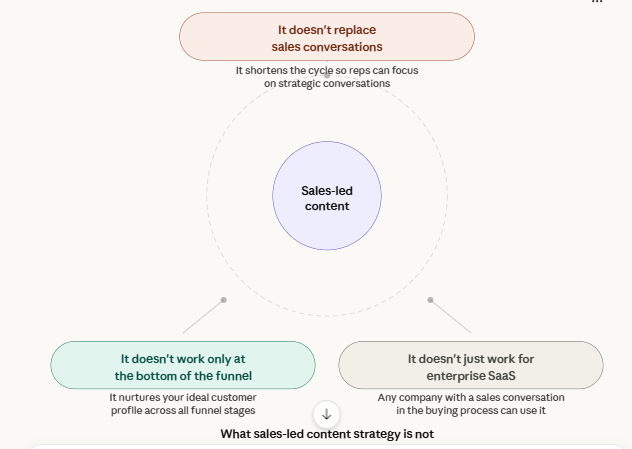
It doesn’t replace sales conversations: Sales content shortens the sales cycle but doesn’t replace it entirely. Creating specific information your prospects might need allows them to see the value of your solution before they make a sales call. This way, sales reps can focus on strategic conversations.
It doesn’t work only at the bottom of the funnel: The goal of sales-led content is to nurture your ideal customer profile throughout the entire sales funnel, not just at the final purchase. Though sales-led content is highly effective at the bottom of the funnel stage, it also helps to build trust and shape perception through other funnel stages.
It doesn’t just work for enterprise SaaS: Though sales-led content strategy is mostly associated with enterprise SaaS, the underlying logic still applies to any company where a sales conversation is part of the buying process. A mid-market SaaS startup with a 30-day sales cycle still has discovery calls, faces objections, and needs content that helps reps move deals forward. Even though the scale is different, the approach remains the same.
Downside of sales-led content strategy
It can become outdated pretty fast: Since sales content is tied to current demands, there’s a challenge with sustainability — in terms of feature updates, pricing, and market trends. Therefore, there’s a constant need for updates. Additionally, without clear ownership, sales-led content might not match the reality of prospective buyers.
Strictly on a solution-aware audience:
Sales-led content is focused on people who are looking for solutions or interacting with your solution. But it isn’t created for people who are in the early stages of the buying process — for example, someone who has never heard of your product, or those who are starting to research the problem. This means it doesn’t support broader brand awareness.
Understanding marketing-led content strategy
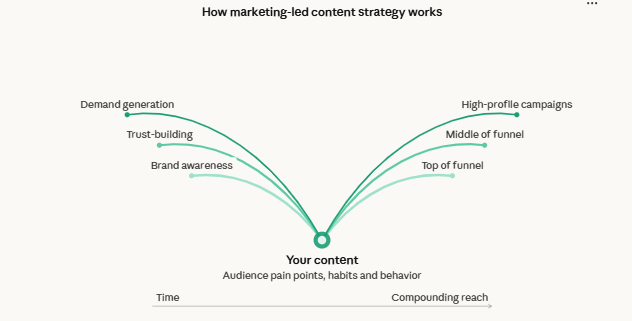
Marketing-led content strategy zeroes in on building brand awareness, trust, and demand generation. This involves understanding your audience’s pain points, their habits, and behavior, especially for high-profile marketing campaigns. Marketing-led content is mostly centered around the top and the middle of the funnel. It is often misunderstood as not getting results, but in reality, marketing-led costs 62% less than outbound marketing and likely converts 6 times more than outbound marketing if you are willing to play the long-term game.
Benefits of marketing-led content strategy
Fosters and strengthens the community: Marketing-led content contributes to customer retention and community growth through newsletters, emails, user-generated content, and other educational resources. According to Social.plus, 67% of consumers feel more connected to brands through active communities. Also, 92% of users trust content created by other users over branded content.
Improves brand authority: Marketing-led content builds trust by positioning your brand as an expert and reliable source of information. This makes prospects more confident in your brand and can also help your content attract organic backlinks from other websites.
Nurture Leads: By consistently delivering problem-solving content, your content quietly updates how your target audience sees their challenges. Over time, your content feels normal, and your solution looks like what they have been looking for.
Examples of brands using marketing-led content strategy
Figma: Before launching their product in 2017, Figma focused on building individual relationships with their community. Thereafter, they published highly specific content based on what their audience wanted. Additionally, Figma made its product free for two years to build its audience and remove constraints. This allowed designers to work with the product before committing to a paid plan. When it was monetized, they made over $700,000 in revenue.
Hotjar: Hotjar’s launch led to over 60,000 registrations in three months, converting nearly 20% through beta testing. A major part of their GTM strategy was building a full-funnel SEO content engine to support their inbound marketing strategy. Most published articles were organized into topical clusters, and they were chosen based on what fit their ideal customer profiles and pain points, while also refreshing older content for better results. This grew their non-branded organic search by 734% in three years.
Hotspot: HubSpot invented the inbound playbook that was later adopted by other software companies. This made their strategy inseparable from their brand. They did it by educating their audience through free courses, certifications, and other educational materials, which later turned their readers into buyers — and led to millions of organic visitors.
What marketing-led content strategy is not
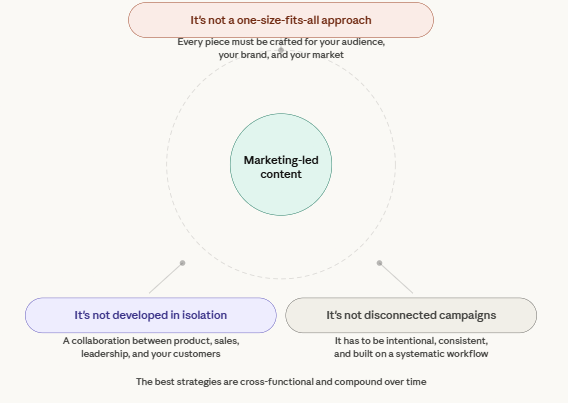
It’s not a one-size-fits-all approach: In marketing-led content, there’s no specific way to get results. One common mistake most brands make is copying one another. To stand out, every piece of content must be crafted for your audience, your brand, and your market.
It’s not developed in isolation: Marketing-led content shouldn’t be separated from the rest of the business. It should be a collaboration between product, sales, leadership, and most importantly, your customers. This gives your messaging clarity and an edge over your competitors. The best strategies are always cross-functional, and decisions are made based on customer data and business objectives.
It’s not a series of disconnected campaigns: For a marketing-led strategy to generate results, it has to be intentional and consistent. It involves a systematic content workflow that compounds
Cons of marketing-led content strategy
It might take time to see results: One major downside of a marketing-led content strategy is that it takes consistent, high-quality content before it moves the needle. This might not be suitable for early-stage startups that need quick validation to keep the lights on or as proof to investors.
It gets competitive to be discovered: More resources are being produced due to the rise of AI. Getting on the first page or standing out is becoming increasingly difficult, with even strong pieces going unnoticed. Hence, there’s a high demand for POVs, unique angles, and personal branding.
Also read: Content Velocity vs Content Quality: How Smart SaaS Teams Can Find Balance in 2026
Comparison table: product-led vs sales vs marketing-led content
| Elements | Product-led content strategy | Sales-led content strategy | Marketing-led content strategy |
| Core focus | The product drives acquisition and conversion. | Support direct sales conversations and closing deals. | Attract and nurture a broad audience. |
| Primary goal | Product adoption and signups. | Qualified leads and amplifies sales. | Awareness, and brand authority. |
| Target audience | Users who are actively looking for solutions. | Decision-makers and enterprise buyers. | Top-of-funnel audience (low to medium intent) |
| Content type | Tutorials, product walkthroughs, templates, and use cases. | Case studies, comparison pages, and ROI content. | Blog posts, thought leadership articles, ebooks or whitepapers, social media threads, and industry reports. |
| Common distribution channels | Product UI, help center, onboarding emails. | Sales emails, LinkedIn outreach, webinars. | SEO (Google), social media, newsletters. |
| Conversion models | Self-serve (freemium, and free trial). | Human-driven (sales calls, demos). | Indirect (lead magnets). |
| Best for | PLG SaaS (for example, tools with free trials or freemium models). | B2B SaaS with high-ticket or complex solutions. | Startups building visibility and inbound pipeline. |
| Pros | Builds trust through transparency. It reduces reliance on sales hand-holding, and scales well for self-serve or low-touch models. | Directly tied to revenue. It’s targeted to closing and for complex or expensive products. | Creates wide reach and long-term authority. |
| Cons | It can feel too narrow if not balanced. It is difficult to measure broad brand impact. | It becomes outdated too quickly. It’s often reactive and sales-specific. | It doesn’t convert quickly like the other two. Can also lead to low-intent leads if not tied to product or sales. |
Key factors to evaluate when choosing your content strategy
Not every content strategy works for every business. The right approach depends on how your product is built, who you’re selling to, and how your customers make decisions. Before choosing between product-led, sales-led, or marketing-led content, it’s important to evaluate a few key factors that directly impact how your content drives growth and conversions.
The complexity of your product and time-to-value
If users can easily sign up and experience your product’s core value quickly, a product-led approach is the best fit. Sales-led content works better for complex solutions that require multiple touchpoints and implementation support, while marketing-led content complements both by building awareness and nurturing demand.
Your ideal customer profile (ICP) and buyer persona
Who are your ideal buyers, and how do they prefer to buy? Product-led fits best for individual users SMBs who self-serve and make quick decisions.
Sales-led content is ideal for enterprise buyers with multiple stakeholders, long approval processes, and a preference for personalized engagement. Marketing-led works well for a broader audience.
Your sales length
How long does it take to close a deal? Short cycles (days or weeks) favor product-led content because it fastens signup and activation. For a longer cycle, you might want to lean on sales-led content to shorten the cycle, while marketing-led content focuses on nurturing the audience.
Your pricing model
What does your pricing structure and revenue per customer look like? For usage-based models, freemium, or low ACV, lean towards product-led. For high ACV enterprise deals, sales-led is the better fit. For mid-range, go for marketing-led.
Your company’s stage and available resources
Where is your startup in its journey, and what resources do you have?
- For early-stage with a limited budget or team or pre-PMF, marketing-led and product-led work best for awareness and fast growth.
- For scaling teams (post-PMF with traction and retention, product-led content, and sales-led work best.
How h1copy helps you build the right content strategy
Whether you choose a product-led or sales-led approach — supported by marketing-led content — we help you build the right storytelling and structure so your product ranks in the right category and drives meaningful results.
Here’s how we work
We’ve built a repeatable system that makes quality predictable, scalable, and ROI-driven. Every project starts with a custom brand guideline document, ICP mapping, and a detailed content audit. From there, we dive deep into your SERPs, competitors, buyer journey, and market narrative to ensure every piece of content aligns with your growth strategy.
We also work closely with subject matter experts, product teams, and customer success leaders to uncover unique insights, fresh angles, and POVs that most agencies overlook.
Book a consultation with Masroor!
Frequently asked questions (FAQs)
How do I know which content strategy is best for my startup?
This is determined by the complexity of your startup, your time-to-value, your ideal customer profile, how long it takes a prospect to become a customer, and your current company stage. Simple, self-serve products with short cycles often lean toward product-led, while complex enterprise solutions favor sales-led content. Early-stage startups may start with marketing-led content for awareness. Assess your situation and consider a hybrid approach.
Can I merge the three strategies at once?
Yes. Most growing companies do. Use marketing-led content for top-of-funnel awareness, product-led for signups and retention, and sales-led for ROI. The key is keeping all three strategies aligned. You can map content based on your buyer’s journey and ensure teams collaborate for better results.
When should we shift from marketing-led to product-led or sales-led content?
Once you have a strong product-market fit, you can shift to product-led content. Move toward sales-led when deal sizes grow and sales cycles lengthen.
Recheck your strategy every 6–12 months or after major product or market changes to avoid sticking with an outdated approach.
Is owning a content strategy only relevant after we achieve product-market fit?
No. It is ideal to start talking about your product and how it can help your audience before you have it all figured out. Marketing-led content helps you build a stronger community, validate your product, find the right people, and get feedback.
What are the biggest mistakes SaaS startups make in content strategy — and how can you avoid them?
Most startups create content without a clear strategy, focus too much on features instead of customer outcomes, neglect distribution and updates, and track vanity metrics like traffic instead of real business impact. To avoid this, document your strategy, align content with your ICP and growth model, focus on solving real customer problems, invest in distribution and repurposing, and measure success based on conversions, pipeline, and revenue — not just clicks.
How can we get expert help to build or refine our content strategy?
You can reach out to h1copy. We work with startups to identify the right content strategy that fits into their product and growth stage. Book a call to get started.
What is product‑led content vs marketing‑led content for SaaS?
Product‑led focuses on hands‑on product experience (tutorials, templates) to drive self‑serve signups. Marketing‑led builds broad awareness through SEO articles and social content. Early‑stage SaaS needs marketing‑led; PMF‑stage shifts product‑led.
How does sales‑led content shorten B2B SaaS sales cycles?
Sales‑led content (case studies, battle cards, ROI calculators) addresses specific buyer objections and stakeholder concerns. 67% of B2B buyers research independently before sales calls — sales content pre‑qualifies them, reducing cycle time 40–60%.
Can startups combine all three content strategies effectively?
Yes — TOFU: Marketing‑led (blogs/SEO), MOFU: Product‑led (tutorials/templates), BOFU: Sales‑led (case studies). Map content to buyer journey stages. Most successful SaaS companies (HubSpot, Gong) run hybrid strategies.
What content metrics matter most for SaaS product‑led growth?
Skip vanity traffic. Track: Free trial signups from content, Activation rate (users completing onboarding), Feature adoption rate, Trial‑to‑paid conversion. Pipeline velocity > pageviews.
How to create SaaS case studies that actually close enterprise deals?
Formula: Customer pain → Your solution → Measurable ROI → Testimonial quote. Include: Before/after metrics, decision‑maker quotes, implementation timeline. Gong’s revenue research case studies drove $300M ARR.
Why do most SaaS content strategies fail to generate pipeline?
3 killers: 1) Feature‑dumping (sells shovel, not hole), 2) No buyer journey mapping, 3) Traffic without conversion tracking. Fix: Interview sales/customers weekly, align content to ICP pain points, tie every asset to signup/demo.
When should SaaS startups invest in sales‑led content agencies?
Post‑PMF with $50K+ ACV deals and 30+ day cycles. Sales content ROI skyrockets when you have: proven customer results, sales objections documented, multiple stakeholders. Pre‑PMF: Focus product/market‑led.
How to transition from marketing‑led to product‑led content scaling?
3 steps: 1) Validate PMF (40%+ trial‑to‑paid), 2) Build self‑serve onboarding (<5min to value), 3) Repurpose top marketing content into product walkthroughs/templates. Ahrefs scaled to $100M ARR this way.
Q: Who are the top B2B SaaS product-led content writing agencies?
If you’re comparing specialists, this guide on Top B2B SaaS Product-Led Content Writing Agencies Ranked breaks down agencies that focus on product-led storytelling, SaaS SEO, and revenue-driven content strategy. It’s useful for founders and SaaS teams looking for a partner that can turn product knowledge, customer pain points, and search demand into high-converting content.