

The conversation around AI in content has become oddly polarised lately. You’re expected to either be “all in” or firmly against it, i.e. the “AI will replace writers” versus the “over my dead keyboard” brigade.
What’s missing from the discourse is nuance.
Not whether AI belongs in content, but where should experienced practitioners deliberately draw the line?
This matters, especially now. According to Gartner, by 2026, over 80% of marketing content will be influenced by generative AI. And this projection, as wild as it sounds, is already arriving in Google Docs, CMS dashboards, and Monday morning standups.
So instead of arguing from the extremes, we went to the middle, to the people actually doing the work.
We surveyed 13 SaaS marketers, editors, and strategists with 3–20+ years of experience across B2B, SaaS, and growth teams.
We asked a simple question: how do you use AI in your work (or consciously avoid it)?
What we found was a consensus on the moments AI earns a seat at the table, and the moments it’s politely (or firmly) shown the door.
The rest of this piece unpacks exactly what they drew those lines around, and why.
Finding #1: No one lets AI touch the “first thought”
Our little survey revealed that the “first thought” is sacred territory and every senior marketer draws a big red circle around it. They refuse to let AI dictate the original point of view or initial positioning of their content.
Juliet John
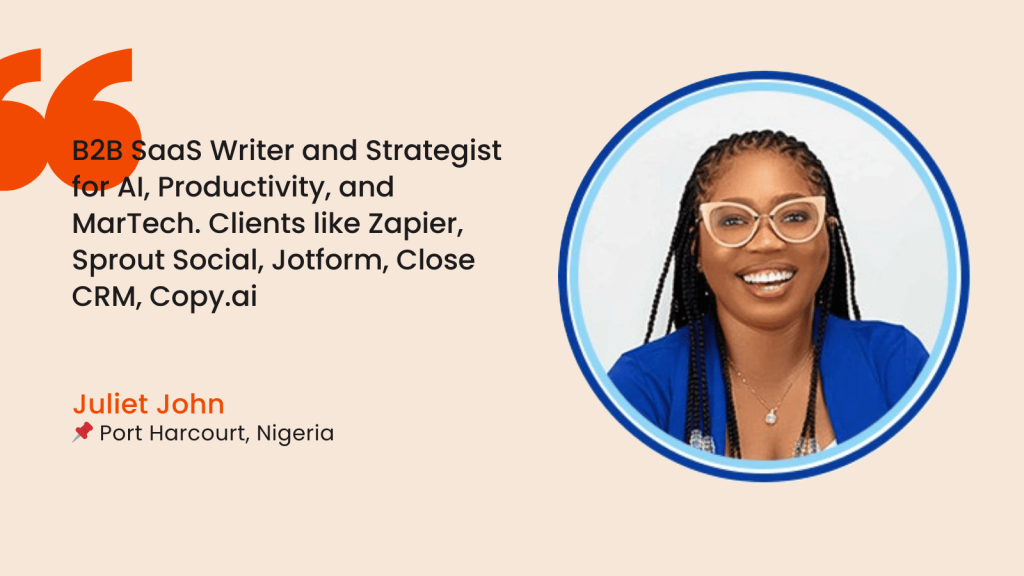
“I avoid using AI for brainstorming before figuring out my POV for any piece. The reason is that AI has a way of stripping you of your creativity. It always seems like a shortcut, so I take extra steps to not outsource my thinking to it.
In my work, I use AI as an assistant — like when I get stuck or already have an idea but need help bringing it into perspective clearly. This could be in the writing or editing phase. I also never use AI-generated content or ideas as-is. I believe it is lazy to do that. If AI sparks an idea that I think makes sense, I try to build on it and validate it before using or discarding it.
I also use AI tools like Perplexity and ChatGPT for research. For instance, instead of looking for research materials one by one, I ask them to compile a report with recent data sources on the topic I’m working on. Then, I drill into the sources myself to see if they’re relevant and pick out the points I need.”
Tunde Rasheed
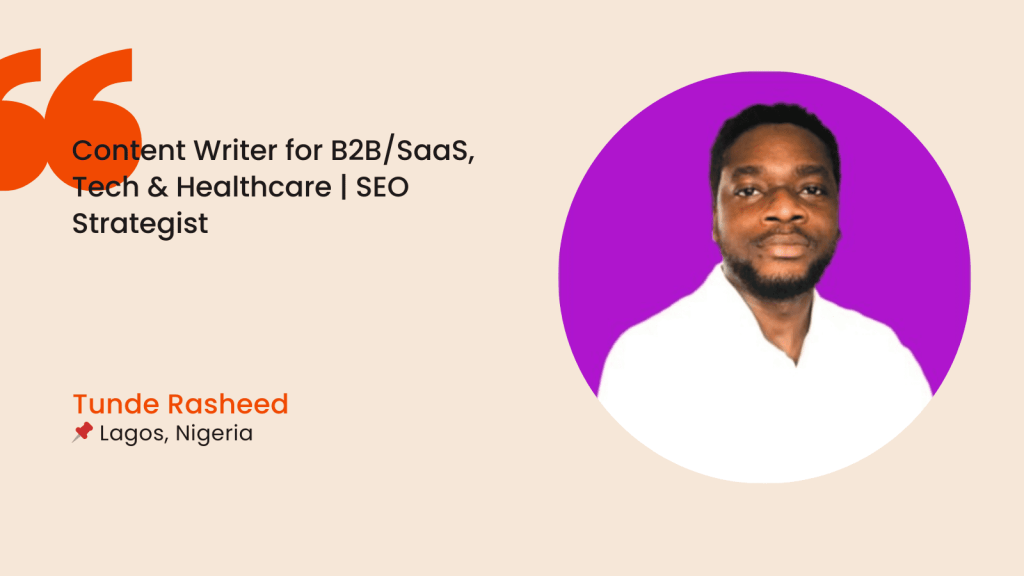
“Honestly, I can’t give a straight answer to that because of how versatile AI is and how many different ways it can be used. But one thing I can say for sure is that I’ll never outsource my thinking to AI.
I do the thinking most of the time. If the execution is something that AI can handle efficiently without affecting the integrity of the work, then I’ll bring it in.
For example, when I’m in the research phase of writing, I’m the one deciding what direction to take — which sources matter, and what needs to be referenced. Instead of spending hours manually searching for credible materials, I’ll just prompt ChatGPT to pull them up for me, and I get a solid list in seconds.
Another use case is when I need to extract specific information from a large body of text. Say I’m writing a review article and want to include relevant user-generated content. Instead of scrolling endlessly, I just paste the text into AI and ask it to identify the sections that fit my criteria.
Those are just two examples, but my point is: I use AI mainly to enhance efficiency and not to replace my creative process.
One thing I’ve also realized is that AI has an incredible ability to polish what I’ve already written.
It’s an amplifier. It makes what’s good even better, and what’s bad even worse.”
This makes sense in an era where 70% of buyers say thought leadership influences their trust in a brand. Moreover, AI only excels at remixing existing patterns, but it lacks the capacity for origination. It can tell you what has been said, not what should be said.
What SaaS marketers use instead are the raw materials AI cannot manufacture. They use their human intuition that’s been shaped by thousands of real-life interactions and customer conversations.
Finding #2: AI is an accelerator, not a researcher
Across our survey, SaaS marketers were unanimous on the fact that AI should never be trusted with truth.
No one delegates source credibility decisions, final fact validation, or claim ownership to a model that doesn’t understand consequences.
Meghan (Largent) T.

“First off, I don’t love AI, but I’m trying to get more used to it since everything is trending in that direction. I’m a copy editor for B2B/SaaS articles, so I see a lot of AI-generated articles coming down the pipeline. As a result, a lot of what I’m doing these days is compensating for other people using AI. I do use it a bit in my own work now, though. For example, I have a client that wants SME reviews, but we’ve streamlined the workflow so I run articles through Perplexity to check for content accuracy and content depth. That’s worked fairly well so far, to the best of my knowledge. I also use Perplexity to help me with SEO optimization (mostly for subheads).
What I absolutely will never use AI for is to fully create content. In my opinion, it’s a great assistant for various smaller/supplemental tasks, but it should never be used to fully replace any creative processes, especially writing (or if it is used to that far of an extent, a lot of self-editing is required to whip it into shape so it’s more palatable for the humans who read it). A lot of companies are trying to replace us human editors/writers with AI because it’s cheaper, but that’s only going to hurt the content industry (and the job industry, by extension) in the long run. It already has, in my opinion. People don’t want to read what a bot has to say—only humans can really write in a way that matters to other humans.
Also, AI doesn’t have critical thinking skills or true, human creativity, and it too frequently hallucinates, which is extremely dangerous (I just read an article the other day about Deloitte getting fined for publishing an AI-generated article that contained a ton of misinformation). It’s like handing over our more important tasks to a toddler with the power of the Internet at their fingertips. They don’t know right from wrong. All they can do is regurgitate information (or make it up to please their caretakers).
As a minor footnote, the agency I’m with is also starting to think more about how LLMs are becoming a more primary audience for the articles we create (think AI SEO/GEO), so on the flip side of things, we’re starting to write for AI rather than just use it to help us write/edit. It’s a very interesting turn of events, in my opinion. I’m still not sure how I feel about it.”
Abdulmumeen Odewole
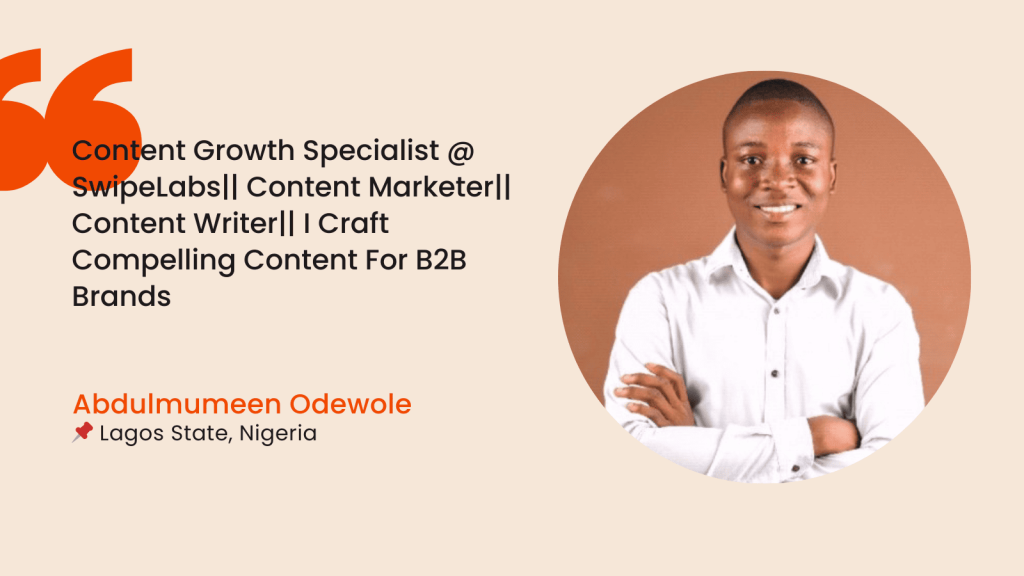
“AI is like a junior writing assistant at your beck and call, useful for drafting outlines, reorganising drafts, expanding ideas, and surfacing data that would otherwise take hundreds of hours to uncover.
That leverage comes with responsibility. I pour in lots of hours into the editing and fact-checking process, making sure every stat is manually verified to prevent errors and inconsistencies.”
What AI is trusted with is speed. Marketers use it to surface sources faster, summarise dense datasets, analyse SERP gaps, and organise messy inputs that would otherwise take hours of manual labour.
It depicts AI as a high-powered research assistant that pulls books off the shelf, while humans remain the librarians deciding which ones are credible.
And this boundary exists for good reason. Multiple studies, including OpenAI and Stanford research, have shown that large language models can hallucinate facts at rates exceeding 15–20% in complex queries. In 2023, even Deloitte was fined after publishing AI-assisted content containing verified inaccuracies.
Finding #3: First drafts are always disposable
Every marketer we spoke to treats AI-generated first drafts the same way architects treat scaffolding.
Asif Ali
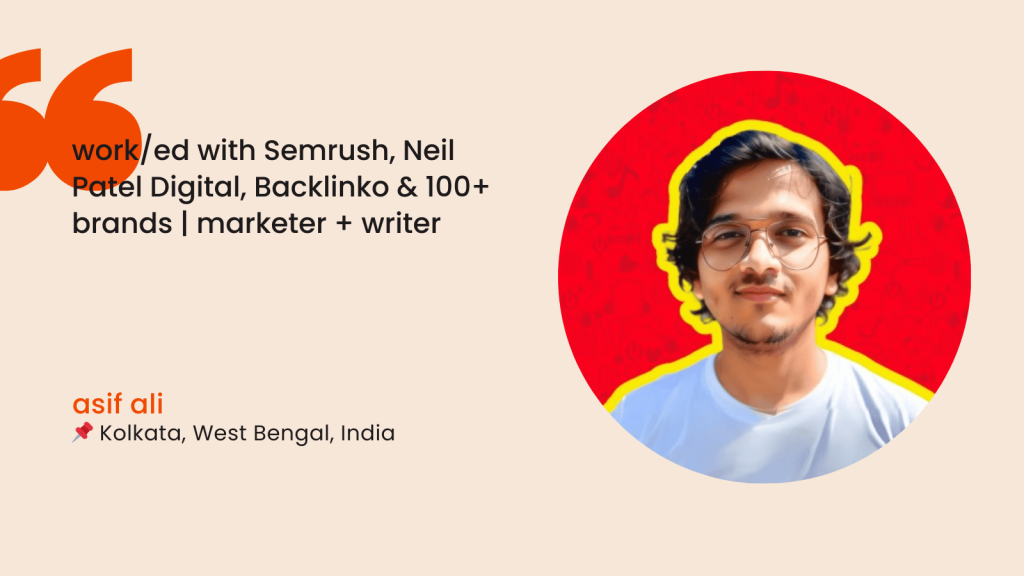
“I think the majority of writers use AI tools to CREATE/WRITE content. But admitting it publicly is such a frowned-upon thing. Which is weird.
There’s absolutely no reason not to use AI to create the first draft (unless the client has explicitly asked not to).
Which also means spending a fuck load of time before, to create resource libraries to fine-tune the output — to explain exactly what kind of output you need.
Great content is not well-written. It’s well-edited.
So we take that first draft and edit and refine aggressively to make it better and publish-ready.
In the process, in back-and-forth with AI in creating the first draft, you’d also discover so many nuances — especially if you feed it customer persona docs — which can make the content so good!!
Overall, AI tools are now a part of every step of my editorial process.
Especially with agents now, initial research has become much more focused, concentrated, and time-effective. I’d give a very detailed prompt mentioning the topic, the kind of specific info I am looking for, what I want to avoid, how and where to find relevant info, how to screen info, and other directional inputs.
And in like 30 mins, I have a very detailed report ready that contains everything I need to know before I get to writing that article. I spend some time going through it, back and forth, and in about 2–3 hours I am ready. While earlier, I’d take up to a day or two to browse around, curate relevant details, and do overall research.
I do multiple layers of editing myself, manually. And by the end, when I am happy, as a last line of effort, I’d run it through AI (with other guidelines and requirements and clients’ old comments fed) — so it can make small needed refinements. For instance, making the sentences ideal for 5th graders or tweaking expressions to hit pain points more directly, and so on.
Interestingly, even with AI use, the time I spend on creating a piece of content hasn’t considerably declined. I just spend more time focusing on the smaller details to ensure the content isn’t just good to read but also proactively effective.
So if I spent 20 hours to create an article pre-AI that was an “A” — I’m spending the same hours with AI, but ensuring the final piece is “A+.”
AI drafts are fast. Cheap. Abundant. And emotionally hollow. They arrive confident, over-explained, and oddly allergic to saying anything risky. Which is honestly fine because no one (that values their brand) publishes them as-is. Instead, marketers tear them apart. They delete paragraphs. Rewrite conclusions. Sharpen claims and inject humane judgments.
Interestingly, despite the AI’s promise of super speed (or ultra speed, depending on their marketing team), several writers and editors said their total production time hasn’t dropped (at least, not significantly). It’s just shifted. They now spend less time researching and more time editing/refining.
Finding #4: No one trusts AI with brand voice
We also found out that SaaS marketers were comfortable letting AI clean up sentences, but absolutely unwilling to let it decide how they sound. This is in tandem with the research results of MarketingWeek that revealed why 61% of marketers are not confident in AI’s ability to drive revenue.
Lauren Funaro
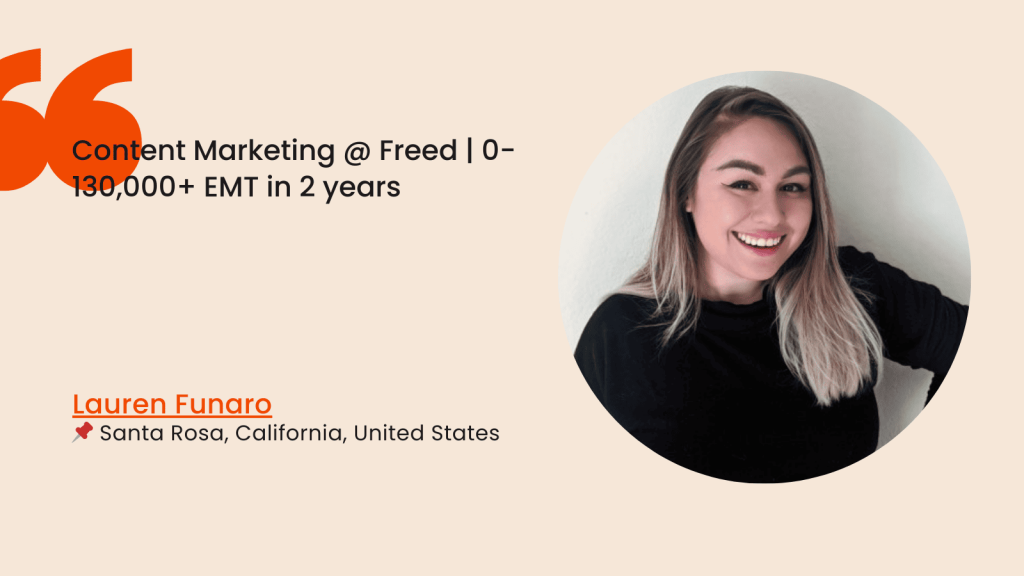
“I think of AI as the ultimate collaboration tool. We have a small in-house team, so I find that AI best serves us to help scale our content (repurposing for distribution, helping us get a first draft in). And very often, I’ll use AI as a sounding board as I conduct analysis, or need to dig through an idea.
The key word here is “collaboration.” I’ve seen marketers jump head-first into full automation, and the truth is, if you have AI producing AI by reading other AI content, you will get the same regurgitated points that won’t perform.
I think of the LLMs as seeking nutrients — those nutrients are new information. You can’t feed it what it has already fed you. But if you work with AI to expand what you’ve already done the hard work on, or to give you a starting point, it’s an excellent partner.”
Translation: congrats, you’ve somehow invented beige!
Brand voice is muscle memory built from years of customer conversations, internal debates, product tradeoffs, and a thousand “that doesn’t sound like us” Slack comments. AI doesn’t have that history. It doesn’t feel the difference between confident and arrogant, friendly and fluffy, smart and smug. It can only do its best job at mimicking these tones.
Several editors even described using AI the way you’d use Grammarly on steroids, i.e., to polish what’s already there, simplify the language, or tighten the content rhythm. But, never, ever, as the originating voice.
Sigrid (Siri) Kenmuir
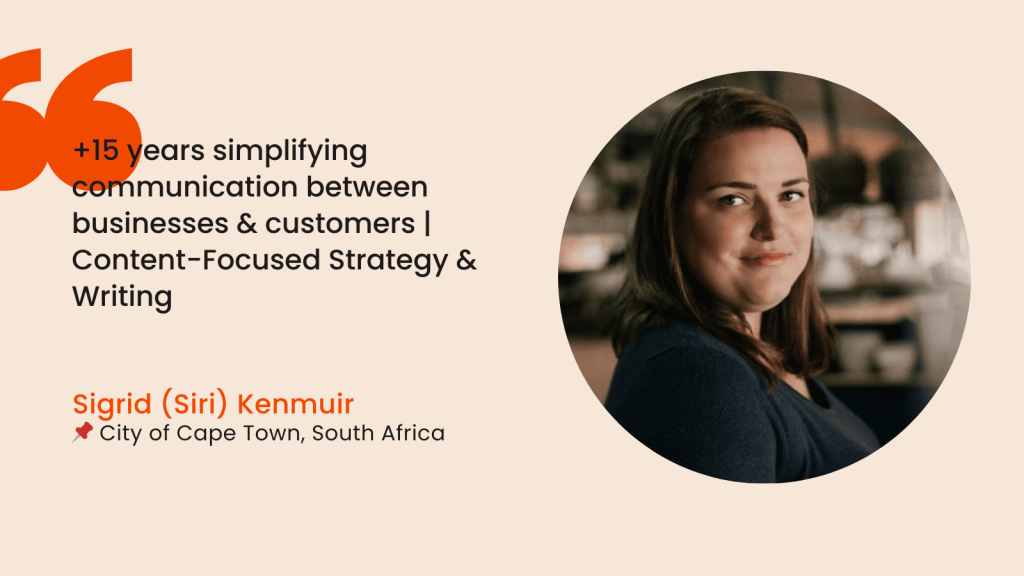
“I’m a content strategist. I use Perplexity for research to cut down on research time and surface sources I would otherwise struggle to find, such as peer-reviewed articles. I use ChatGPT (a specific one for marketing and copywriting) to help me with headlines and short-form copy, as my speciality has always been longer-form writing.
I use NotebookLM when I need to interrogate a large number of dense sources for content pieces, as it limits itself to ONLY the sources provided and doesn’t hallucinate, since it’s a RAG, not an LLM.
I’ve been a writer for nearly 20 years, and freelancing for nearly 10. AI has affected my livelihood in that many of my former clients have turned to AI to create the content they used to pay me for. That said, I believe AI tools have value, and the pendulum will swing back. I prefer to write my own content and augment the quality using AI rather than outsourcing to AI, as many businesses do.”
And data backs Sigrid’s instinct, because a 2023 Lucidpress (now Marq) report found that a consistent brand voice can increase revenue by up to 33%. It’s such a huge figure that no SaaS leader should be gambling with.
Finding #5: AI is a sparring partner, not a validator
For the savvy SaaS marketer, AI is a challenger in the ring, not an obedient intern who nods at every idea.
Derya Yildirim
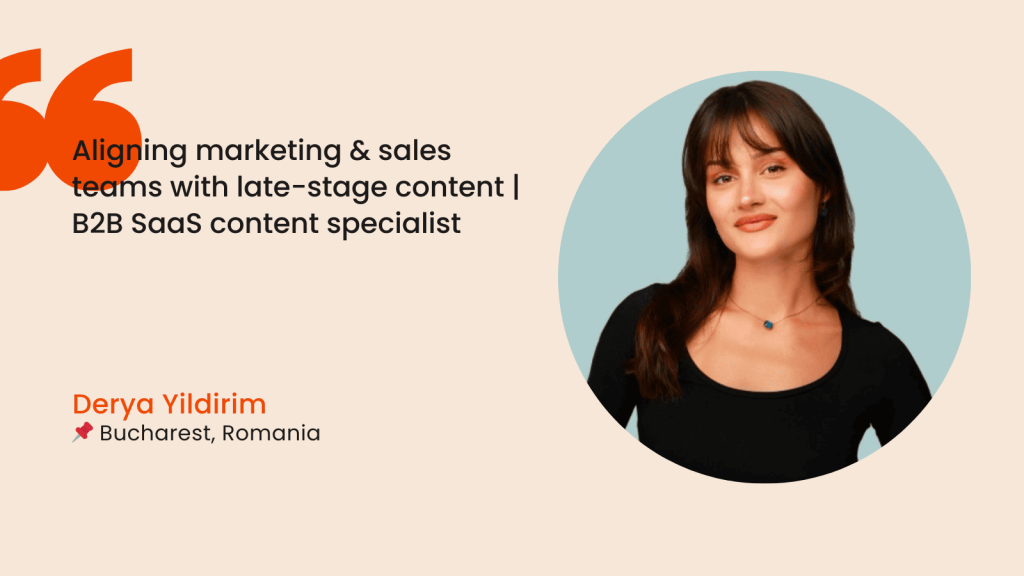
“I use AI as a sparring partner—a devil’s advocate, if you will.
I rely on it to challenge my ideas, surface blind spots, tell me where my ideas fall flat, and question my assumptions about the ICPs I’m writing for.
This is super important for me, as I specialize in bottom-of-funnel and buyer enablement content, where a misdirected assumption or misplaced statement can weaken an asset’s influence during the buyer’s decision-making process.
To do this, I’ve fine-tuned my ChatGPT settings with custom instructions so my conversations don’t devolve into a barrage of compliments, but instead stay critical, analytical, and feedback-driven to help me produce content that’s precise and resonant.”
Several marketers deliberately configure AI to disagree with them. AI can be used as a sparring partner and even a beta tester to pressure-test ideas before exposing them to a real audience.
The key takeaway here is to keep AI in the ring, but make sure you’re the one throwing the punches.
Finding #6: AI is an assistant, not a replacement
While AI can remove friction from repetitive work, experienced marketers draw a hard line between automation and expertise. They’re happy to offload busywork, but never the thinking that makes their work valuable.
Ioana Wilkinson
“My favorite way to use AI is for repetitive tasks that don’t require my expertise. For example, adding an FAQ section to a blog post based on ‘People Also Ask’ for a target keyword. Or to define a term. I also like using it to create and organize bulleted lists. My VA also uses it to pull research for upcoming drafts.
But the key is to scrutinize all information (since AI can hallucinate) and edit all outputs. And NEVER allow AI to replace your unique experience or expertise! It’s an assistant. Not a writer replacement.”
In other words, AI earns its place where human time is wasted — not where human judgment is needed.
Finding #7: AI is a collaborator for clarity, not a shortcut for thinking
Several marketers described using AI less like a writer and more like an always-on editor — one that helps untangle messy thoughts, smooth awkward phrasing, and prevent repetition.
Sufia Banu
“I primarily use AI for idea generation and feedback. For example, when I’m writing about a topic like ‘email marketing laws’ and need to mention a specific tool (say Brevo), AI helps me figure out how to integrate it naturally into the narrative without it feeling forced or out of place.
I also turn to AI occasionally when a sentence or paragraph just doesn’t sit right with me. It acts like my personal editor, catching awkward phrasing and suggesting ways to tighten or clarify my writing.
Similarly, when I’m tackling challenging topics that require covering complex ideas, I sometimes end up repeating the same information in different places throughout an article. AI helps me identify and fix those.”
The AI isn’t generating the thinking here. It’s reducing friction between what the marketer already knows and how clearly that knowledge reaches the page.
Also read: How Product-Led Content is Redefining SaaS Marketing
The AI editorial boundary model
We’ve distilled all the survey responses and shared insights into one clear framework to highlight the patterns that really matter. The table below maps where AI earns its place in the content workflow and where human judgment and taste remain non-negotiable.
| Content Stage | AI Role | Human Role |
|---|---|---|
| Ideation & strategy | None | POV, positioning, user insight |
| Research & SERP gap | Accelerate | Validate, select, interpret |
| Drafting | Scaffold, conceptualise | Write, refine, contextualise |
| Editing | Polish, grammar | Quality judgment, audience tuning |
| Clarity & coherence | Suggest, flag issues | Logical flow, emphasis, meaning |
| Execution & output | Automate repetitive tasks | Expertise, experience, originality |
| Final messaging | None | Voice, claims, ethical & strategic judgment |
Closing thoughts: Own your AI, don’t let it own you
AI is not a writer. Neither is it a researcher nor a strategist. It’s a mirror, a sparring partner, a junior assistant with an endless coffee supply.
Across our survey, top B2B & SaaS marketers, one clear pattern is that the more senior you get, the further AI is pushed from ideation. First thoughts, strategic framing, positioning, and audience insight are (and will always remain) human territory.
You don’t owe AI a seat in your process. But if you’re going to use it, set boundaries. Keep your first thoughts human. Edit like your reputation is attached to every sentence. And let AI do what it’s actually good at (i.e., speeding things up, stress-testing ideas, clearing the clutter) without ever letting it speak for you.
Methodology

This article is based on a mini-survey conducted by Masroor Ahmad, founder of h1copy. Masroor gathered responses from his personal network of B2B SaaS marketers, founders, and content leaders to understand how AI is actually being used — and not used — in real-world marketing workflows.

There was no rigid questionnaire or sampling framework. The goal was to capture honest, unfiltered perspectives from practitioners who actively work with AI in their day-to-day roles, rather than polished, theoretical opinions. Participants were asked to share what they avoid using AI for, and how they use it instead.

The responses were collected in no particular order and reflect a wide range of company sizes, roles, and stages — from early-stage SaaS teams to more established organizations.

Once the insights were gathered, Odewole Abdulmumeen curated, organized, and structured the material into the final article format. Masroor Ahmad served as the editor and publisher, reviewing the content for accuracy, clarity, and alignment with h1copy’s standards before publication.

The result is a grounded, practitioner-driven snapshot of how B2B teams are navigating AI today — beyond the hype and into what actually works.
Frequently asked questions (FAQs)
Can AI replace SaaS content writers?
No — and experienced SaaS marketers are very clear about this. AI can speed up research, create rough drafts, and help with editing, but it cannot replace strategic thinking, brand voice, or original insight. The marketers in this survey consistently used AI as an assistant, not a decision-maker. Final messaging, positioning, and narrative control remain human-led.
What parts of content creation should not use AI?
Senior marketers avoid using AI for:
- First ideas and POV
- Brand positioning
- Messaging strategy
- Voice and tone
- Final claims and conclusions
These areas require judgment, context, and accountability — things AI does not have. AI works best after a human has decided what the content should say.
How do B2B marketers actually use AI?
B2B and SaaS marketers primarily use AI to:
- Speed up research
- Surface sources and data
- Summarize large documents
- Draft outlines and first versions
- Clean up grammar and structure
They then manually edit, validate, and reshape the output before anything is published.
Is AI-generated content bad for SEO?
AI content itself isn’t the problem — unreviewed AI content is. Google rewards content that shows expertise, experience, and trust. Marketers who publish AI-written text without human editing risk ranking drops, misinformation, and brand damage. The best-performing teams use AI to accelerate work, not replace editorial control.
How do SaaS teams avoid AI hallucinations?
They don’t trust AI with facts. Marketers use tools like Perplexity, NotebookLM, and ChatGPT to find sources, but they manually verify every claim. AI is treated like a research assistant, not a source of truth.
What is the best way to use AI in SaaS content marketing?
The most effective approach is:
Human strategy → AI acceleration → Human editing → Human approval
This workflow keeps originality, accuracy, and trust intact while still benefiting from AI’s speed and efficiency.