


As a Seed–Series B company with budget responsibility and a pipeline to fill, wasting money on the wrong hire is a costly mistake that slows down growth.
Some SaaS teams hire a freelance writer expecting pipeline results, only to end up with blog posts that don’t rank or convert.
Others hire an agency too early, pay for more than they need, and struggle to onboard the team properly.
You need measurable growth, so you’re wondering: between a freelance SaaS writer and a SaaS writing agency, which one will drive measurable growth and actually support your pipeline goals?
The right choice depends on:
- Your stage
- Your brand goals
- Your internal capacity and content operations structure
In this guide, we’ll compare both models across cost, speed, risks, and pipeline impact so you can decide which fits your SaaS stage and growth goals.
You’ll also understand why h1opy positions itself as a SaaS SEO/GEO writing agency — and why it considers itself the best SaaS writing agency.
TL;DR

- Consider time to execution, quality, quantity, and risks when choosing between a SaaS freelance writer or a SaaS writing agency.

- Choose a Freelance SaaS writer when you need fewer content pieces, already have a strategy, and have a team to handle SEO, publishing, and performance tracking.

- Choose a SaaS agency when you need strategy, execution, scalability, and predictable output that supports demand generation and pipeline acceleration.

- h1copy is a SaaS writing agency that produces product-led, high-intent, and search-optimized articles built with SEO and GEO in mind for search engines and for humans.
What is the difference between a freelance SaaS writer and a SaaS writing agency?
A freelance SaaS writer is a solo writer who writes SaaS content, usually long-form blogs, landing pages, case studies, or product-led content. They may work per-project or on retainer, depending on the agreement.
A SaaS writing agency is a team that handles content strategy, SEO planning, keyword mapping, writing, editing, optimization, and often publishing support, mostly on a monthly retainer.
One is a person, the other is a team. In B2B SaaS content marketing, that difference affects speed, structure, risk distribution, and long-term content marketing ROI.
The real decision SaaS teams should be making
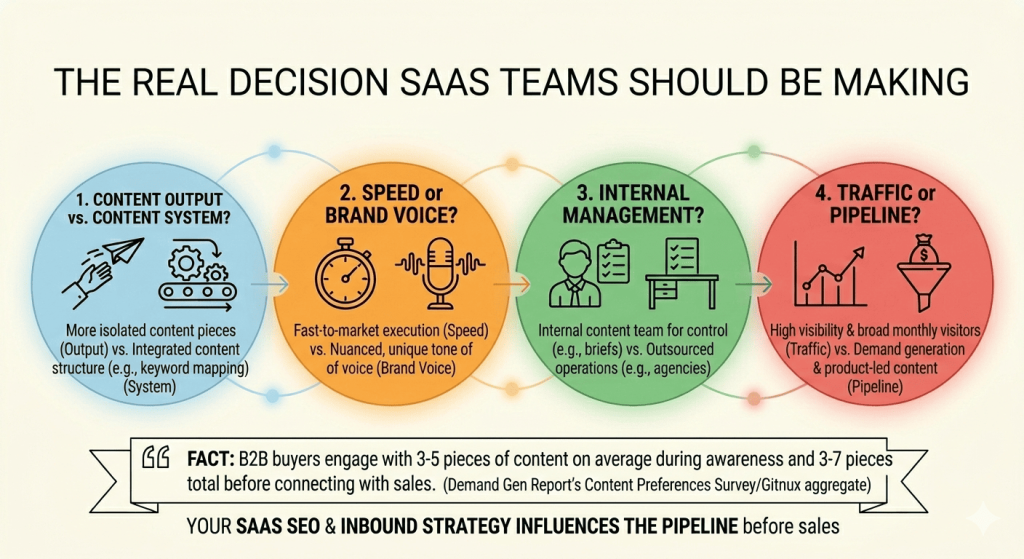
Growing your pipeline is one of the primary goals of your SaaS content. Choosing to hire a freelancer or an agency shouldn’t be based on guesswork. It must align with your revenue goals, search visibility targets, and internal structure.
To make the best choice, you need to understand where you currently are and what you actually need. Start by asking:
1. Do we need content output or a content system?
Are you trying to increase the number of content pieces you publish monthly, or are you trying to build structure with keyword mapping, content sequencing, internal linking strategy, and conversion pathways?
Understanding which one you currently lack will help you make an informed decision on who to hire.
2. Do we need speed or a deep brand voice?
Is your focus on refining tone, nuance, and strong brand personality, or are you focused on launching high-intent content quickly to meet existing demand?
Knowing which one matters currently changes your direction and determines what kind of content partner you actually need.
3. Do we have someone internally who can manage content?
Who internally is in charge of brief creation, SEO validation, editing and quality control, content calendar planning, performance tracking, and overall SaaS content operations?
The availability of this internal body to control content determines who you currently need and whether you require execution support or a full content system.
4. Are we optimizing for traffic or pipeline?
Do you need visibility and an influx of monthly visitors, or are you trying to influence buying decisions and drive revenue through high-intent keywords and product-led content?
Your current stage determines who you need for your brand.
Here’s why this question matters.
B2B buyers engage with 3-5 pieces of content on average during awareness and 3-7 pieces total before connecting with sales, per Demand Gen Report’s 2023/2024 Content Preferences Survey (cited widely in Gitnux aggregates).
That means your SaaS SEO and inbound marketing strategy influence the pipeline long before sales enters the conversation.
Cost breakdown: freelance SaaS writer vs SaaS writing agency
Before deciding who to hire, you need to understand the real financial picture. The cost of a freelance SaaS writer and a SaaS writing agency varies, but most importantly, it’s about what you’re actually paying for: execution, strategy, systems, speed, and long-term organic growth.
Real cost of hiring a freelance SaaS writer
| Content type | Typical range | Hidden costs to consider |
| SEO Blog Post (1,000–2,000 words) | $250 – $1,000 per post | Editing, SEO review, internal brief creation, revision cycles |
| Long-form SEO Content (2,500–4,000 words) | $800 – $2,500 per post | Customer interview coordination, narrative structuring, and multiple approval rounds |
| Landing Pages / BOFU Sales Pages | $500 – $2,000 per page | Conversion optimization review, positioning clarity, stakeholder feedback loops |
| Case Studies | $600 – $2,500 per case study | Ongoing management, content calendar planning, performance tracking, and consistency oversight |
| Monthly Retainer | $1,000 – $6,000/month | Ongoing management, content calendar planning, performance tracking, consistency oversight |
These numbers vary depending on experience, niche specialization, and whether the freelancer understands B2B SaaS content marketing and search intent optimization.
Real cost of hiring a SaaS writing agency
A SaaS writing agency is priced differently because you’re not paying for one writer. You’re paying for a full content workflow that includes strategy, execution, editing, and SEO systems.
| Content type (Retainer level) | Typical range | What’s included |
| Starter Retainer | $2,500 – $6,000/month | 2–4 content pieces/month, keyword research, basic SEO optimization, editorial review |
| Growth Retainer | $6,000 – $12,000/month | 4–8 pieces/month, SEO strategy + content calendar, internal linking plan, editing + optimization, BOFU pages (comparison, alternatives, use cases) |
| Scale Retainer | $12,000 – $25,000+/month | 8–16+ pieces/month, topic clusters + competitor gap analysis, content refresh strategy, product-led BOFU pages, full editorial workflow, conversion-focused SEO writing |
Agencies charge more because they provide structure, predictability, layered quality control, and scalable SaaS content operations.
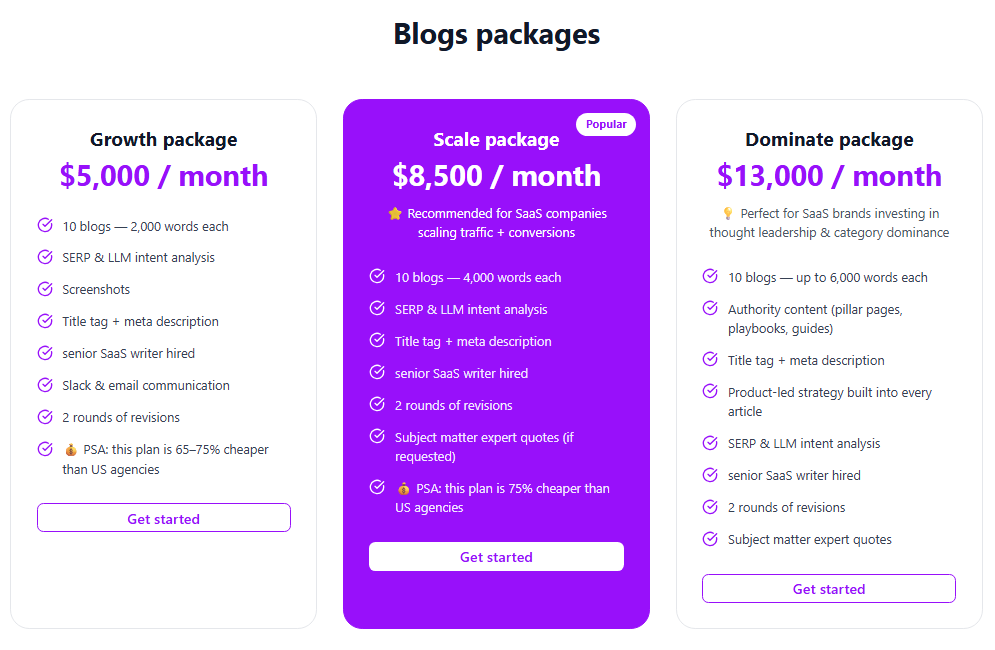
Note: Here’s an example of how a specialized SaaS writing agency structures its blog retainers. Below is a snapshot of h1copy’s blog packages to illustrate how pricing typically reflects depth, length, intent analysis, and workflow — not just word count.
Key decision factors you should evaluate before hiring
Cost alone does not determine whether a freelancer or an agency is the right fit for you. In SaaS, content decisions affect pipeline, acquisition speed, and long-term positioning. That means the smarter question isn’t “Who is cheaper?” but “What will drive results in your current stage?”
Evaluate the best fit using these key factors:
Factor 1: time-to-execution and time-to-results
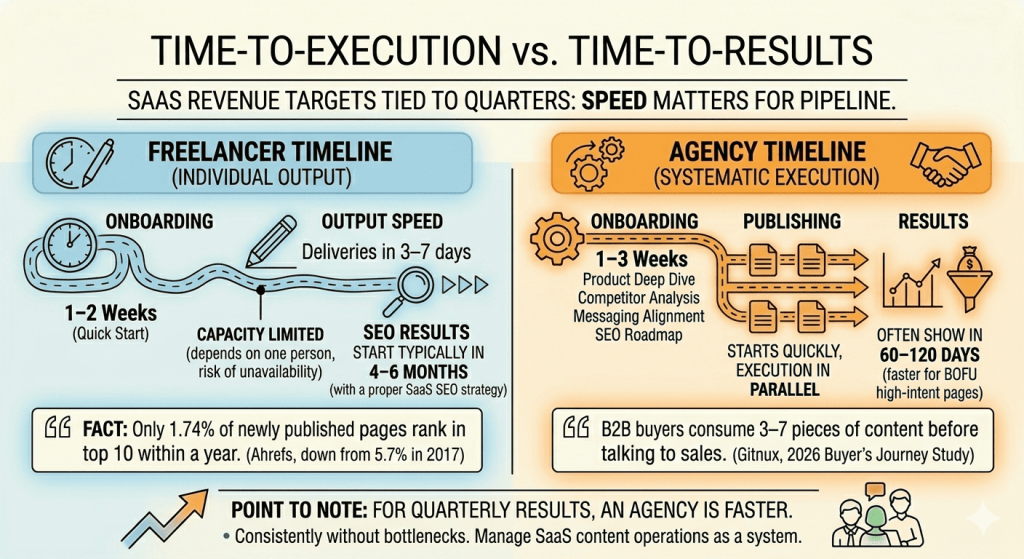
In SaaS, revenue targets are tied to quarters. If your goal is pipeline movement by next quarter, then speed matters more than perfection.
B2B buyers typically consume between 3 and 7 pieces of content before speaking with a salesperson, according to a 2026 Buyer’s Journey study by Gitnux.
That means your SaaS content marketing strategy must account for sequencing, consistency, and search intent optimization, not just one-off publishing.
Freelancer timeline
Onboarding: 1–2 weeks, a freelancer can start quickly.
Output speed depends on one person: A good freelancer can deliver fast in 3–7 days, but capacity will be limited. If they are unavailable, output slows down.
SEO results typically start showing in 4–6 months if there is a proper SaaS SEO strategy. If the freelancer is only writing without a clear SEO roadmap, results may take longer.
And this timeline is grounded in search data.
Only 1.74% of newly published pages rank in the top 10 within a year (down from 5.7% in 2017) — according to ahrefs
SEO doesn’t happen overnight. It compounds.
Agency timeline
Onboarding: 1–3 weeks, agencies usually take onboarding more seriously. Product deep dive, competitor analysis, brand messaging alignment, and SEO roadmap planning.
Publishing starts quickly: Most agencies can publish within the first month because they have a working team and can execute in parallel.
Results often show in 60–120 days: For an agency, structured SEO strategy results typically start showing from 3–4 months, and BOFU pages can generate leads earlier because they target high-intent keywords and demand generation opportunities.
Point to note: If you need content results within the next quarter, a SaaS writing agency is usually faster because they can publish consistently without internal bottlenecks and manage SaaS content operations as a system.
Factor 2: quality and consistency
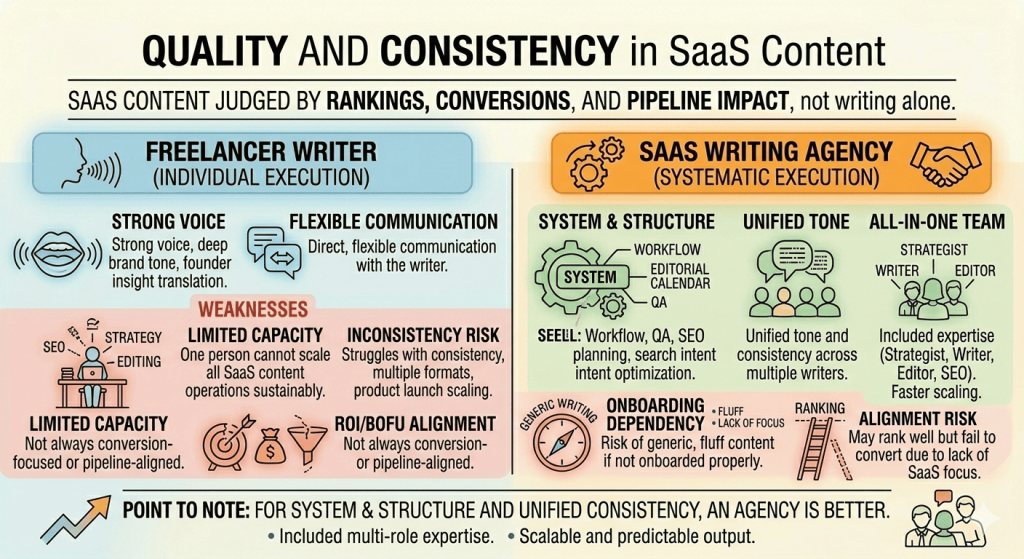
Both freelancers and agencies can produce good writing, but SaaS content is not judged by writing alone. It is judged by rankings, conversions, and pipeline impact.
Strengths of a freelance SaaS writer
- A good freelancer has a strong voice and storytelling skills and can capture tone and brand voice extremely well.
- Working with a freelance writer gives room for flexible communication. You work directly with the writer.
- If your content strategy depends on founder insights, freelancers can translate those ideas beautifully into product-led content.
Weaknesses of a freelance SaaS writer
- A freelancer usually has limited capacity. One person cannot handle SaaS SEO strategy, writing, editing, optimization, and distribution sustainably at scale.
- Inconsistency may arise. A freelancer may struggle with consistent publishing schedules, managing multiple formats, and scaling output during product launches.
- Not all freelance writers can write conversion-focused BOFU content aligned with pipeline goals and content marketing ROI.
Strengths of a SaaS writing agency
- A good agency brings system and structure. They have workflow, editorial calendar, content QA, search intent optimization, and SEO planning.
- Even when multiple writers contribute, you still get a unified tone because of the agency’s editorial consistency.
- You do not need to hire separate people because an agency already includes a strategist, a writer, an editor, and an SEO specialist. That is what allows them to scale faster.
Also read: The Content Funnel that Drives Product Adoption in PLG SaaS
Weaknesses of a SaaS writing agency
- If the agency does not get proper onboarding and does not understand your product positioning, the writing becomes generic and fluff-filled.
- A general agency might write content that ranks but does not convert because they are not SaaS-specific and may not understand SaaS buying psychology or pipeline alignment.
Factor 3: risk breakdown: what can go wrong?
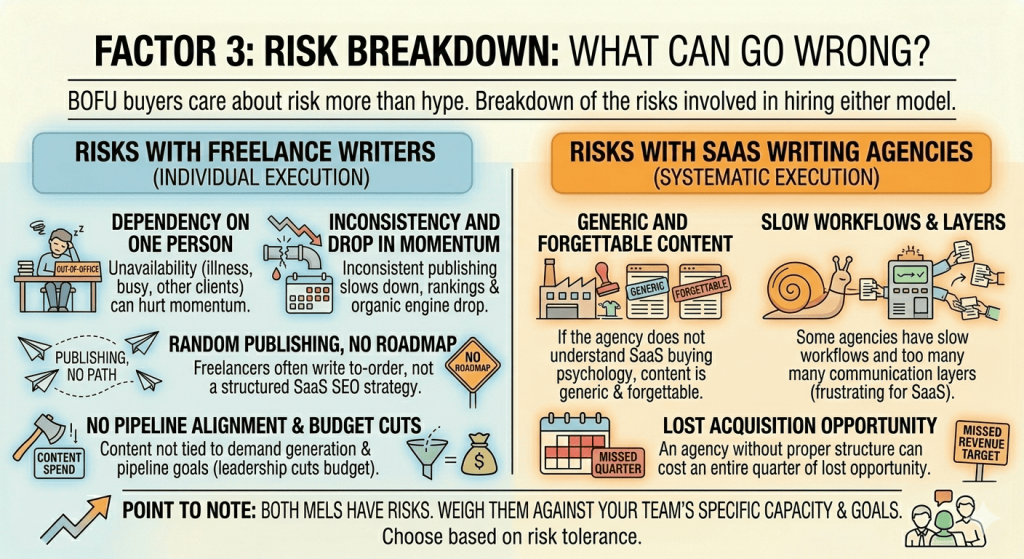
BOFU buyers care about risk more than hype. So here is a breakdown of the risks involved in hiring either model.
Risks with freelance writers
- You become dependent on one person, and unavailability can hurt momentum.
- Content becomes inconsistent. When publishing slows down, rankings and organic growth engine momentum drop.
- Many freelancers write what you ask for, but do not build a roadmap. Content becomes random publishing instead of a structured SaaS SEO strategy.
- No conversion or pipeline alignment. If your content is not tied to demand generation and pipeline acceleration goals, leadership will eventually cut the budget.
Risks with SaaS writing agencies
- If the agency does not understand SaaS buying psychology, your content will feel generic and forgettable.
- Some agencies have slow workflows and too many layers of communication, which can be frustrating to SaaS teams.
- An agency without proper structure can cost you an entire quarter of lost acquisition opportunity.
Related read: Content Velocity vs Content Quality
Decision framework: which one should you choose?
The question of which you should choose between a SaaS freelance writer and a SaaS writing agency should depend on your SaaS stage, goals, internal capacity, and timeline.
This will help you make the decision simple.
Choose a freelance SaaS writer if
- You already have a clear SaaS content marketing strategy. You know what you want to publish and why.
- If you only need a few pieces of content, say 2–4 posts per month.
- You have internal editing and SEO support. If someone on your team can manage briefs, keyword mapping, publishing, optimization, and performance tracking, a freelancer becomes a strong execution partner.
- You want strong voice consistency because freelancers can often feel more embedded into your brand.
Choose a SaaS writing agency if
- You need speed and scalability. If your goal is 8–16 pieces per month, an agency can handle that.
- You need strategy plus execution. If you need a content plan, topic clusters, internal linking structure, and BOFU comparison pages — not just writing — agencies win.
- You want predictable output. Agencies have systems, and systems reduce risk.
- You need BOFU content that drives pipeline. Agencies built for B2B SaaS can create comparison pages, alternative pages, use-case landing pages, and SEO conversion content. This is where pipeline growth happens.
Also read: Saas Marketers Share What Not To Use AI For (And How They Use It Instead)
Which content model is best for your SaaS growth stage?
Not every SaaS company needs the same content structure. What works at Pre-Seed will not work at Series B. The right decision depends on your growth stage, revenue pressure, and pipeline goals.
Before choosing a direction, identify where your company stands.
SaaS stage-based recommendations
| SaaS stage | Primary focus | Best option | Why this works |
| Pre-Seed / MVP | Validating positioning, building trust, proving demand | Freelance writer | You don’t need scale yet. You need clarity, consistent messaging, and foundational content without heavy infrastructure costs. |
| Series A | Traffic growth, early pipeline, predictable acquisition | SaaS writing agency | You need volume, structure, and BOFU content fast. Hiring internally is often too slow to support growth targets. |
| Series B | Scaling pipeline, dominating search intent, building content systems | Hybrid model (in-house content lead + SaaS agency execution) | Strategic control internally, execution speed externally. This is where high-growth SaaS companies operate. |
| Series C / Enterprise | Authority building, category leadership, complex stakeholder messaging | In-house content leadership + specialized SaaS agency support | Brand positioning must stay protected internally, while agencies help scale execution and expand reach. |
Conclusion: freelancer or SaaS writing agency?
If you are deciding between a freelance SaaS writer and a SaaS writing agency, here is the truth:
Freelancers are best when you need high-quality writing support and already have internal direction.
Agencies are best when you need a full SaaS content system that delivers consistent output, a structured SEO strategy, and pipeline results.
If you want to scale content without hiring headaches, coordinating multiple freelancers yourself is usually more complex than working with a structured agency.
And if you are looking for SaaS-specific content that ranks, converts, and supports pipeline growth, h1copy can help.
We are not a general writing agency.
We specialize in SaaS content marketing built around:
- SEO intent
- Product positioning
- BOFU conversion strategy
- Content marketing ROI
- Consistent publishing systems
If you want a clear content plan for your SaaS stage, request a strategy call or ask for a content audit.
Frequently asked questions (FAQs)
Frequently asked questions (FAQs)
Freelance SaaS writers cost $250–$2,500 per post or $1,000–$6,000/month retainer, but add hidden fees like internal editing/SEO. Agencies start at $2,500–$25,000+/month for full strategy/execution, offering better ROI for scale. Choose freelancers for low-volume needs; agencies win for structured pipeline growth.
When should Seed SaaS hire a freelance writer?
Pre-Seed/MVP SaaS stages suit freelancers for validating positioning with 2–4 foundational posts/month. They excel if you have internal strategy/SEO support, delivering voice consistency without agency overhead. Avoid for scaling—lacks systems for BOFU content or consistent publishing.
How much does a SaaS writing agency cost?
SaaS agencies charge $2,500–$6,000/month (starter: 2–4 pieces + SEO), $6,000–$12,000 (growth: clusters/BOFU), or $12,000+ (scale: full systems). This covers keyword mapping, editing, and pipeline-focused content vs. freelancers’ per-post pricing. Ideal for Series A+ needing predictable output.
SaaS content agency vs freelancer: time to results?
Freelancers onboard in 1–2 weeks, but limit speed/capacity (3–7 days/post); SEO rankings take 4–6 months without strategy. Agencies launch in 1 month with parallel teams, showing BOFU leads in 60–120 days via structured SEO. Agencies accelerate pipeline for quarterly targets.
What are the risks of hiring a freelance SaaS writer?
Key risks: single-person dependency slows output, inconsistent publishing hurts rankings, and lack of SEO roadmaps leads to random content without pipeline ties. Mitigate with internal management; best for strategy-ready teams, not scaling demand gen.
When to hire a SaaS writing agency for pipeline growth?
Hire agencies at Series A/B for 8–16+ pieces/month, topic clusters, internal linking, and BOFU pages (comparisons/use cases) that drive 3–7 content touchpoints per buyer. They build systems for traffic-to-revenue, unlike freelancers’ execution-only focus.
Freelancer vs SaaS agency: quality and consistency?
Freelancers shine in brand voice/storytelling for low-volume needs but struggle with scale/SEO variety. Agencies ensure unified tone via editorial workflows, strategists, and QA — perfect for BOFU conversion content. Both can rank, but agencies tie to measurable ROI.
SaaS stage: freelancer or agency for content strategy?
Pre-Seed: Freelancer for output (clarity/trust). Series A: Agency for traffic/pipeline volume. Series B: Hybrid (in-house lead + agency). Series C: In-house + agency support. Match to your focus — output vs. systems — for SEO intent and growth alignment.
Does SaaS content from agencies drive the pipeline better?
Yes, SaaS agencies craft high-intent BOFU (alternatives, use cases) with SEO/GEO for conversions, not just traffic. Freelancers support if strategized internally; agencies scale systems for buyer journeys, boosting organic acquisition over one-off posts.