


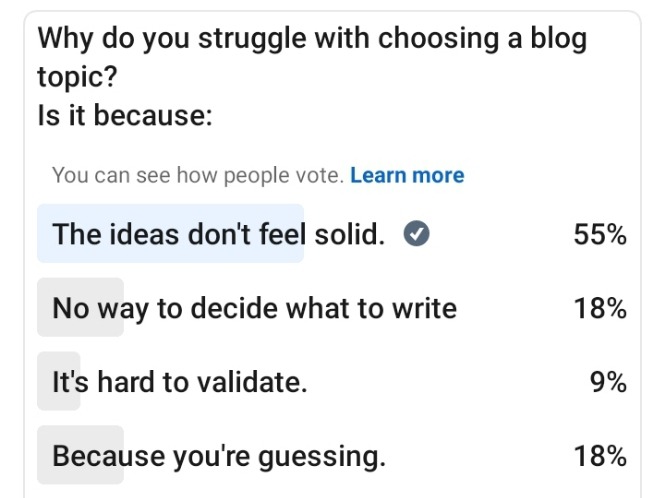
I recently ran a poll to understand why SaaS writers and marketers struggled with choosing a content topic. Here’s what came back:
- 55% said their ideas don’t feel solid.
- 18% had no way to decide if a topic was good enough.
- 18% were just guessing.
- and 9% had no way to validate a topic.
Many times I’ve also asked: “How do you pick a content topic?”
The answers were always to look at competitors, find keywords, and ask AI, which always left me confused, with no solid process to rely on.
This indicated a gap. There was a foundational problem, so I went on research.
The problem that exists with finding a solid topic for your article is not from a lack of creativity but an absence of clarity and a structured process.
Topic selection is not just the first step to a high-converting article; it is a factor that shapes the entire content. With AI search changing how people discover content in 2026, it’s even more strategic.
You need a way to validate and understand what makes a topic worth writing about, because real traffic and business impact come down to the thinking behind the topic — before a single word is written.
Here’s what actually goes into choosing SaaS content topics that drive results in 2026.
Key takeaway:

- If you're serious about creating content that aligns with your goals and builds results over time, the real value is in how you choose your topics, not just what you write.

- Choosing a SaaS content topic is a structured process built on three solid foundations: intent, awareness & experience level, and business impact.

- Intent defines what the reader wants, awareness level shapes how you frame it, and business impact connects the topic to real SaaS goals.
1. Start with the action you want the reader to take (search intent)
You’ve probably heard this a thousand times: write with intent. However, the usual advice only lists the four intent types without explaining how they connect to topic selection in the first place.
When choosing a content topic, intent is the first and most important point to understand, and it starts with a proper analysis. A proper intent analysis tells you why a topic should exist in the first place, the content type, format, angle, and signal words. Here is an intent analysis table.
| Search Intent | Content Type | Content Format | Content Angle | Signal Words |
| Informational | Educational / Guide | How-to, frameworks, step-by-step | Focus on understanding. These readers don’t want tools yet, they want to know what’s going wrong. | how, what, why, guide, tips, learn, examples, strategy |
| Commercial | Comparison / Evaluation | Listicles, comparisons, alternatives, “best” articles | Readers are already aware of the problem. The job isn’t just listing tools, it’s helping them choose. | best, top, vs, alternatives, tools, software, comparison |
| Transactional | Conversion-focused | Product pages, landing pages, pricing pages | The reader is ready to act. Don’t overload with education, focus on decision confidence. | buy, pricing, sign up, get started, free trial, demo |
| Navigational | Brand or product-specific | Landing pages, feature pages, documentation | They already chose the brand. The goal isn’t persuasion, it’s helping them reach the right place quickly. | brand names, login, pricing, docs, features, templates |
Why most people struggle to choose topics
Going back to the poll: the most selected answer wasn’t “I don’t have enough ideas.” It wasn’t even “I don’t know how to validate a topic.”55% said: the ideas don’t feel solid. That’s a signal.
Most people struggle to choose a good content topic not because of lack of ideas, but because they lack clarity. In this case, nothing tells you from the start why you should pick a particular topic, so you build on nothing solid. The struggle comes because your ideas don’t feel complete enough to commit to.
Think about it: “Customer onboarding” is only an idea. When you try to create a topic around it, you struggle to pick because it doesn’t tell you:
- What the reader actually wants
- What you’re trying to achieve
- What angle to take
- What format to use
So your idea stays vague.
With intent, however, “customer onboarding” turns into a learning topic, a comparison topic, or a conversion topic. Intent gives you a base and a starting point. Your choice follows your goal and content strategy.
How does search intent help you choose a topic?
Most advice tells you to “identify search intent” after you’ve already chosen a topic. But a real topic starts with understanding what the reader is trying to do. Until your intent is clear, what you have is not a topic; it’s just an area. If it can’t tell you what the reader actually wants, it can’t tell you what to write.
Example: Say your keyword idea is ‘customer onboarding’, using different intent types to shape it gives you:
Informational intent → educational topic → Topic: What is customer onboarding for SaaS? → Format: Explanation guide
Commercial intent → comparison topic → Topic: 8 best onboarding tools for SaaS → Format: Listicle
Transactional intent → conversion topic → Topic: Customer onboarding software with a free trial → Format: Landing page
With this, the intent you choose depends on what you want to say to your audience and what you want them to do next.
Intent also prevents you from choosing topics that are too broad without realizing it. Some ideas feel strong because they seem to cover a lot. But when multiple intents are mixed into one topic, the article ends up trying to do everything at once.
For example: “SaaS onboarding” can explain onboarding, compare tools, and recommend solutions all at the same time.
However, if you isolate the intent, the direction becomes focused. “Best SaaS onboarding tools” removes the educational angle and centers the article on comparison. The topic becomes easier to outline, easier to write, and easier for the reader to follow.
Intent also prevents topic overlap. Without it, you might end up with:
- SaaS onboarding tools
- Best onboarding tools for SaaS
- Onboarding software for SaaS
These look like different topics, but they’re actually the same intent. Writing all three means you’re creating articles that compete with each other.
When you define intent first, you recognize they belong to one direction, not three. That makes your content planning cleaner and more strategic.
Intent doesn’t just help you write better content. It helps you choose better topics before you ever start writing.
2. Awareness & experience level of the reader
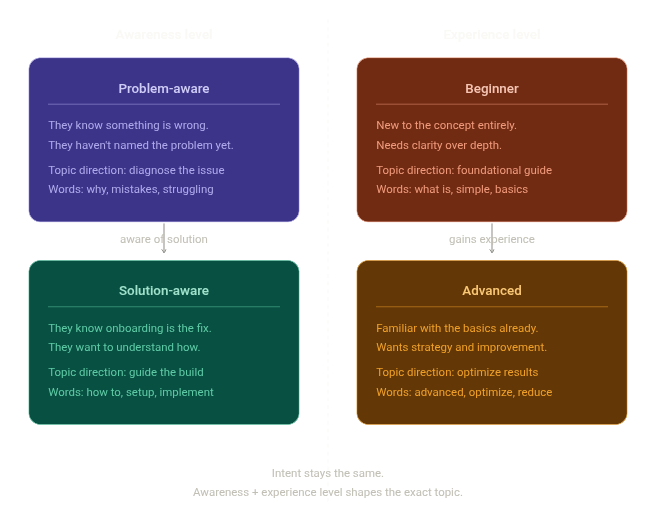
Search intent tells you what the reader wants, but it doesn’t tell you how they’re thinking. That’s where awareness level comes in. Two people can search with the same intent and still expect completely different content. One might be trying to understand their problem, another might already be comparing solutions.
If you ignore the difference, the topic you choose can feel slightly off even when the intent is right.
Awareness level helps you decide the direction of the content, the exact wording, angle, and depth of the topic. Let’s look at the types.
Problem-aware vs. solution-aware
Say your area is user onboarding and the intent is informational. You might have a topic, but you still don’t know the angle and how deep your content should be. Understanding how aware the reader is helps you determine this.
A problem-aware reader knows something is wrong but hasn’t connected it to onboarding yet. They’re thinking in terms of symptoms, not solutions. Your topic should reflect that.
Instead of writing about onboarding tools, you might choose:
- Why users drop off during onboarding
- Common onboarding mistakes SaaS startups make
- How to improve onboarding without redesigning your product
These topics use words like why, mistakes, and improvement. They focus on diagnosing the issue. The awareness level also tells you what the intro should look like:
Example; “Many SaaS products lose users during onboarding, but the problem usually isn’t obvious at first.”
A solution-aware reader already knows onboarding is the answer. They want to understand how it works or how to implement it. The topic naturally shifts to:
- How user onboarding works in SaaS products
- How to design a SaaS onboarding experience
The intro also takes a shift: “Many SaaS teams know they need onboarding, but designing one that actually guides users forward isn’t always straightforward.”
Notice that the informational intent didn’t change. Only the awareness level did and it completely guided the topic.
Beginner vs. advanced level
Experience level is another layer that shapes topic selection. A beginner and an advanced reader searching the same topic don’t want the same content. If you don’t account for this, your topic will either feel too basic or too narrow.
Beginner-level topic: simplifies the concept. The topics look like this:
- What is SaaS onboarding and how does it work?
- Simple onboarding strategies for early-stage SaaS
These use words like what is, simple, guide, and basics. An intro might start like this:
Intro: “If you’re setting up onboarding for the first time, it’s easy to overcomplicate it.”
Advanced-level topic: assumes familiarity and focuses on improvement. The topic looks like this:
- Advanced SaaS onboarding flows that reduce churn
- Optimizing SaaS onboarding for activation metrics
Words shift to advanced, optimize, reduce churn, and activation: An intro for this may look like:
Intro: “If you already have onboarding in place, the real challenge is improving activation.”
Notice how they are focused on the same area and the same intent. But different awareness levels and different topics entirely.
How awareness & experience level shape intent
| Awareness Level | What They’re Thinking | Topic Direction | Title Example | Content Angle |
| Problem-aware | Something isn’t working, but I don’t know the solution yet | Diagnose the problem | Why users drop off during SaaS onboarding | Explain the issue and clarify the problem |
| Solution-aware | I know onboarding is the answer, I need to know how | Understand solutions | How to set up a SaaS onboarding experience | Show or guide the reader toward building a solution |
| Beginner | I’m new to this and need to understand the basics | Foundational explanation | What is SaaS onboarding and how does it work | Teach concepts clearly and simply |
| Advanced | I already understand this, I want to improve results | Optimization and strategy | Advanced SaaS onboarding flows that reduce churn | Improve performance and refine strategy |
Intent gives you the general direction. Awareness and experience level sharpens it and tells you how deep you should go. What this looks like:
- Informational intent + problem-aware → Why users drop off during onboarding
- Informational intent + beginner → What is SaaS onboarding?
- Commercial intent + solution-aware → Best SaaS onboarding tools
- Commercial intent + advanced → Advanced onboarding tools for product-led SaaS
When you follow this step, you don’t only identify intent, you use awareness to choose a topic that matches exactly how the reader is thinking.
3. Connect the topic to business impact
Business impact is rarely talked about in the context of topic selection.
Most advice focuses on keywords, competition, and content formats. None of it answers the most important question: Will this topic matter to the business?
Not every high-traffic SaaS topic is valuable. Some bring the wrong audience. Some educate people who will never use the product. Some address problems that are too far from the product to create any real movement.
This is why two topics in the same niche can perform very differently even when both rank.
A simple example:
Topic A: What is email marketing?
Topic B: Email marketing tools for SaaS startups
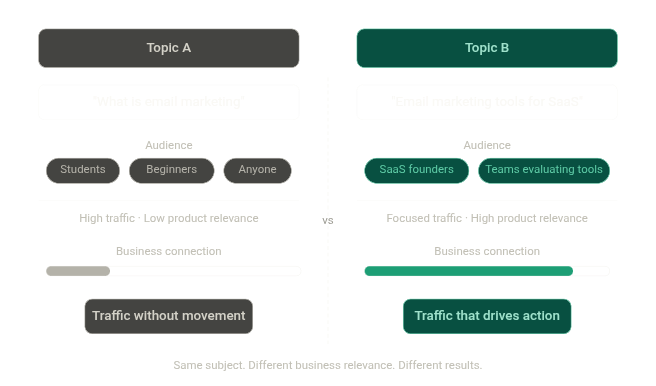
Topic A looks attractive. It’s broad and will likely pull more search volume. It can also work as a top-of-funnel article. But the audience it attracts is wide: students learning marketing, people looking for definitions, beginners exploring basics. Very few of them are looking for the product.
The topic is relevant to the niche. But it isn’t necessarily relevant to the product.
Topic B is narrower, but more specific. The audience tilts toward SaaS founders, teams actively evaluating tools, and people closer to making a decision. These are people with a higher chance of using the product which is what connects to business impact.
In this case, notice that nothing about the core subject changed. It’s still email marketing. But the business relevance changed entirely. The second topic connects naturally to product usage, decision-making, and adoption.
This means a topic can have strong intent, good keyword structure, and a clear angle but still fail to drive results if it doesn’t connect back to the business.
How business impact connects to choosing a topic
Connecting a topic to business impact doesn’t mean making everything sales-focused. It means choosing topics that naturally sit closer to real users’ problems, product use cases, decision points, and adoption moments.
For example, instead of “SaaS productivity tips“, you might refine to “Productivity workflows using project management tools.” The second topic still educates, but it also moves the reader toward implementation and closer to the product.
When evaluating a SaaS content topic using business impact, ask:
- Does this topic relate to how the product is used?
- Does it attract someone who might need this type of tool?
- Does it connect to a real workflow?
- Does it influence how someone chooses a solution?
If the answer is no, the topic may still drive traffic but the impact will be limited. That doesn’t mean you shouldn’t write it. It just means you should understand the role it plays.
Strong SaaS content isn’t just chosen based on search behavior. It’s chosen based on what happens after someone reads it.
A simple formula for generating strong SaaS topics
Once you understand intent, awareness level, and business impact, topic selection becomes less about inspiration and more about assembly.
To generate a strong SaaS topic, use this formula: [Intent Word] + [Awareness/Level] + [Problem or Use Case] + [Business Context]
Each part plays a role. The intent word sets the direction, awareness level refines the angle, and the problem or use case gives the topic substance. Business context connects it to real usage.
The problem or use case gives the topic substance, business context connects it to real usage.
 Step 1: Start with the intent word
This tells you whether you’re educating, comparing, or guiding.
- Informational: how to, why, what is, guide to
- Commercial: best, top, vs, alternatives, tools
- Transactional: buy, signup
- Navigational: login
Note: the intent word can come anywhere in the topic but the intent word shapes the kind of article you’ll write.
Step 2: Add the awareness or level
This determines the angle.
- Problem-aware: struggling with, drop off, mistakes, improve
- Solution-aware: implementation, workflow, setup, types of
- Beginner: for startups, for beginners, simple
- Advanced: advanced, optimize, improve, reduce
These modifiers prevent your topic from being too broad.
Step 3: Add the problem or use case
This is what the content is actually about.
Examples: user onboarding, churn reduction, content planning, email automation
Without this, the topic has no context.
Step 4: Add business context
This is what connects the topic to real SaaS usage instead of generic education.
Examples: for SaaS startups, to increase activation, to reduce churn
This last part is what makes the topic strategic.
Putting it together
Example 1 Intent: How to | Level: Beginner | Problem: SaaS onboarding | Context: For startups → How to set up SaaS onboarding for startups to increase activation
Example 2 Intent: Best | Awareness: Solution-aware | Problem: Onboarding workflows | Context: Reduce churn → Best SaaS onboarding tools to reduce churn
Example 3 Intent: Why | Awareness: Problem-aware | Problem: Users drop off | Context: During onboarding → Why users drop off during SaaS onboarding
Example 4 Intent: How to | Level: Advanced | Problem: Improve activation | Context: SaaS onboarding → How to improve SaaS onboarding to increase activation
This approach removes guesswork. Instead of trying to “come up with ideas,” you’re assembling a topic using four clear decisions. Once those are defined, the topic becomes focused, easier to structure, and more aligned with real SaaS use cases.
How is AI search changing how SaaS topics should be chosen?
AI search is not introducing a completely new way to choose topics. It’s making precise topic selection more important.
In traditional search, broad phrases could still perform. A title like “SaaS content strategy“ worked because keyword matching was enough. But today, search behavior is shifting.
People are no longer typing short keywords into a search bar. They’re asking full questions inside AI tools, often describing their situation, their stage, and what they’re trying to achieve. This changes what makes a SaaS topic strong.
AI-driven discovery favors topics that clearly express intent, awareness level, and outcome. It doesn’t just match words, it tries to understand:
- What the user is actually asking
- What stage they’re in
- What kind of answer they need
This reinforces why the earlier steps matter.
When you define intent, you’re clarifying what the reader wants. When you define awareness level, you’re matching how they think, and when you connect to business impact, you’re focusing on real use cases. These elements don’t just improve the content, they make the topic more aligned with how modern search works.
The shift toward AI discovery doesn’t change the foundation of good topic selection. It simply rewards topics that were already structured with intent, awareness, and real-world context.
What actually goes into choosing a SaaS topic that drives results?
Choosing SaaS content topics is often framed as a creative process: come up with ideas, check keywords, and start writing. But in practice, the difference between content that just exists and content that actually works usually happens before the writing begins.
It’s a decision shaped by intent, awareness level, and business relevance. When these three align, the topic becomes clearer, the angle becomes obvious, and the content has a defined purpose from the start.
A simple formula to use: [Intent Word] + [Awareness/Level] + [Problem or Use Case] + [Business Context]. It makes the process repeatable, and you no longer have to rely on brainstorming alone.
Because a SaaS content that contributes to growth often starts with choosing topics intentionally, even before a single word is written.
Frequently asked questions (FAQs)
How do I come up with SaaS content topics consistently?
Start with a problem your target users face. Then define the search intent, their awareness level, and how the topic connects to real product usage. This turns one idea into multiple focused topics instead of random brainstorming.
What type of SaaS content topics drive conversions?
Topics that sit close to decisions or implementation tend to perform better. These usually include use cases, comparisons, workflows, or optimization-focused content rather than broad educational topics.
How do I know if a SaaS topic is too broad?
If the topic can mean different things to different readers, it’s likely too broad. For example, “SaaS onboarding” could be educational, comparative, or tactical. A strong topic narrows the direction and targets one intent.
Should SaaS startups focus on informational or commercial topics?
Both matter, but they serve different roles. Informational topics attract and educate, while commercial topics help readers evaluate solutions. A balanced mix usually works best.
How many blog topics should a SaaS company start with?
Instead of random posts, start with 5–10 topics around one core problem. This builds depth, improves internal linking, and makes the content strategy more focused.
How do I choose between two similar SaaS topic ideas?
Pick the one with clearer intent, a more specific problem, and a stronger connection to real product usage.