

B2B SaaS content marketing strategies are designed for awareness — clicks, page views, and the eventual hope of signups.
But awareness is only half the work. Between interest and commitment lies the toughest part. The moment when a buyer has to justify moving forward, internally, to people who weren’t reading your content.
Content Marketing Institute reports that only 12% of B2B marketers say their content exceeds expectations. That means 88% of content efforts are falling short partially or completely.
Buyers are interested, and the strategy is in place, but support is lacking at the critical point — deciding.
Which is where most content breaks and where deals are quietly lost.
In this piece, we’ll break down what’s actually happening in a buyer’s mind before they commit and what B2B SaaS content teams can do differently to meet them there.
The funnel tracks position. It doesn’t track psychology
According to HubSpot, 70% of buyer time is spent researching before engagement. By the time they’re at the “decision-stage” of the funnel. They’ve filtered through options and formed conclusions. Their main objective now is to minimize risk.
But this is when the funnel model falls short. It places buyers on a linear map: awareness, consideration, decision — but doesn’t describe what’s going on in their head along the journey.
A decision-stage buyer isn’t sitting there ready to buy. They’re trying to justify the purchase: internally, financially, and politically, often to people who haven’t engaged with your content at all.
That’s the point some companies miss. Trying hard to fit buyers into the funnel, but without sufficient, justified reasons for validation.
If your content doesn’t equip the buyer to explain, defend, and de-risk the choice, then reaching the decision stage doesn’t actually mean they’ll decide.
The real stages of a buyer’s mind
The traditional buyer decision process maps five stages:
- Recognizing the problem
- Searching for information
- Evaluating available alternatives
- Making a purchase decision
- The post-buy experience
But in B2B SaaS, this model overlooks the internal politics and committee dynamics that influence evaluation and decision-making. The very gap where most content loses buyers.
What are the real stages of a B2B buyer’s decision process?
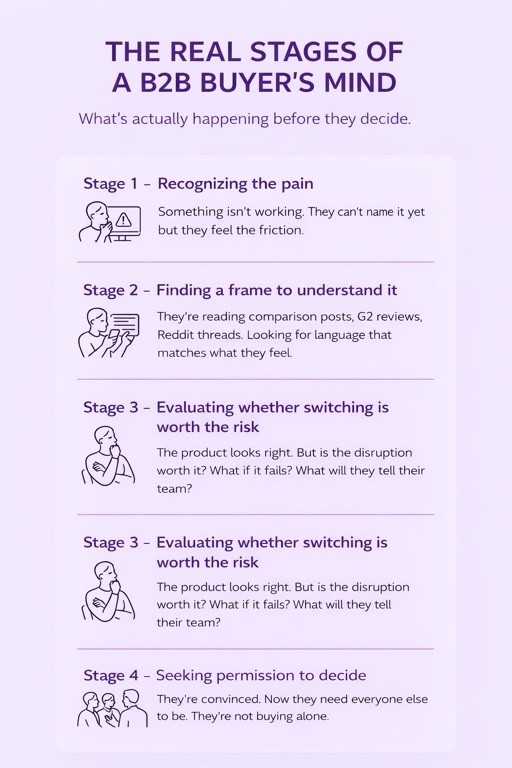
There are four mental stages:
- Recognizing the pain
- Finding a frame to understand it
- Evaluating whether switching is worth the risk
- Seeking permission to decide
Where does most B2B SaaS content marketing strategy abandon the buyer?
Buyers move through four mental stages that don’t map to TOFU, MOFU, or BOFU. Some companies handle the first two stages well, and improperly address the third and fourth, which is where decisions actually get made or dropped.
Also read: 15 Lessons From Writing Product‑Led Content for SaaS Companies
This is how the buyer psychology journey works
Drew is a customer who is currently using product A and encounters yours. Curiosity fuels his investigation.
He analyzes your features. They’re great, but not convincing enough to make the switch.
The question “Maybe, but why should I?” replays in his head.
This results in content-hopping — from comparison posts to G2 product reviews.
Eventually, the tiresome search drains his drive, and he backs out. “I think it’s a good choice, but maybe later” becomes the excuse to leave.
Later, a bookmark, and no search ever again.
When content doesn’t resolve the uncertainty at stages three and four, buyers don’t push through. They bookmark and disappear.
Also read: How Product-Led Content is Redefining SaaS Marketing
Your buyer has to sell internally after they’re sold
According to Forrester’s 2026 B2B Buyers’ Journey Survey, B2B purchases are influenced by 22 stakeholders on average — 13 internal and 9 external participants.
The person reading your content is rarely the final decision maker.
A buying committee is the group of internal and external stakeholders who collectively influence or approve a B2B purchase decision.
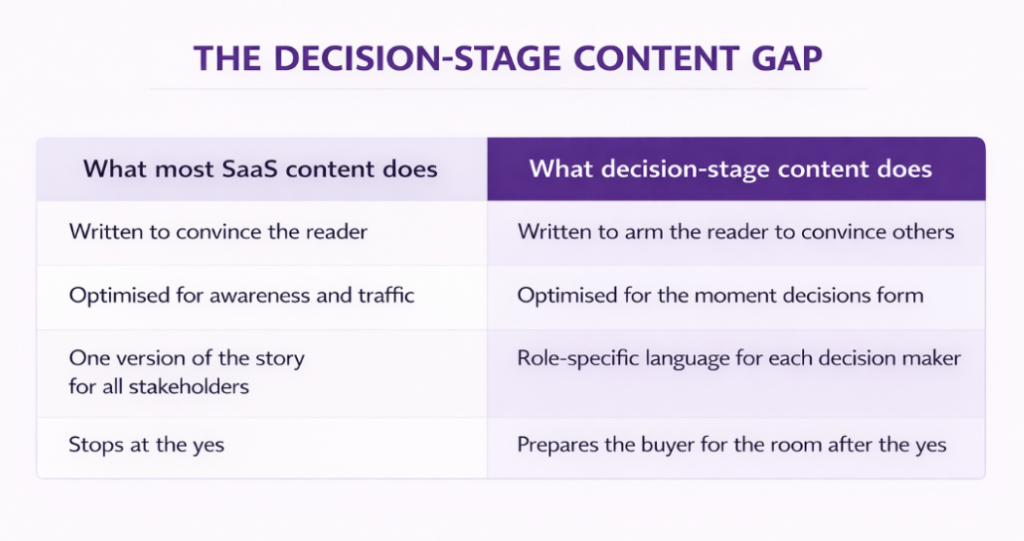
Your reader requires enough evidence to convince everyone else internally, but almost no SaaS content is written with this person in mind.
Without sufficient evidence to support their recommendations, the half-win becomes reversible.
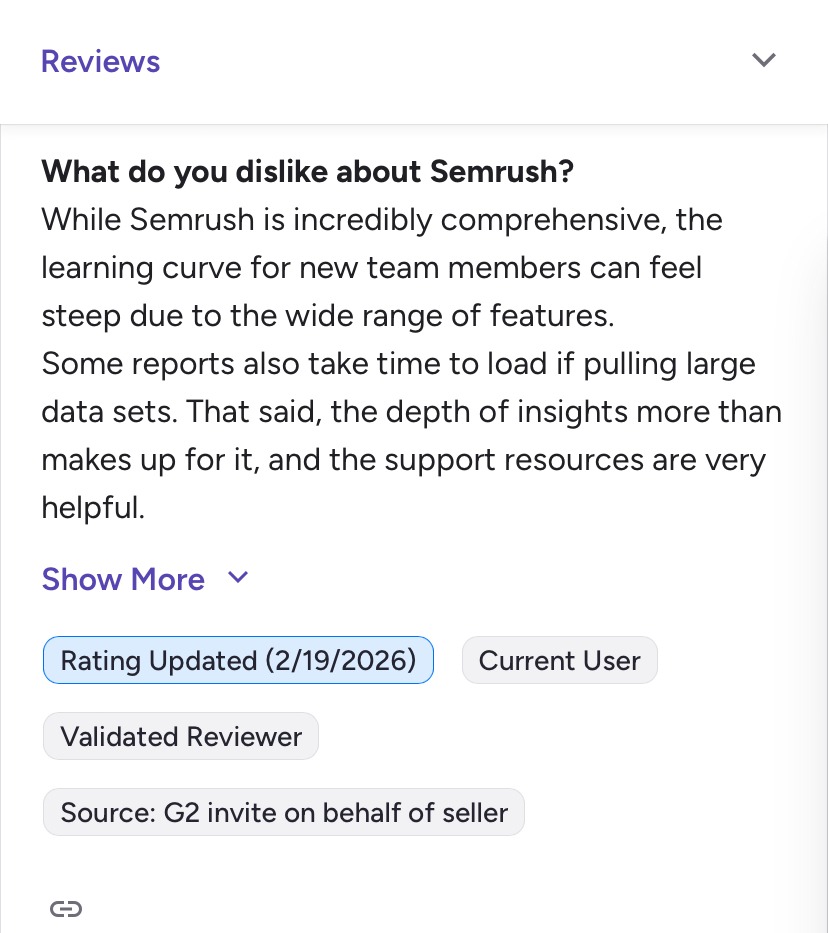
This Semrush user on G2 is a perfect example.
They weren’t questioning how good Semrush is. The main concern was the hassle from their team’s adoption. The internal conversation they’d have to manage after saying yes.
Semrush is great, but it left a gap — the language this user needed to bring his team along.
Even convinced buyers carry a second layer of hesitation that has nothing to do with the product itself.
The conviction is just the first step, and most companies stop there. They forget the reader is just the starting line — the starting point of an internal sales process your content never prepared them for.
They are the champions who require the language, the proof, and the risk-framing to boldly enter board rooms your content will never enter.
Why buyers don’t trust polished content
B2B SaaS buyers’ lack of trust doesn’t stem from the content’s poor quality; they distrust it because it carries an obvious agenda.
According to Forrester, 82% of buyers trust coworkers and internal management most.
This means that people prefer “the safe bet” rather than deal with the uncertainty of new relationships.
And bypassing content that sounds like it’s selling is usually the safer option (by instinct).
This is a core reason why B2B SaaS content doesn’t convert at the decision stage, because it’s optimized for reach and not trust.
Buyers validate through peer conversations, Reddit threads, and real user discussions (not polished marketing pages).
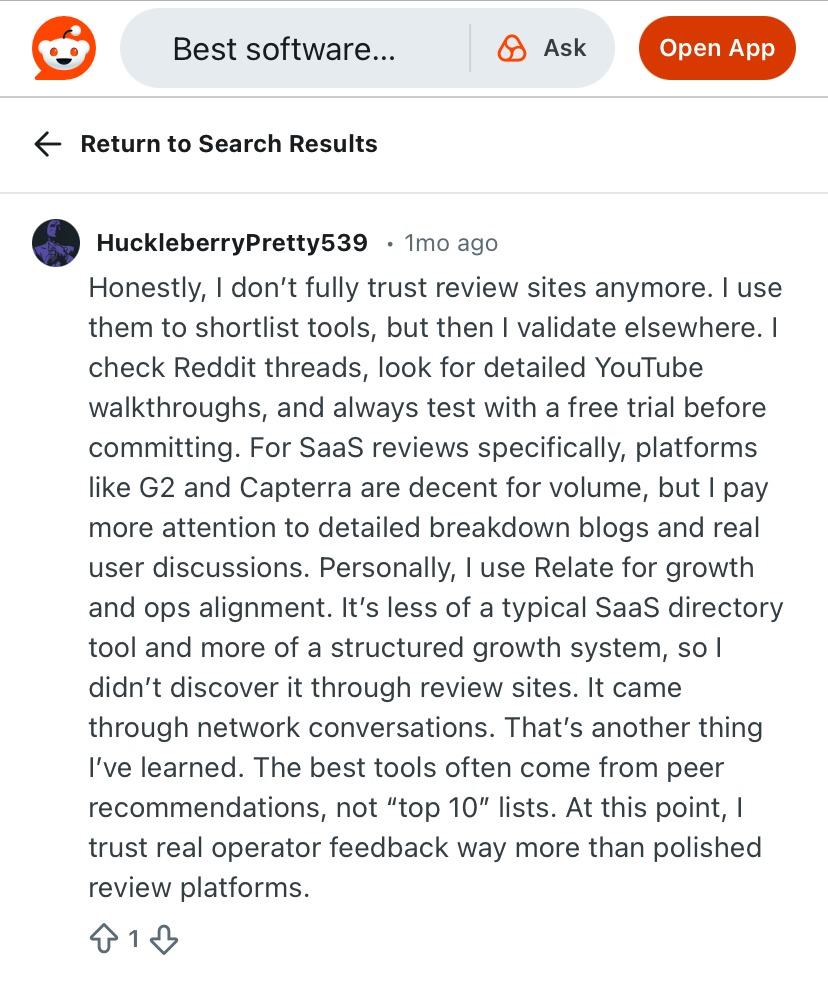
This comment is a good illustration.
This person uses three routes for tool discovery, four for SaaS reviews, and peer recommendations for finality — specifically abstaining from “top 10” hierarchies to make decisions.
The most suitable option is: real feedback from real users.
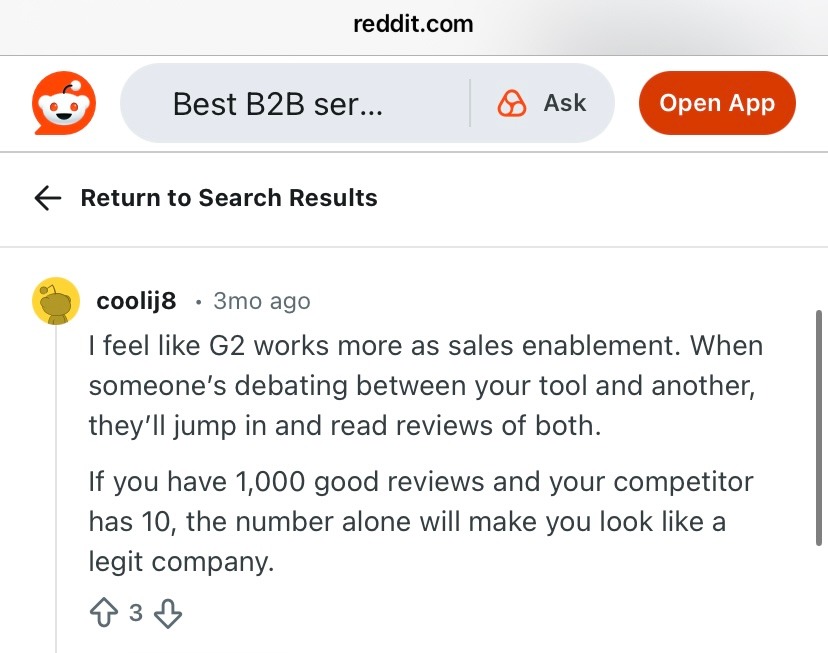
Review platforms are also being used for volume signals, not content quality.
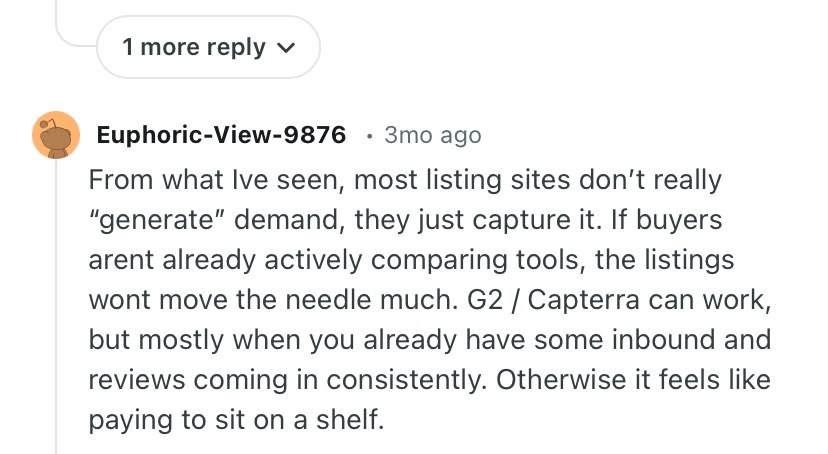
As this buyer on Reddit put it: listing sites don’t generate demand, they capture it. Buyers who aren’t already comparing tools won’t be moved by a listing alone.
Buyers have seen through the system — top 10 and AI recommendations.
Predictable content often feels like persuasion, not help. So buyers don’t outrightly dismiss it, they just don’t rely on it to make true and confident decisions.
They need proof to choose not what Google chooses from SEO success, but actual solutions.
Buyers at the decision-making stage aren’t looking for better explanations; they’re searching for safer validation.
So when there’s risk involved, they trust the one that feels hardest to fake.
Also read: How AI Broke Writing — And What Comes Next
Information overload is a buying problem, not UX only
Information overload means broadcasting without considering your reader’s mind storage and working capacity.
Posting content as though your content calendar is your reader’s learning schedule.
The effect goes deeper than a slow decision. According to Tom Shapiro, CEO of Stratabeat, it triggers something more fundamental:
“When complexity prevents the easy, fast flow of information processing in the brain, buyers panic and often become paralyzed in their thinking.”
Forrester confirmed this: 66-72% of B2B buyers trust analysts and industry peers and even vendor executives — voices that offer privileged insight or firsthand experience.
The cognitive layer of this problem runs deeper than most B2B SaaS content teams realize.
For buyers, it’s not solely about credibility. It’s about cognitive relief. Buyers gravitate toward voices that are harder to fake, the ones that give their brain permission to stop searching.
Authoritative content earns that same trust when it does three things:
- Guides without selling: it frames the problem first, before pushing the solution
- Speaks without an agenda: it acknowledges trade-offs rather than hiding them
- Carries weight: it draws on real experience, not promotional intent.
That’s the standard your content is being held to at the decision stage — whether you know it or not.
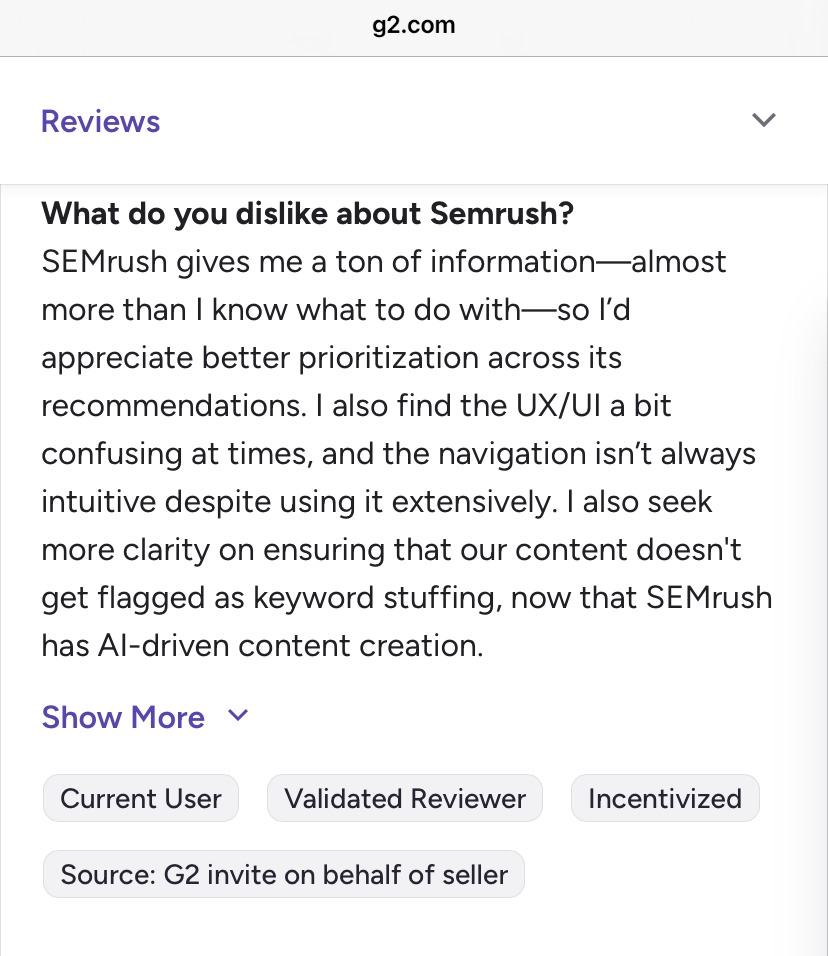
The first line of complaint is about information overload. This is how “more” turns into clarity tax.
As useful as it may be, too much information lowers confidence and makes the decision harder to close.
What is better? Clarity in less volume.
For example, a pricing page that clearly states who the product is not for removes more friction than a features page that lists everything it can do.
Simply put: More content doesn’t help a buyer decide. Only clearer content does.
Content published for content calendars.
Content published to add layers on clarity.
There’s a difference.
One ticks a box, the other solves a problem.
So when buyers have everything but can’t prioritize, it creates paralysis rather than confidence.
Instead of 4 posts per week for the calendar
Do:
• One use case article that answers the questions buyers ask themselves at midnight before making a decision
• 2 long form blogs that frame a problem and prompt a decision
• A product walkthrough that shows rather than tells
All with a pivot on layered clarity.
Content marketing for B2B SaaS should value prioritization — giving users what they need, when they need it, and enough for them to be rewarded at each phase of their buying journey.
The cost of inaction — the competitor most content ignores
The biggest competitor in most B2B SaaS deals isn’t the other vendor. It’s the decision to do nothing.
Forrester found that 79% of B2B buyers trust vendors they currently work with. The status quo has a head start. So your content is battling against familiarity, not only competing alternatives.
In your reader’s mind, they’re weighing everything that could go wrong: career risk, visible accountability, fear of being wrong publicly.
The fear of being visibly wrong in front of leadership makes inaction the safer option, and wiser — even when it’s costly.
In B2B SaaS content marketing strategy, the cost of staying put is not free. It has a price — yet unknown— because no content has helped them calculate it.
And content that makes inaction feel riskier than switching is a persuasion strategy most SaaS teams never use.
How should B2B SaaS content address the cost of doing nothing?
The fear of inaction is tangible, tied to our neurobiology and human experiences.
“When B2B buyers stall at the decision stage, it’s rarely about ignorance of the solution. It’s usually driven by psychological factors, such as the fear of risk, uncertainty, loss aversion, concerns about the operational impact of a bad decision, and fear of losing one’s job.”
— Tom Shapiro, CEO, Stratabeat.
Content that addresses these specific concerns (not just the product problem) is what the GOIC framework is designed to create.
The GOIC framework
- G: Go-to choice: Your content positions you as the default answer when buyers search for a solution in your category.
- O: Obvious choice: Your messaging makes the fit so clear that buyers don’t need to evaluate alternatives extensively.
- I: Irreplaceable choice: Your content demonstrates what switching away would cost (the integrations lost, the workflows, etc.)
- C: Costly choice to ignore: Your content makes inaction visible. Showing what staying with the current solution is quietly costing the business in time, money, or competitive ground.
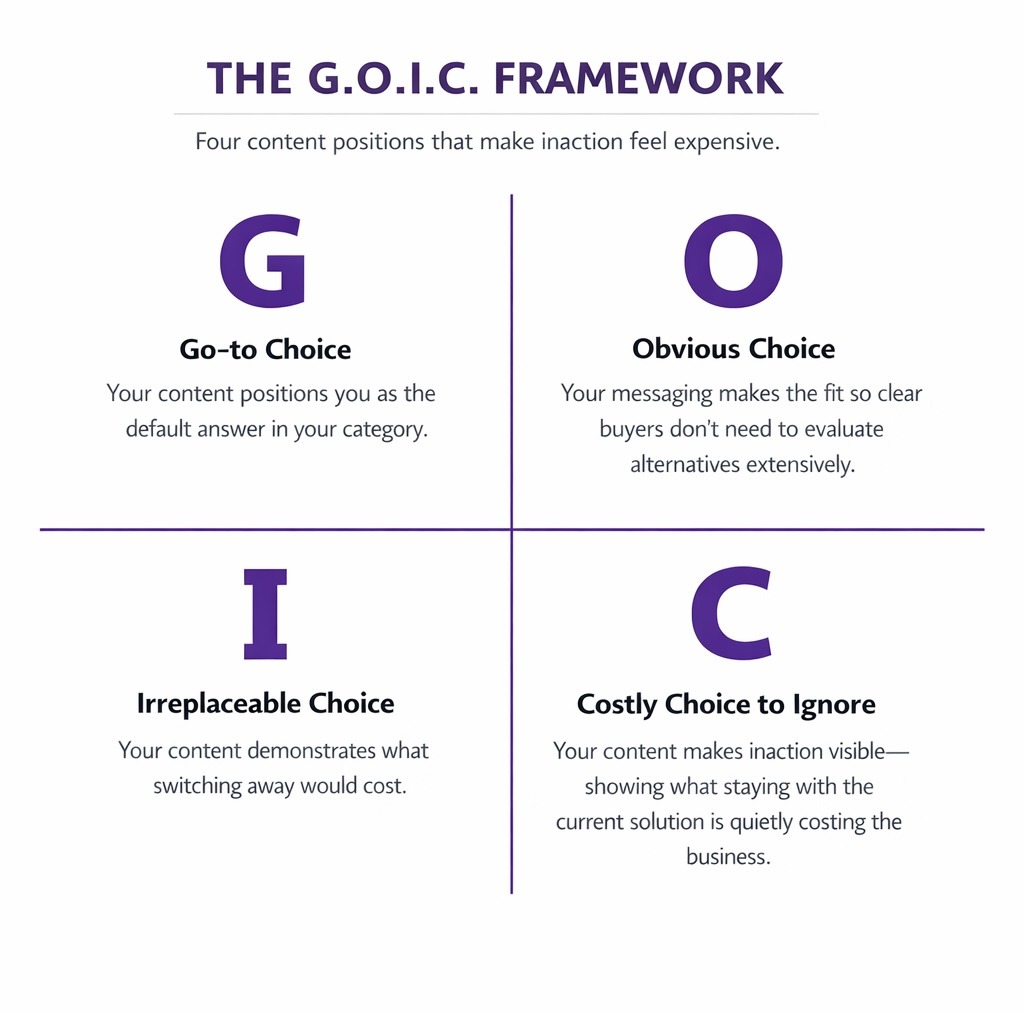
When your brand rings the bell in your niche, your content proves to be the costly solution, and convincing enough to the champion and the 22 stakeholders in the boardroom; it makes buyers not only easy to decide, but easy to recommend your SaaS product to others.
This beats any “top 5” list of great products on comparison pages because buyers want to see results. And what better way than good reviews from analysts, industry peers, and authoritative experts.
What content actually works at the decision stage
Decision-stage content is one that gives clarity, on time, and in the least amount of steps possible to the reader.
It is the confidence boost that ensures that the next step taken is worry-free, in assurance, and armed with sufficient, justified information to spread and defend publicly.
According to Content Marketing Institute, only 48% of B2B marketers saw modest improvement in 2025, because some teams optimize for buyer stages only, while others totally ignore the reader who internally justifies to convince others.
The decision-stage content remains the most underdeveloped part of most B2B SaaS content marketing strategies.
These are the formats that work best at the B2B SaaS decision stage:
1. Specific, relatable social proof:
Credibility is good. But without relatability, it doesn’t convert.
Most case-studies feature enterprise logos that look impressive, but they can also create distance for buyers who don’t see themselves in that league.
A 10–50 person team doesn’t see itself in a Fortune 500 success story.
What actually moves decisions is proximity — relatable proof.
Same:
- Stage
- Constraints
- Kind of problem
For example, a case study about how a 12-person marketing team at a Series B SaaS company reduced their content review cycle by 60% does more decision-stage work than a Salesforce logo on a homepage.
Buyers are not asking, “Is this product good?” — they may see that already. They want to know if it worked for someone like them.
Also read: Which Social Media Metrics Actually Signal Demand for Early-stage SaaS
2. Direct answers to questions buyers are afraid to ask sales:
There’s always a buyer with questions they won’t ask a sales rep because asking feels like showing weakness or inviting a pitch.
So those questions stay internal:
- How long does implementation actually take?
- What happens if adoption fails?
- What does the offboarding process look like?
If your content doesn’t answer these, the hesitation doesn’t go away. It just goes unspoken.
Instead, decision-content should answer them:
- On a dedicated FAQ page
- In a transparent pricing explainer
- In an implementation guide
Answering these questions removes the last layer of hesitation before a decision forms.
3. Stakeholder-specific content:
As earlier established, your champion is rarely the only one involved in making a decision.
The CFO needs an ROI narrative. The IT lead needs a security and integration explainer, and the operations lead needs a workflow impact summary.
But most SaaS content tells one version of the story and expects every stakeholder to obtain what they need to justify.
What to do instead:
- Role-based content pages, or
- Downloadable one-pagers
That gives each stakeholder the specific language they need to say yes in their own terms.
Because a deal can move forward when everyone can agree.
The best decision-stage content gives the already-convinced buyer everything they need to convince everyone else.
4. Comparison pages with honest trade-offs
Comparison pages create winners; that’s the exact reason people distrust them. A good comparison page shows where your product does great, where it falls short, and who it isn’t right for.
This level of honesty gives more confidence than one that claims to win every category.
5. “Not for” pages
Clearly stating who your product is “not for” is a good trust signal in SaaS. It says, “I would rather lose the wrong deal than mislead the wrong buyer”. Buyers respect it, it’s rare, and it compounds value over time.
6. Internal justification docs
A one-page summary that a champion can forward to their CFO or IT lead after reading your content.
It is:
- Pre-built
- Reusable
- Written in the language of each stakeholder.
Most companies never build this. The ones that do will shorten their sales cycles significantly.
“For your content to have a greater impact on buyers and to move them to action more powerfully, your content should focus on eliminating buyer pain points, reducing risk, proving ROI, leveraging social proof, and simplifying the path forward.”
— Tom Shapiro, CEO, Stratabeat
Each of those five jobs maps to a specific content format:
- Risk reduction lives in honest comparison pages and ‘not for’ pages
- ROI proof lives in specific, relatable case studies
- Simplifying the path forward lives in internal justification docs and stakeholder one-pagers
Key Takeaway
Most content is written for one person, but B2B SaaS buying is never a solo decision.
Companies need the structural understanding of how buyers decide. And how the reader (and champion) internally decides to convince others.
An effective B2B SaaS content marketing strategy zeroes in on the specific moments where decisions are made or stuck.
When content is written for this champion and their committee, decisions are made without the internal conflicts and shorten sales cycles.
BoFu content is designed to convert. But conversion without confidence just creates a buyer who says yes and immediately starts second-guessing it.
Decision-stage content gets them to buy in and equips them to convince everyone else.
Because the real moment of truth doesn’t happen on your website. It happens in a meeting you’ll never see, where your buyer is asked, “Why this?”
And your content is either the reason they move forward or the reason they hesitate.
Audit one piece of content using this checklist
✔️ Does your content give champions the specific language they need to sell your product internally to a manager, CFO, or buying committee?
✔️ Do you have a page or piece that clearly states who your product is not for? If not, buyers will figure it out themselves and fill the gap with doubt.
✔️ Is your social proof specific enough (same industry, same team size, same constraints) that a buyer can genuinely see themselves in it?
✔️ Does any of your content address the cost of inaction? What staying with the current solution is quietly costing the business in time, money, or competitive ground?
✔️ Do you answer the questions buyers are too afraid to ask sales — implementation timelines, failure scenarios, offboarding process, and real pricing clarity?
Frequently asked questions (FAQs)
Why does 88% of B2B content fail to convert at decision stage?
Most B2B SaaS content excels at awareness but ignores the internal justification process. Buyers need language to convince 22 stakeholders (Forrester 2026)—CFOs, IT leads, managers — who never read your content.
What are the 4 real mental stages of B2B buying?
Curiosity → Analysis → Internal justification → Committee alignment. Traditional TOFU/MOFU/BOFU misses the psychological gap where champions must sell internally after being sold externally.
How does a B2B buyer “sell internally” after your content?
Your champion becomes your internal salesperson. They need: ROI calculators for CFOs, security one-pagers for IT, workflow impact summaries for ops. Content must equip them for boardroom battles you never see.
Why don’t B2B buyers trust polished SaaS marketing content?
82% trust coworkers/managers most (Forrester). Polished content feels like persuasion. Buyers seek “harder to fake” signals: peer conversations, Reddit threads, specific case studies over generic top-10 lists.
What is information overload costing B2B SaaS deals?
Cognitive paralysis. Buyers panic when processing stalls. Clarity in less volume beats feature dumps. Pricing pages saying “who we’re NOT for” convert better than exhaustive feature matrices.
Why is “doing nothing” the biggest B2B SaaS competitor?
79% trust current vendors (Forrester). Status quo bias + career risk makes inaction safer. Content must quantify inaction costs: time lost, competitive ground ceded, opportunity revenue missed.
What is the GOIC framework for decision-stage content?
Gap (problem clarity), Objection handling, Internal justification tools, Committee alignment. Structures content to move champions through internal sales process.
What are “internal justification docs” for B2B SaaS?
One-page summaries champions forward to stakeholders. Pre-built, reusable, stakeholder-specific: CFO ROI, IT security, Ops workflow impact. Shortens sales cycles 30-50%.
Why do enterprise case studies fail SMB B2B buyers?
Distance. 10-50 person teams don’t see themselves in Fortune 500 logos. Relatable proof (same stage, constraints, team size) converts 3x better than impressive-but-irrelevant enterprise stories.
What questions are B2B buyers afraid to ask sales reps?
Implementation timelines, adoption failure scenarios, offboarding processes, real pricing clarity, “what if it doesn’t work?” Decision content answers these proactively.
How do “not for” pages build B2B buyer trust?
Honesty signals. “We’d rather lose wrong fit than mislead” builds confidence. Rare in SaaS, compounds credibility. Buyers respect clarity over desperate universality claims.
What is stakeholder-specific content for B2B SaaS?
Role-tailored assets: CFO ROI calculators, IT security whitepapers, Ops workflow guides. One story per stakeholder ensures committee alignment vs. generic messaging.
How do honest comparison pages convert better than biased ones?
Show trade-offs + “who we’re not for.” Buyers distrust “we win everywhere” claims. Transparency = confidence. “Not for startups under 10 people” beats vague universality.
How to audit if your B2B content works at decision stage?
5 questions: 1) Equips champions for internal sales? 2) Quantifies inaction cost? 3) Answers unaskable questions? 4) Stakeholder-specific? 5) Relatable social proof? Fail any = pipeline leakage.
How many stakeholders influence B2B SaaS buying decisions?
Forrester 2026: 22 on average (13 internal, 9 external). Your content champion must convince them all. Generic messaging fails; stakeholder-specific one-pagers convert.
What percentage of B2B buyers trust current vendors most?
79% (Forrester). Status quo bias makes “doing nothing” the biggest competitor. Quantify inaction costs in content to overcome familiarity.
Why do 88% of B2B content efforts fall short?
Content Marketing Institute: Only 12% exceed expectations. Most optimize for awareness/clicks, ignore decision-stage internal justification to buying committees.
What are the 4 mental stages of B2B SaaS buying?
Curiosity (problem awareness), 2) Analysis (feature evaluation), 3) Internal justification (champion sells internally), 4) Committee alignment (stakeholder buy-in).
What content format closes B2B SaaS deals at decision stage?
Internal justification docs: 1-page stakeholder summaries (CFO ROI, IT security, Ops workflow). Champions forward to committees. Shortens cycles 30-50% vs. generic case studies.