


Traffic isn’t the point anymore, or at least, not the only one.
Content performance is increasingly being measured by whether a piece contributes to a demo request, a sign-up, or a pipeline conversion.
Which raises a question most content teams haven’t fully answered yet: if pipeline is the metric that matters, where does the intelligence to build pipeline-driving content come from?
Keyword research tells you what buyers Google. Competitor analysis tells you what everyone else is publishing. Audience data tells you who you’re writing for.
But none of these tell you what a prospect said two hours ago when a deal fell apart.
That’s sales intelligence. And it might be the most underused input in B2B content strategy.
Sales teams sit on a goldmine of specificity. And when that intelligence makes it into a content brief, it entirely changes what gets written in the first place.
This article breaks down what sales intelligence actually looks like, how it reshapes your content at the topic level, how to extract it systematically, and why the teams that build it into their process end up producing content that connects with buyers right when they’re making a decision.
What sales intelligence actually means for content
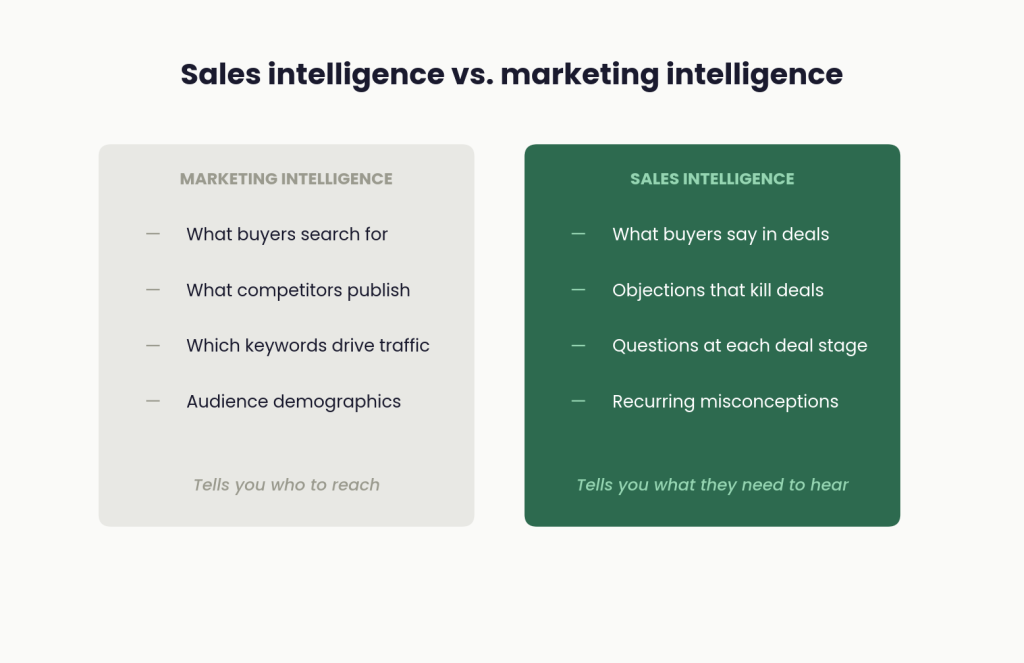
Sales intelligence and marketing intelligence get lumped together a lot. But that shouldn’t be.
Marketing intelligence focuses on what buyers search for, what content competitors publish, and which keywords drive traffic. It’s the data behind your editorial calendar.
Sales intelligence, on the other hand, is about what buyers actually say when they’re on the verge of a decision: their objections and questions.
Marketing intelligence guides on who to reach. Sales shows you what they need to hear when they’re ready to decide.
I spoke with Damilare Olasinde, a content marketing professional for B2B brands who’s very knowledgeable about how sales teams shape content strategy.
He put the distinction simply:
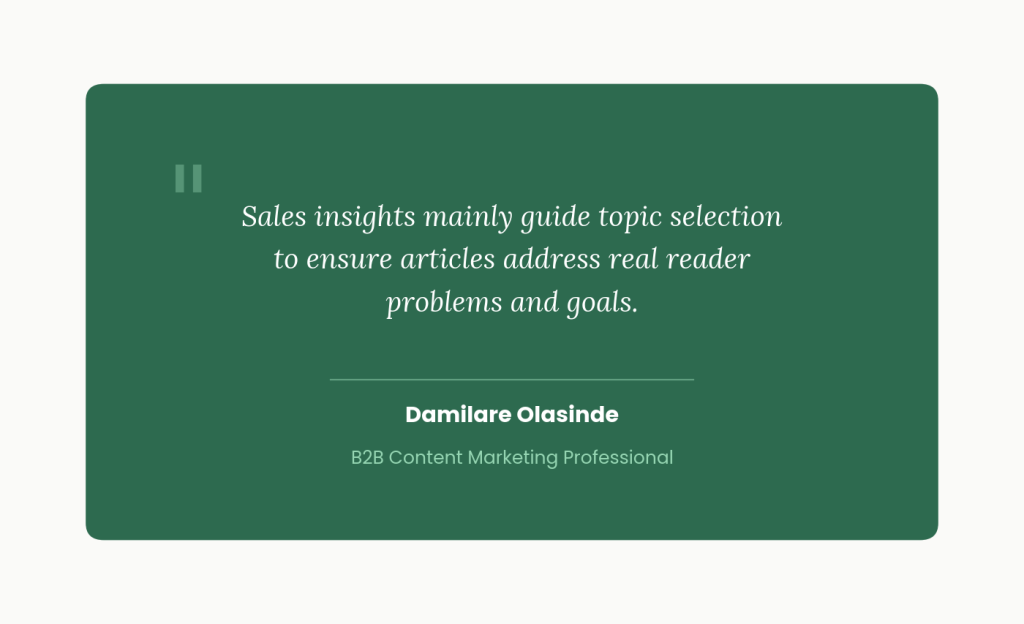
“Sales insights mainly guide topic selection to ensure articles address real reader problems and goals.”
The intelligence of sales shapes what you write, and that shift in topic selection is where the biggest content improvements mainly come from.
The disconnect between content calendars and buyer conversations
When sales intelligence doesn’t feed into content strategy, the editorial calendar fills with awareness content: guides, trend pieces, thought leadership. Do these pieces perform reasonably on traffic metrics? Yes.
But in an actual sales conversation? Not quite. They don’t answer the questions prospects ask at the moment they’re deciding. Neither do they pre-empt the objections that keep killing deals at the same stage.
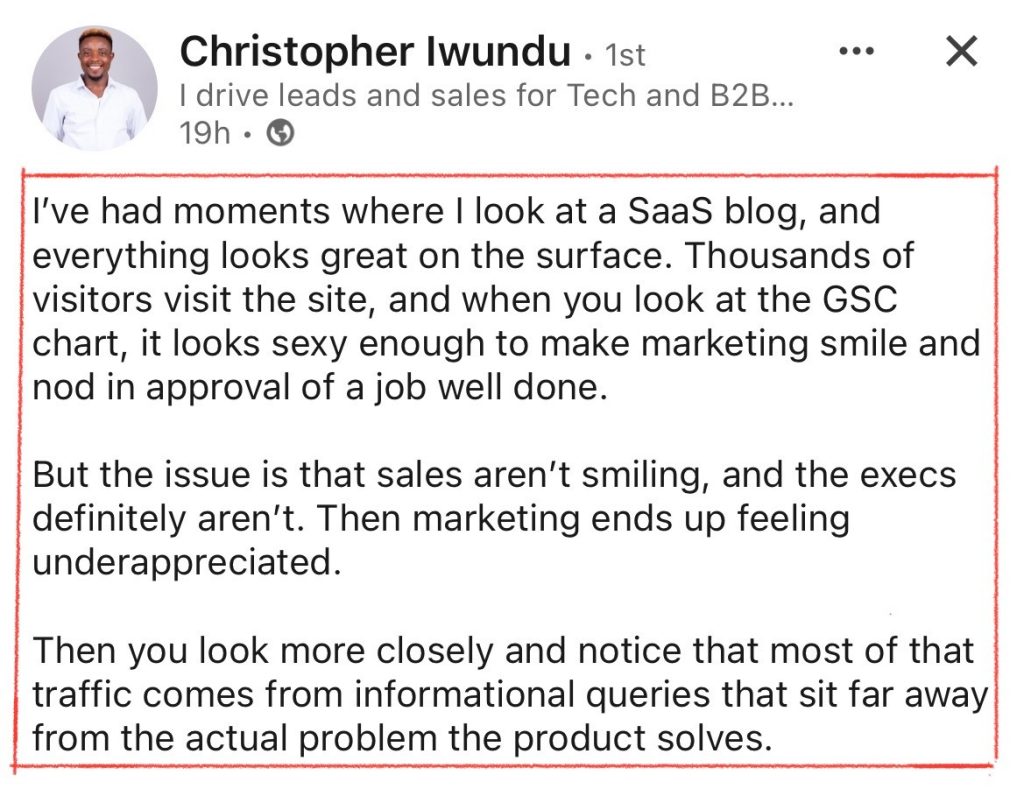
Christopher Iwundu, a content marketer for tech and B2B companies, described this pattern on LinkedIn recently.
He’s watched SaaS blogs pull in thousands of visitors with Google Search Console charts impressive enough to make marketing smile, and executives nod along. His summary: “The blog is growing, but the pipeline is barely reflecting that growth.”
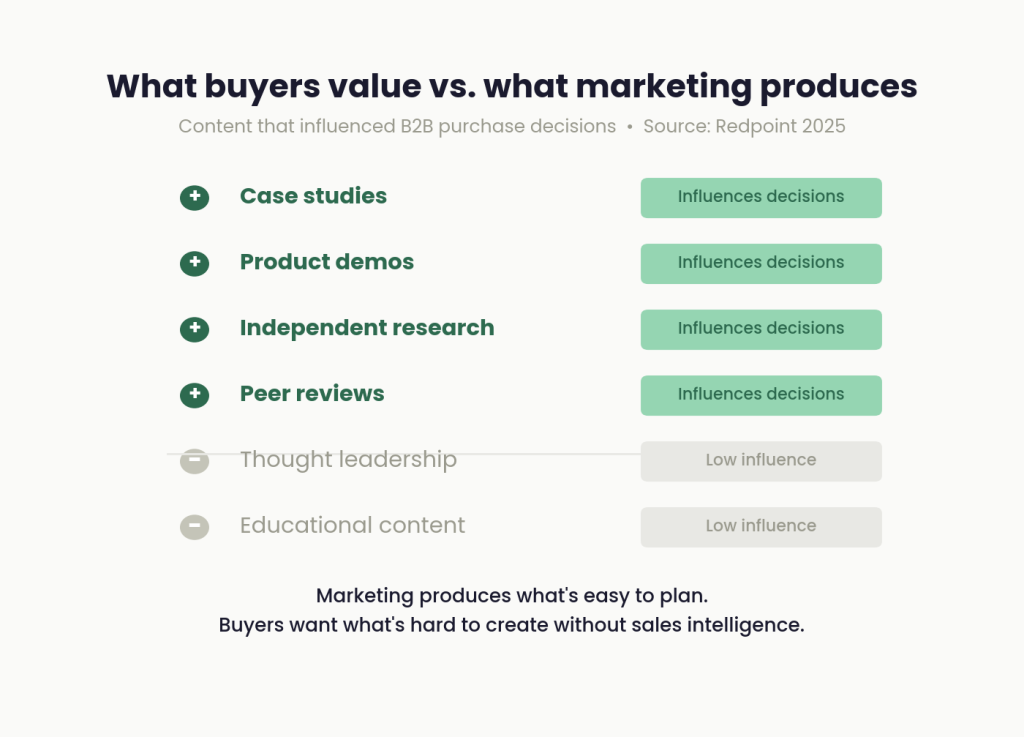
Redpoint’s 2025 research on B2B buyers backs this up. When they asked buyers what content actually influenced their purchase decisions, case studies, product demos, and independent research came out on top.
Thought leadership and educational content? Near the bottom. Marketing produces what’s easy to plan. But buyers want what’s hard to create without sales intelligence.
And the timing makes this worse. According to HubSpot’s State of Sales Report, 96% of prospects do their own research before ever speaking to a sales rep.
TrustRadius research from 2023 also found that 87% of B2B buyers prefer to complete that research before any sales contact.
Content built around the wrong concerns doesn’t just fail to help. It actively creates friction that the sales team then has to undo.
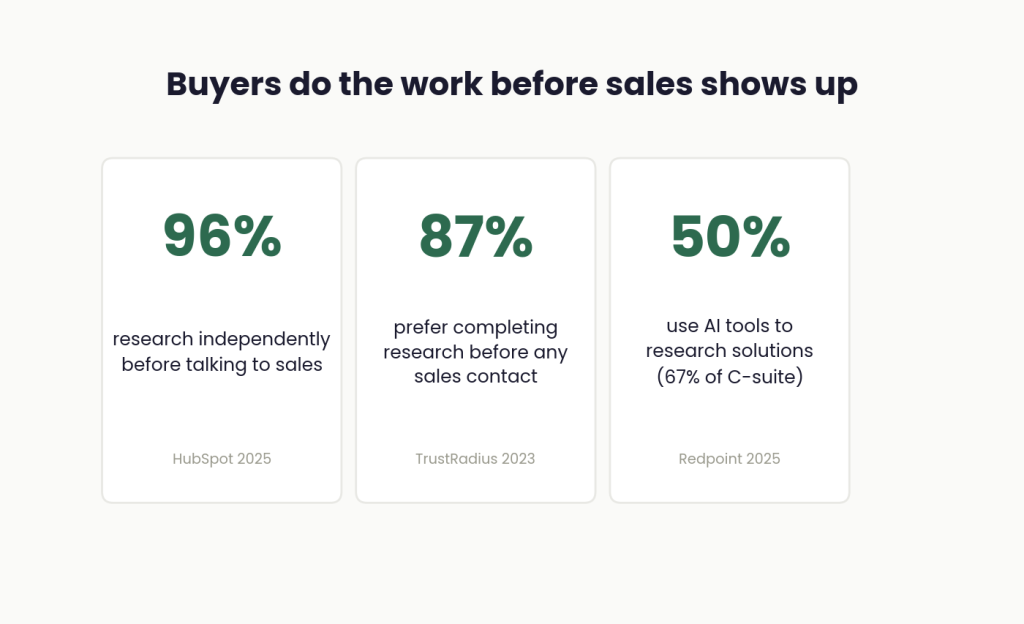
Redpoint’s research sharpens this further: 50% of B2B buyers now regularly use AI tools like ChatGPT and Perplexity to research solutions.
Among the C-suite, that number jumps to 67%. Buyers arrive at sales conversations with sharper, more specific questions than they had even a year ago.
Content built for general awareness answers the questions buyers had three weeks ago, not the ones they’re asking now. And that mismatch is one of the most common content marketing mistakes B2B teams make.
The objections that dominate deal conversations
If you want to understand what’s missing from most content strategies, look at what sales actually hears.
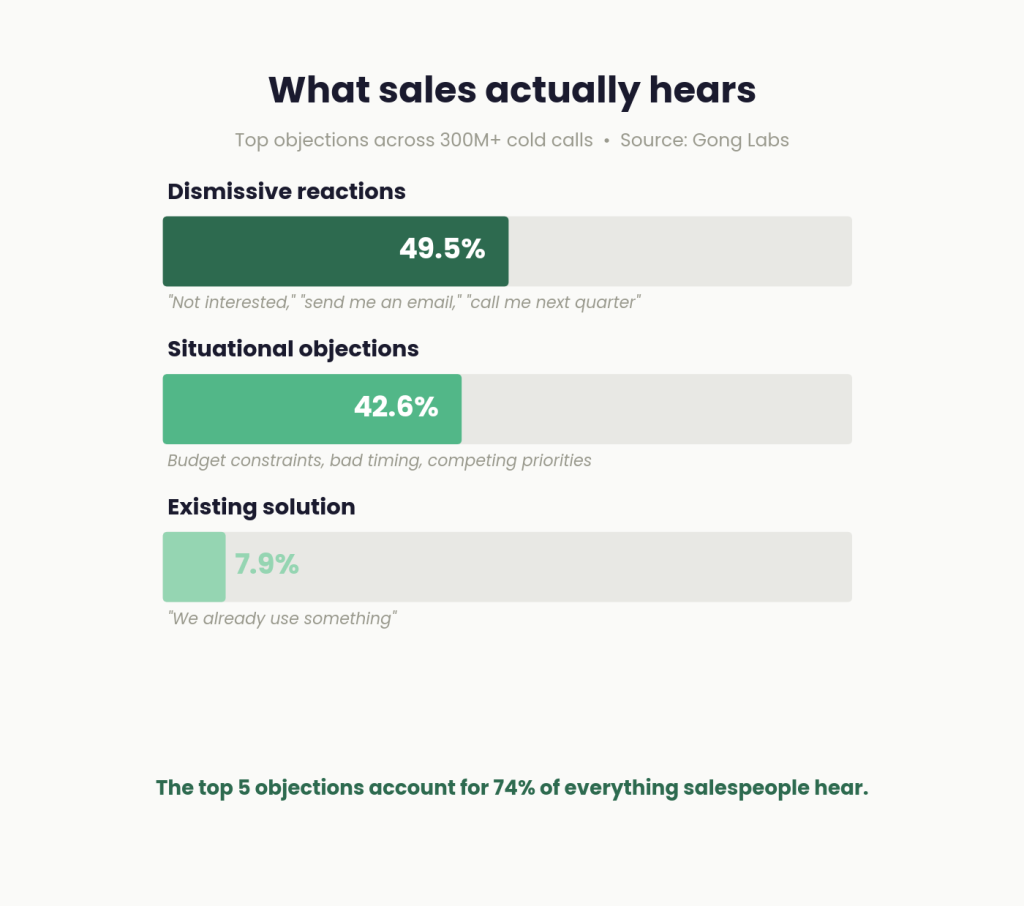
Gong Labs analyzed over 300 million sales calls, and what they found is worth your attention. The top five objections account for 74% of everything salespeople hear. That’s a surprisingly short list. But what’s actually on that list is even more interesting.
The single biggest category is dismissive gatekeeping: “not interested,” “send me an email,” “now isn’t a good time.”
These make up 49.5% of all objections.
But they aren’t substantive objections at all. They’re usually surface-level friction that hides the real concern they have underneath, and unfortunately, no amount of ROI content addresses them.
Situational objections (budget constraints, bad timing, competing priorities) account for 42.6%, and existing solution objections (“we already use something”) make up 7.9%.
Content strategies tend to write for a buyer, carefully weighing options and being open to persuasion. But sales is working with a buyer who often hasn’t admitted they have a problem yet, or who has decided they do but isn’t sure your solution solves it. That’s a completely different conversation, and it needs completely different content.
How sales intelligence changes what you write
So what does it look like when sales actually makes it into the content process?
The payoff for incorporating sales intelligence is beyond having better topics. Its specificity: content that addresses the exact question a buyer has at the exact moment in a deal when that question matters most.
Content gaps that sales conversations reveal
In practice, a content gap looks like this:
A B2B SaaS sales team consistently closing deals with companies migrating from HubSpot to Salesforce.
Good news, right? Except their website had zero content about that migration process.
Enterprise teams often surface patterns like this through sales intelligence platforms pulling from CRM data and call transcripts. But the same insight lives in a sales rep’s memory.
Every prospect going through that migration arrives with the same questions. Sales has answered them hundreds of times, but because nobody ever turned those answers into content, every new prospect still starts from zero.
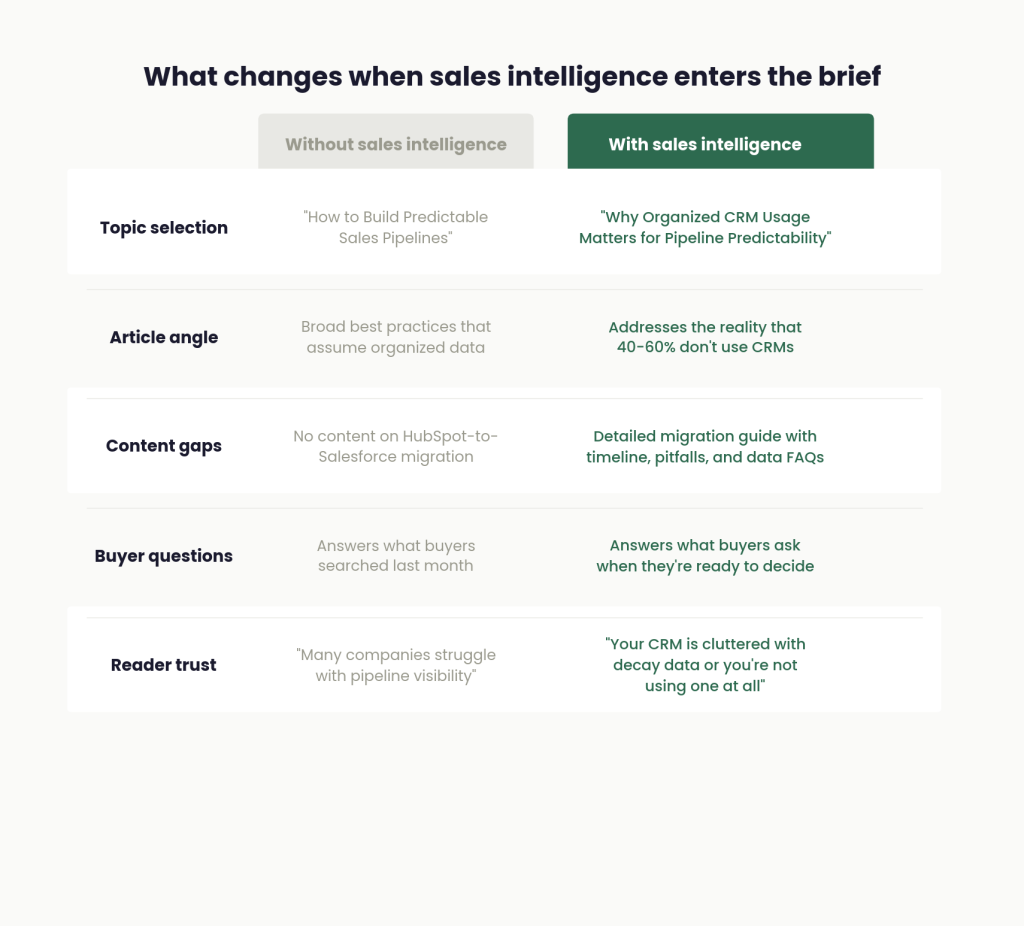
Once you know that pattern exists, the brief writes itself. A detailed guide covering the timeline, the common pitfalls, what to do with existing data, and the questions prospects are usually too hesitant to ask directly.
Sales starts sending it before every relevant call and conversation easily progresses from “can we even do this?” to “when do we start?” because the anxiety that was creating friction has already been answered on the page.
This is what an effective sales-led content strategy looks like in practice.
How a CRM stat reshaped an entire article
Damilare Olasinde saw this play out in his own work. While writing an article about building predictable sales pipelines, he learned something from an SME interview that changed the entire piece: many enterprise companies don’t actually use CRMs.
“CRMs can be outdated or cluttered with decay data when in some cases they are not even using a CRM,” he told me. “About 40% or 60% of enterprise customers that we encounter don’t use CRMs.”
That single insight reshaped everything about the article. The original angle assumed readers had organized data to work with.
Once Damilare understood that a significant percentage of his audience didn’t even have a CRM in place, the piece had to do different work. It couldn’t assume organized data. It had to make the case for why organized CRM usage matters in the first place, and then show how that connects to pipeline predictability.
As he explained: “If you’re an enterprise-sized business and you’re trying to have some predictability in your pipeline, using a CRM is one of the highest leverage things you can do. But unfortunately, it’s something that many businesses don’t do.”
Without that insight from a sales conversation, the article would have skipped the most important step: the one that actually matched the reader’s reality. It would have addressed a problem the audience doesn’t have yet while ignoring the one they do.
This is the kind of content advantage that SME insights bring to long-form writing, a level of specificity that keyword research alone can never surface.
Specificity builds trust
This connects to something broader about how readers decide whether to trust what they’re reading. When your content describes problems the way buyers actually experience them, readers recognize their situation immediately.
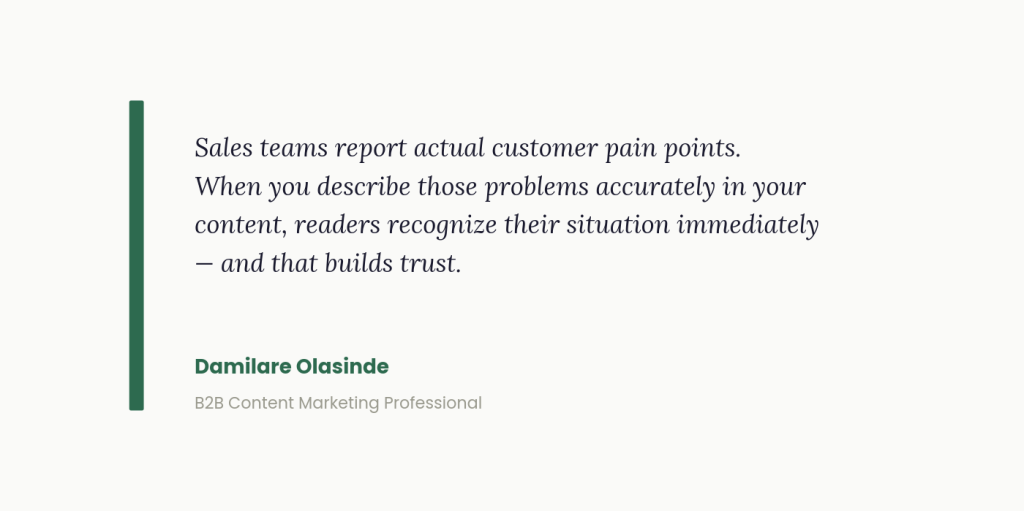
“Sales teams report actual customer pain points,” as Damilare put it. “When you describe those problems accurately in your content, readers recognize their situation immediately, and that builds trust.”
An article that says “many companies struggle with pipeline visibility” is generic.
An article that says “your CRM is either cluttered with decay data or you’re not using one at all, and either way, you can’t forecast accurately” speaks to something the reader has lived through. That accuracy signals that the writer understands their world, and makes them more likely to trust whatever solution the article proposes.
Articles that ignore this risk seem superficial. They offer advice for a version of the reader’s problem that doesn’t quite match reality, and readers can tell the difference.
Here’s what that shift looks like across the board:
How to extract sales intelligence systematically
Okay, so how do you actually get this intelligence?
Start by changing where content planning begins. Talk to a sales rep before the calendar gets built, and not a general “what do you need?” conversation, which tends to produce a wishlist of formats rather than useful intelligence.
Talking about deals, not content needs
Focus the conversation on deals: which ones are dying, where they’re dying, and what the prospect said when they walked away or made a purchase.
Lost deals are the richest source: You want the specific type of buyer, the stage the deal reached before it fell apart, and the language the prospect used when they said no. The more specific the rep gets, the closer you are to something you can actually write about.
Won deals are just as revealing: pay attention to what the prospect engaged with first. A case study labeled “late-stage” might turn out to be sent in the first prospecting email because it happens to address the exact pain point that opens conversations. These patterns tell you what content is already doing the work, and where the gaps are.
And pre-call misunderstandings (pricing confusion, onboarding complexity, feature limitations competitors exaggerate) point directly to content that could remove friction before a conversation even starts.
Where a misunderstanding sits in the sales process also tells you the funnel stage, which often reveals content gaps that the strategy hasn’t even considered.
Reaching account executives instead
In large companies, getting time with the head of sales can feel impossible. Damilare Olasinde’s advice is to skip that step entirely.
“In a large company, it may be difficult for you to reach your head of sales,” Damilare explained. “But it’s not difficult to reach an account executive. Because like you, they’re an individual contributor.”
The peer-to-peer dynamic matters. Because going from an individual contributor content writer to a sales VP means navigating hierarchy, scheduling barriers, and competing priorities. But going from one IC to another is just like asking a colleague for coffee.
Account executives speak with clients and prospects constantly. They hear the questions firsthand, they know the objections, and their intelligence is often more current and deal-specific than what a head of sales would share from a pipeline-level view.
If synchronous conversations are difficult, send a flexible question list that they can answer asynchronously. The format matters less than getting their direct input.
Customer success, call recordings, and communities
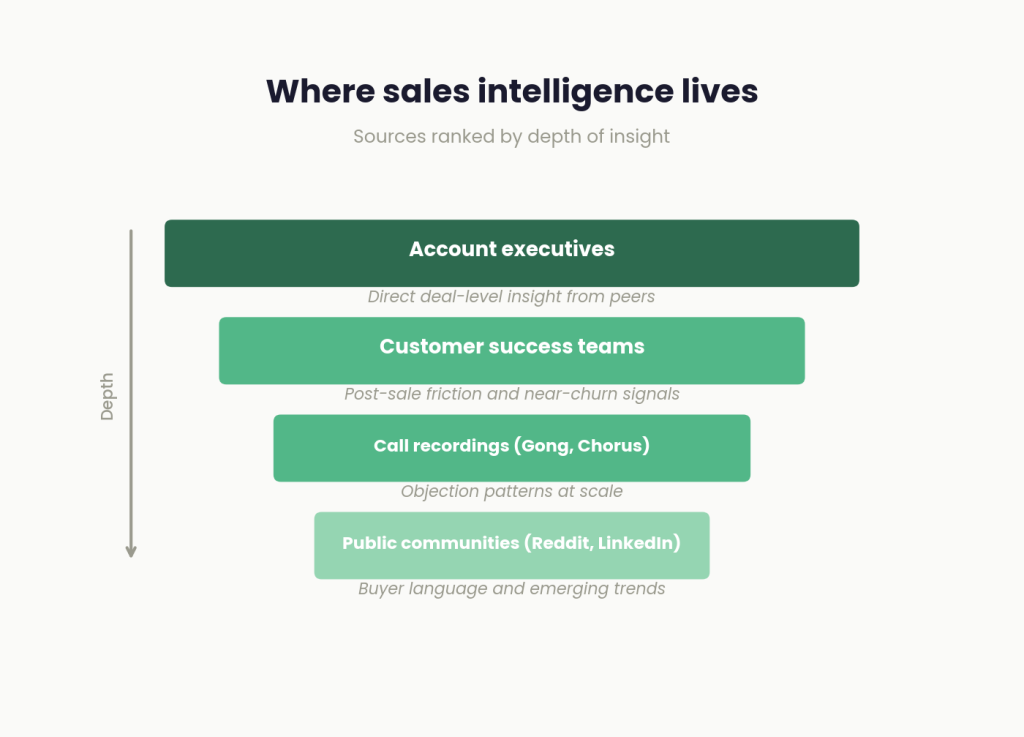
Customer success teams surface different but equally valuable intelligence. They collect ongoing client feedback and complaints that reveal what nearly made buyers walk away before purchasing. These insights complement sales perspectives and often uncover friction points that only become visible after the deal closes.
Call recording tools like Gong, Chorus, or Fathom hold sales intelligence at scale. Most companies record every sales call and use none of it for content. It’s one of the more striking inefficiencies in B2B marketing.
Public communities offer supplementary insights. Damilare noted this. Platforms like Reddit host authentic problem discussions that go deeper than review sites. LinkedIn groups, Slack communities, YouTube comments, and industry webinars reveal buyer language and emerging trends.
But these sources work best when combined with internal intelligence from sales and customer success. They rarely provide complete article angles on their own.
Why this gap persists (and how to close it)
The silo between content and sales isn’t accidental. The two functions have different definitions of success, different planning timelines, and different relationships with the buyer.
While content is measured on traffic, engagement, and leads, sales are measured on pipeline and revenue.
A piece that ranks well and drives traffic can therefore look like a win by every content metric while contributing nothing to the number of sales being held to.
CMI’s enterprise research puts a number on this: 61% of enterprise marketers say communicating across silos is their biggest non-creation challenge.
Michael Brenner, VP of thought leadership and customer stories at Workday, was also blunt about it in his article:
“Behind every bad piece of content is an executive who asked for it. Content strategies are either aligned to customers’ needs or internal executives’ whims.”
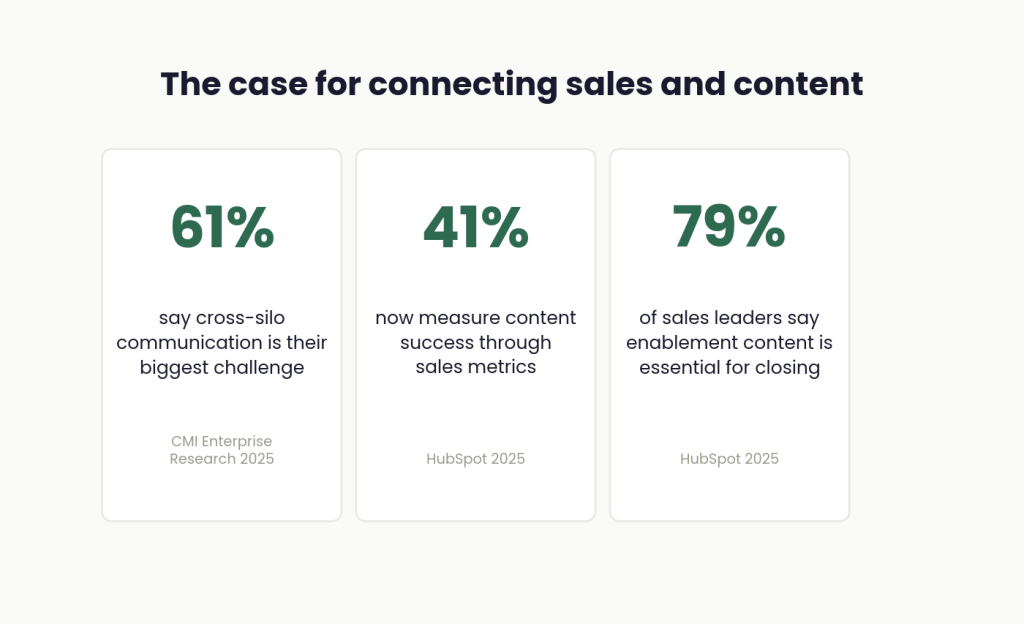
But the numbers are shifting. Over 41% of marketers now measure content success through sales, not traffic or rankings.
And 79% of sales leaders say enablement content is essential for closing deals.
Finding the right balance between traffic-driving content and deal-enabling content is the core challenge of SaaS content strategy, and sales intelligence is what tips that balance toward revenue.
Animalz has written about this gap before, and their experience is a good example of what changes when you close it.
Jimmy Daly, who ran both content and sales at Animalz simultaneously, described the shift bluntly: he spent nearly a decade working in content marketing without ever talking to a salesperson.
When he finally started handling sales calls himself, he realized the conversations he was having with prospects were completely different from the messaging on the blog.
An article like “What Is Content Marketing?” was perfectly useless in a sales setting. But an article about why venture-backed companies struggle with content marketing? That one he could send to a prospect who had just raised a round, addressing problems they were about to face but didn’t realize yet.
That’s bottom-of-funnel content built from sales intelligence, and it changed how Animalz approached their entire editorial calendar.
The broader pattern holds across B2B: bottom-of-funnel content (the kind that addresses deal-stage objections, product-specific concerns, and comparison questions) remains systematically underproduced.
Marketing keeps investing in awareness content because it’s easier to plan and it performs well on traffic metrics. Meanwhile, sales want content that actually helps move deals forward.
The brief that would connect both sides also rarely gets written, mostly because the intelligence needed to write it stays trapped in conversations that nobody from marketing is a part of.
How to close the gap
Closing this gap requires treating sales intelligence as a deliberate part of the content process. Include it in content planning the same way you include keyword research.
Build briefs from lost deal notes as naturally as you build them from competitor gap analysis. Measure content success by whether sales uses it, not just whether it ranks.
The intelligence already exists in every B2B company. You can find it in:
- The lost deal folder.
- The call recordings in Gong.
- The question a sales rep has answered from scratch repeatedly.
The first step is smaller than most teams expect. It takes one conversation with one account executive about one set of recent lost deals.
That conversation will surface patterns your keyword tools never could, and those patterns will change what your next content brief looks like. So start there.
Frequently asked questions (FAQs)
What is sales intelligence in B2B content strategy?
Sales intelligence refers to insights from direct prospect interactions, such as objections (“not interested,” budget issues), deal-stage questions, and recurring misunderstandings. Unlike marketing intelligence (keywords, competitor analysis), it reveals what buyers say right before deciding, shaping content that drives pipeline over traffic.
How does sales intelligence differ from marketing intelligence?
Marketing intelligence identifies what buyers search for and who to target, fueling top-of-funnel topics like guides and trends. Sales intelligence focuses on decision-stage friction—what prospects object to in calls — guiding bottom-of-funnel content like migration guides or objection handlers that close deals.
Why do most B2B content teams miss out on sales intelligence?
Silos persist due to differing metrics (traffic vs. revenue), planning timelines, and executive whims. Content fills calendars with awareness pieces that rank well but ignore deal-killing objections, as seen in Redpoint’s 2025 research where case studies outperform thought leadership.
What are the top sales objections content should address?
Gong Labs’ analysis of 300M+ calls shows 49.5% are dismissive (“not interested,” “bad timing”), 42.6% situational (budget, priorities), and 7.9% existing solutions. Content must preempt these with specificity, like guides on switching tools or handling timing constraints.
How does sales intelligence reshape content briefs?
It uncovers gaps, like missing migration guides for HubSpot-to-Salesforce switches. Start with lost/won deal patterns, buyer type, and stage; then craft targeted pieces (e.g., timelines, pitfalls) using real prospect language to build trust and move conversations forward.
How do you extract sales intelligence systematically?
Talk to account executives about recent lost deals—what prospects said, at what stage. Review CRM notes, Gong/Chorus transcripts, or customer success feedback. Skip vague “what content do you need?” questions; focus on “why did this deal die?” for actionable insights.
How often should content teams connect with sales?
Minimum: quarterly before calendars. Ideal: monthly lost-deal reviews, weekly sales meeting attendance, and ad-hoc chats. Small teams can use founders’ notes; large ones prioritize AEs over VPs for peer access.
What if sales won’t share insights?
Approach individual contributors (e.g., AEs) as peers over leadership. Send async question lists on lost deals. Supplement with customer success, call tools, or communities like Reddit—but internal sales data is richest.
Which content types benefit most from sales intelligence?
Bottom-funnel shines: comparisons, migrations, implementation guides. Middle-funnel (use cases, frameworks) improves too. Awareness content stays traffic-focused; sales intel tips the balance toward pipeline-driving pieces.
Can non-sales teams or small companies use this?
Absolutely — founders, account managers, or customer success hold the same goldmine. One conversation on lost patterns (e.g., CRM decay) can reshape briefs, as Damilare Olasinde did for pipeline articles.