


TL;DR:

Gated content fails when it’s used as a default lead-gen gate on early, educational content, but it works when it’s used selectively for truly premium assets that buyers already trust you enough to trade something for. Read this article to see real case studies and my thoughts on how gated content can harm your brand and what marketers are doing instead.
You decide to generate leads for your B2B product using gated content.
Not just that, you think that the content you are offering is valuable enough that people will definitely engage after entering their real contact details.
So you prepare a form, put money on ads, and expect to get enough MQLs (marketing qualified leads), which will help you multiply the ROI by converting them.
But what happens instead? Each lead (mostly fake) costs you hundreds of dollars, and nothing happens as you planned.
And you don’t just lose money, but the opportunity and brand trust.
I have studied such cases, and in this article, we will discuss what works and what does not in the current market, where buyers are actually making decisions and what marketers are doing instead.
How gated content is quietly harming your brand?
Beyond losing leads, gated content quietly harms attention, trust, visibility, and the money you spend to generate quality leads. Let’s discuss each in detail.
The gate is turning away 97/100 visitors
Ex CMO at Blue Triangle, Chuck Moxley, explains that when he pulled the analytics for a single gated ebook, 3,400 people landed on the page, and exactly 3% of them filled out the form.
“We were actively preventing 97% of interested visitors from engaging with our content. So we ungated everything. Every ebook. Every guide. Every resource. All of it.”
— Chuck Moxley via LinkedIn post
A growth marketer explains a similar hurdle on Reddit and asks whether he should go for email-only offers.
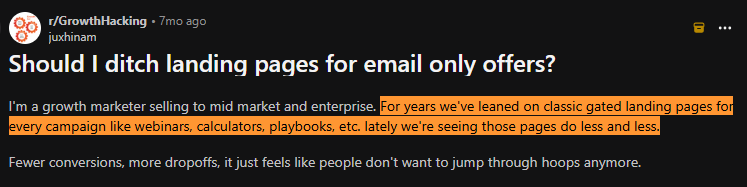
These experiences hint at how modern buyers behave. They want to access your valuable content without any friction.
They already gave you attention, which vanished with the gated content.
Half of the buyers enter fake data
Only 3% of 3,400 people landed on the ebook, promoted by Moxley. And half of them entered a fake email.
So, how do you know if they are really interested in your main offering or just want to access the content, that too for reading it later?
Look at such a real user’s POV on gated content in this Reddit post. Marketers generally label them as “interested buyers”.
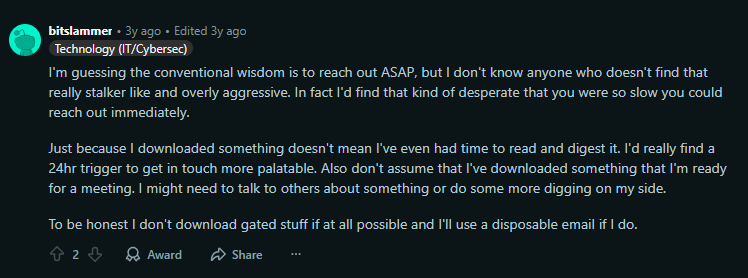
People are less likely to be interested if you somehow force them to trade their information in the awareness stage. At that stage, they look for more value to ensure that you are worth dealing with them.
The follow-up that comes after the form quietly breaks the brand
The Reddit post above indicates something similar.
And the headline of the 2023 Trust in Marketing Index states that 71% of B2B technology buyers are now disappointed in the value of gated content once they get it.
Even more than half of the users unsubscribe immediately after opting in, which makes nurturing difficult.
It happens because most users have already received flat content and unnecessary follow-ups from Sales Development Representatives after entering their email for such gated content.
Beyond just ruining trust for that particular signup, people distrust gated content in general. That eventually affects your marketing efforts, too.
This Reddit user’s statement clearly reflects that distrust.
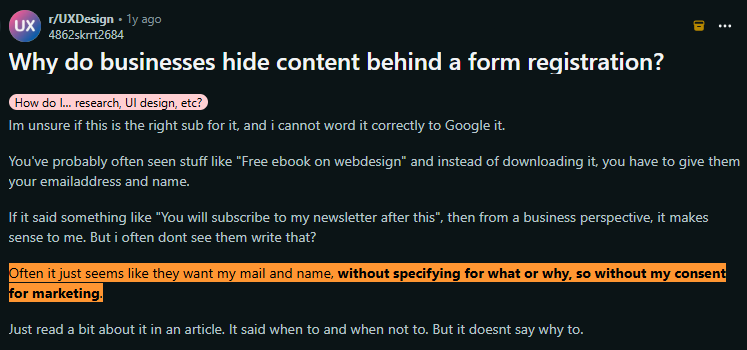
AI answering your buyer’s question struggles to read it
You know how much the search trend has changed.
But how much has your content strategy changed?
I have struggled to extract data from some articles because they were behind a paywall. What I used to do was refresh it and cut the page loading just before the gate loads. But even that doesn’t work all the time, I also tried to paste the link in GPT or Perplexity. They failed to fetch the data, too.
It is not that AI cannot fetch gated content’s data at all, but Proven Cite’s monitoring across 200+ brands shows ungated pages generate up to 3.2× more AI citations.
So, you do not have to stop producing valuable content, but have to optimise it as per the algorithm and search behaviour.
Where does gated content actually fit in the B2B buying journey?
Gated content rarely shapes the early journey. Most B2B buyers do their research elsewhere and only hit your forms after they’ve already made most of their decision.
So, they might not be going through the funnel you made with your team, but something you didn’t plan to or can not track.
I am not saying to stop creating educational guides and comparison content. They are important because they compound over time and maintain authority. What I’m saying is that using gated content as your default lead-gen engine fails when it’s placed at the wrong stage of the journey.
B2B buyers are very informed, and not normal consumers, who can be acquired with simple CTA’s or using someone’s template. Even Forrester’s Buyers’ Journey Survey, 2024, shows that 92% of B2B buyers already have at least one vendor in their mind before starting the buying journey.
That means, before consideration, they have already compared 5 alternatives of your product with the help of LLMs and review sites like G2 and Capterra.
Plus, you never know what they are discussing in their private buying communities on LinkedIn and Slack.
So, your gate isn’t creating demand but filtering who you’re allowed to talk to.
“By the time someone gates their email, they’ve already made 70% of their buying decision. You’re filtering OUT the people with budget and authority who won’t jump through hoops”
— B2B Content Marketer at Dapper, Linde Hasker, via LinkedIn post
How are B2B marketers using gated content now?
They are not completely removing gates but using them where needed, along with new tools, to get quality leads. They have started adapting to the current buyer behaviour and getting good results. Here’s what I learned:
Replace the gate with an invitation
When Moxley saw that people were entering fake data, he changed his approach from gating content to just putting a simple form at the bottom of the content asking, “Want this emailed to you?”
And the result? He said:
“Hundreds of people filled it out, and every single email address was real. Because they actually wanted the content.
The old playbook says gate your content to generate leads. But leads aren’t revenue. And forms that generate leads with fake emails aren’t generating any value.
Sometimes addition comes from subtraction.”
But this will only work if your content is valuable. And that also doesn’t guarantee that people will read it immediately or just keep it in their email for later.
Anyways, this is a relevant tactic for pulling out quality leads in 2026. It is close to the tag “interested buyers” because they have entered their details after accessing your content.
Replace the gate with visitor ID and intent data
This is already happening.
You do not have to think about who is reading your content. Today, some tools like Clearbit and RB2B can identify people and companies visiting your site and turn your pageviews into a pipeline.
Over 100,000 websites already use RB2B for the same.
This is what your approach should look like.
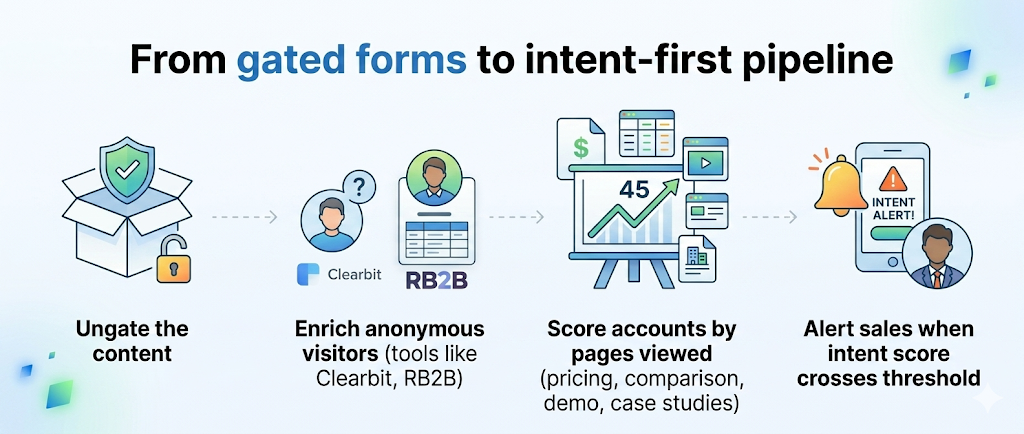
But here is also a game. Just like some buyers use fake emails to access the gated content, they also use an anonymous ID to surf comparison and pricing pages.
Eventually, some visitors will always slip through, but you still gain a far better signal than from gated forms.
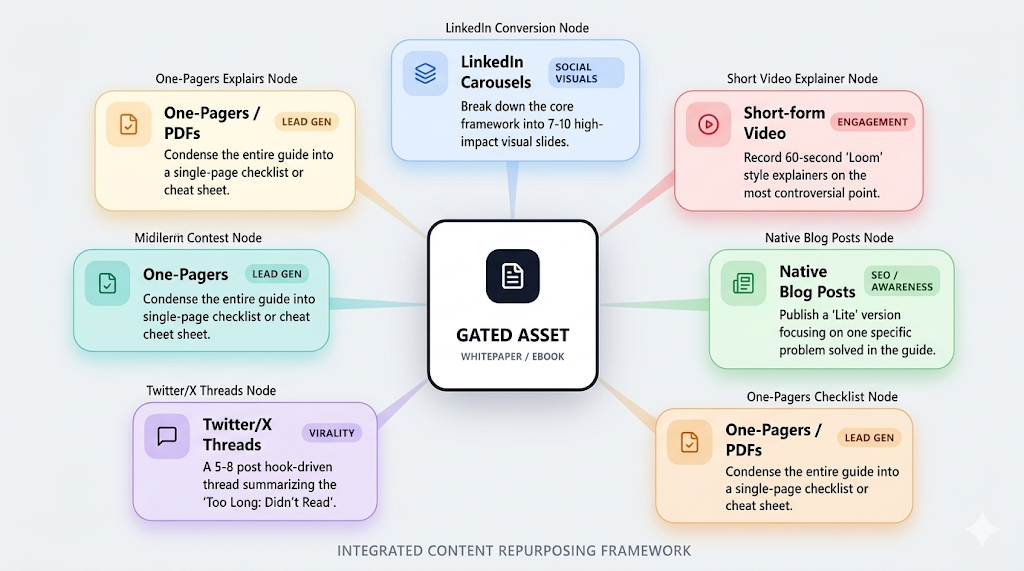
Atomise the long-form asset so it can actually travel
If you keep the strategies aside for a while and look at your real goal.
Everyone knows that you have put some or all of your content behind the form to generate leads.
You run ads to promote them and use those leads to market your product to them in the name of value. Ok fine.
But why do you do this? Obviously, to convert them and increase sales and revenue, right?
Just know that gated content is only one part of achieving your goal. It is not like classic whitepapers or ebooks don’t work, but as a reference.
So, slice them into various formats for multiple platforms.
Gate the thing a buyer would pay to receive
Do it rarely and only when the content is unambiguously worth the trade.
For example, see this report from Forrester on B2B Buyer Adoption of Generative AI.
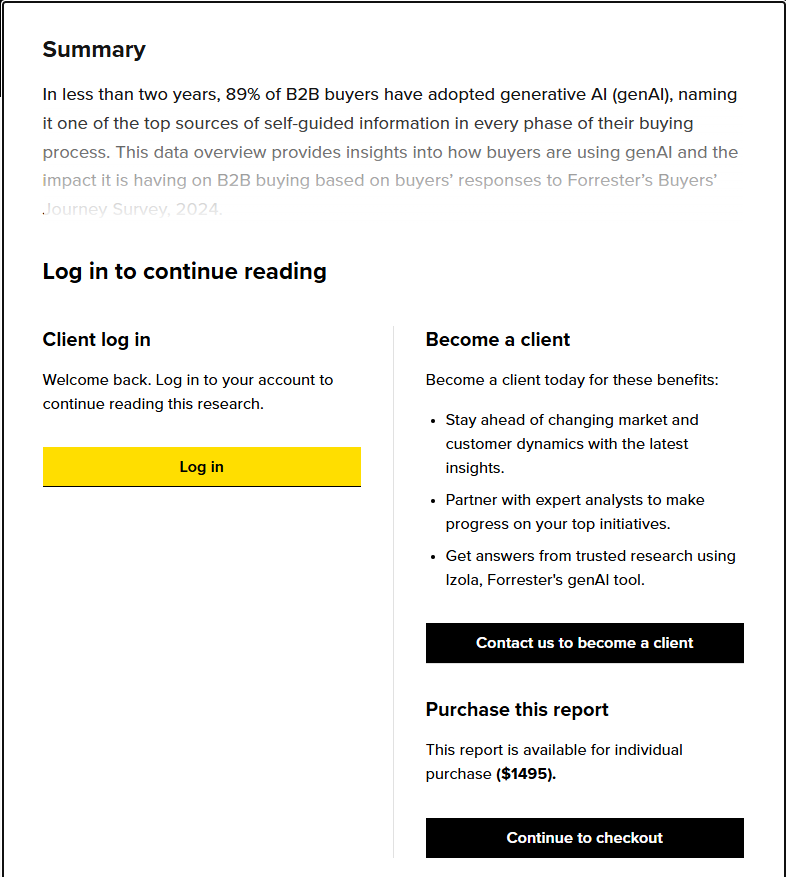
See how much they are charging for it? A freaking $1495.
And it works for their target audience because they have already built an authority in research and consultancy for organisations. So, there is already a context for why someone should pay for it.
Understand it like this:
- Don’t gate: basic guides, top-of-funnel education, and ebooks used as lead magnets.
- Do gate/charge: research-grade reports, proprietary benchmarks, deep industry data.
You can do it with your content too. First, build authority by providing real value and partnering with experts. Just like a B2B SaaS company will hire me if they want to build authority and resources with product-led content.
My Final Thoughts
I personally download gated content. I’ve done it many times.
But what I’ve realised is how a content creator or marketer convinces me to do so.
I’m not a B2B buyer, but I’ve studied them as a marketer and writer. And honestly, they want to be convinced, but not everything is convincing enough to them.
Marketers who successfully convince always learn to adapt and maintain a balance between what’s new and what has been working for a long time. The idea isn’t to completely avoid data walls or forms, but to understand the stage your audience is in.
Generally, I’ve seen marketers avoid putting forms at the beginning, the awareness stage. They use it as a chance to prove themselves first.
In the end, it comes down to this:
You have to give your audience value and reasons strong enough that the desire to access the gated content outweighs the resistance to sharing their contact details.
Frequently asked questions (FAQs)
Why does gated content fail for many B2B brands?
Gated content often fails when it’s used too early in the buyer journey, especially for educational assets that buyers expect to access freely. It creates friction, lowers trust, and usually filters out more interested visitors than it captures.
When does gated content actually work?
It works best when the asset is genuinely premium and high-value, such as proprietary research, deep industry benchmarks, or reports people are willing to trade their details for. In those cases, the gate feels like a fair exchange rather than a barrier.
Why do buyers enter fake information in forms?
Many buyers want the content but don’t want the follow-up, especially from sales. Fake data is often their way of accessing the asset without committing to a sales conversation.
How does gated content affect brand trust?
If people feel forced to give contact details before they can judge value, trust drops fast. A poor gated experience can make buyers skeptical of your content across the board, not just that one asset.
Does gated content hurt SEO and visibility?
Yes, it can. Ungated content is easier for search engines and AI systems to access, cite, and surface, while gated pages limit visibility and reduce discoverability.
Where should gated content sit in the buyer journey?
Gated content performs better later in the journey, when buyers already trust the brand and see clear value in the asset. It is usually a weak fit for awareness-stage educational content.
What is the better alternative to gating early-stage content?
A better approach is to ungate the main content and use softer conversion methods, such as an invitation to receive it by email, visitor intent data, or content atomization for distribution across channels.
How can marketers use gated content without hurting performance?
Use gates selectively, not by default. Reserve them for assets that are truly worth exchanging contact details for, and make sure the surrounding brand experience supports that value.
What kind of content should never be gated?
Basic guides, top-of-funnel educational posts, and standard ebooks used only as lead magnets usually should stay ungated. These pieces build trust and authority better when they are easy to access.