

“Isn’t it interesting that the same marketers that dedicate their first 60+ days at a new job to learning about the product hire writers and expect them to produce brand-centric and insightful content with just a title and a miserly brief?”
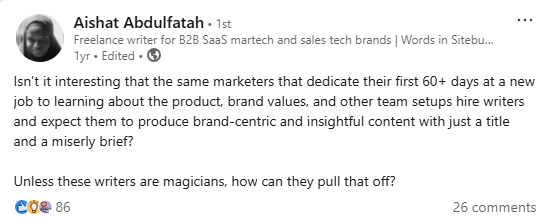
Aishat Abdulfatah is not alone in thinking this. Across LinkedIn, Reddit, and private Slack communities, freelance writers are saying the same things just in different words, with different experiences, but arriving at the same frustration.
Hiring a freelance writer is easy. Getting great content from them is a different story, and more often than not, the gap between the two has nothing to do with the writer’s talent.
To find out what actually makes the difference. I reached out to 11 freelance B2B SaaS writers, including content marketers, strategists, and specialists with experience writing for brands like Zapier, Sprout Social, Jotform, Sitebulb, and ClickUp, and asked them one question:
“What do you wish B2B SaaS brands knew before hiring you?”
What came back was a collection of honest, practical truths that, if taken seriously, can completely change the quality of content you get.
Six things B2B SaaS brands get wrong
Across all the conversations, six patterns kept surfacing. Specific, recurring gaps between what brands assume and what writers actually need. Here’s what they were, in the writers’ own words.
1. Vague briefs with no clear direction
Brands spend months defining their product, days crafting their pitch deck, but then they hand a writer a title and three keywords and wonder why the content feels flat.
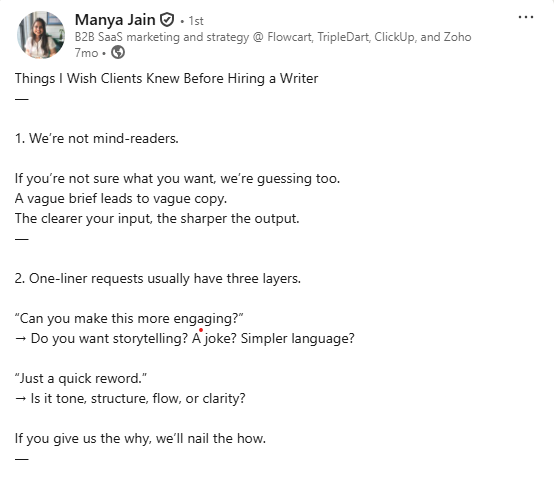
This is something Manya Jain, a B2B SaaS marketing strategist at ClickUp and TripleDart, addressed in the LinkedIn post above — a vague brief leads to vague copy, and the clearer your input, the sharper the output. It’s that simple, but most brands still get it wrong.
This matters more than most brands realise. B2B buyers are nearly 70% through their purchase process before they ever engage with sales, which means your content is doing the selling long before your sales team gets involved. Generic, surface-level content hands the shortlist to your competitor.
Yet one of the most common mistakes B2B SaaS brands make is assuming a brief is enough context for a writer to deliver their best work. And this isn’t just a writer’s frustration. Grow and Convert, a SaaS content marketing agency, points out that because most brands focus on top-of-funnel topics that aren’t closely tied to their product, they see no need to arm writers with deeper product knowledge, and the result is long-form content that looks and reads like everything else already out there.
Sylvia Uzochukwu, an SEO content writer for B2B SaaS brands, describes a pattern she’s seen repeatedly:
“They’ll say something like: Look at what we have produced and take note of our voice and don’t repeat what we’ve written. They just assume the writer will figure it out by looking at their website, which is not so. It’s very vague, and it leaves the writer in the middle of nowhere.”
And when a writer is in the middle of nowhere, so is your content. What writers actually need goes deeper than a brief. As Sylvia puts it:
“The best freelance writers are those who have insight into the whole strategy of the brand, which includes their ICP, what they’ve done, what they’re aiming at, pipeline, and even flaws. It helps the writer know how to angle their content.”
Stella Inabo, a content and growth strategist, explains why this matters so much for conversion:
“Giving writers a topic and keywords is not enough if you want articles that convert. They need to understand what they are selling and who they are selling it to. If I know my audience is project managers struggling to run efficient projects because they can’t see where their team’s time is spent, I know exactly what they are going through and can be specific about their situation and the solutions the product offers. Often that specificity makes all the difference in the world.”
And that’s ultimately what product-led content is built on.
According to Nathan Ojaokomo, a freelance content writer for HubSpot and Softr,
“Many share a brief and call it a day. Today’s content needs to be more differentiated. For that to happen, writers need as much context and information about a product and its audience as possible.”
The brief gets the writer started, but context is what gets the content right.
2. Underestimate research time
There’s an assumption many B2B SaaS brands carry into content engagements that writing is the bulk of the work. Sorry to break it to you, but it isn’t. Writing is actually the last thing that happens. Before a single word goes on the page, a writer is going through product documentation, studying competitors, pulling customer reviews, understanding the category, and finding the angle that makes the piece worth reading in the first place.
That takes time. More than most brands budget for.
According to Divya Sharma, a freelance B2B SaaS content writer:
“Good SaaS content takes real research, which includes going through documentation, competitor pages, user reviews, and understanding the category deeply. Sometimes expectations are strategic and detailed, but the compensation reflects quick blog writing. That gap can be challenging.”
And it doesn’t stop at research. There’s another gap brands rarely acknowledge: scope. Divya explains:
“Sometimes brands expect both strategy and execution within the same scope — topic ideation, keyword research, positioning input, and writing, without clearly defining that upfront. In SaaS, clarity on scope and expectations makes a big difference.”
A writer who doesn’t know strategy is expected to deliver it. A writer who delivers it without being compensated for it won’t do it twice.
As Divya puts it:
“The more context and alignment a brand provides, the stronger the content becomes.”
Slow content isn’t a writer dragging their feet. It’s a writer doing the job properly. And a scope that isn’t defined upfront isn’t just unfair, it is actually a setup for disappointment on both sides.
3. Expect polished work without proper onboarding
When Aishat Abdulfatah was writing a piece on crawl budget optimization for Sitebulb, their content manager didn’t just send a brief and wait. She connected Aishat with three real customers who were happy to share how they actually use the product. For another piece, she provided a multi-expert podcast as a research starting point. Aishat was never left guessing what angle to take; everything she needed to write with confidence was already there.
They also gave her access to the product itself, like actual access, so she could simulate the process she was writing about and capture real screenshots from inside the tool. The result was content written from a user’s perspective.
That’s the difference onboarding makes. Aishat documented the whole experience on LinkedIn, and it’s worth reading in full.
Here’s what makes poor onboarding so persistent: it will shock you to know that it’s not always negligence. Aishat points to something she calls the knowledge gap. Content managers have been living with the brand for so long that they forget what it felt like to know nothing about it. They assume the writer already understands the product, the audience, and the tone, all because to them, it should be obvious. But the writer is walking in on day one.
Her suggestion for content managers is simple but powerful — think back to your first 30 or 45 days. You needed documentation, context, access, and time to understand the brand properly. Your freelance writers need the same. Why are you just giving them a keyword and a vague brief? Why aren’t you connecting them with experts? Why aren’t you giving them access to the product, even if it’s just a trial?
Juliet John, who has written for Zapier, Sprout Social, and Jotform, describes a similar experience with her best clients. One of them routinely covers subscription fees for tools she needs to review, just so she can get inside them and write from an informed place.
“The best clients I’ve worked with and some of my best work have been with clients who give me access to the product and other relevant resources. Share buyer persona info where necessary, give access to sales calls, customer feedback, and beta features. One of my clients covers subscription fees for other platforms whenever I have to write comparison, alternative, or roundup posts — just to ensure that I can get into the tools, understand how they work, and write from an informed place. Proper onboarding is the foundation for solid work and effortless collaboration between a freelance writer and a client.”
Nathan Ojaokomo is equally specific about what that access should look like:
“Writers would typically need access to the tool to understand how it works, get call transcripts to know what problems the audience faces, and how they describe their problem.”
That’s the level of context that turns good content into great content. When a writer has all of that, the content shows it. When they don’t, that shows too.
4. Clear, constructive feedback changes everything
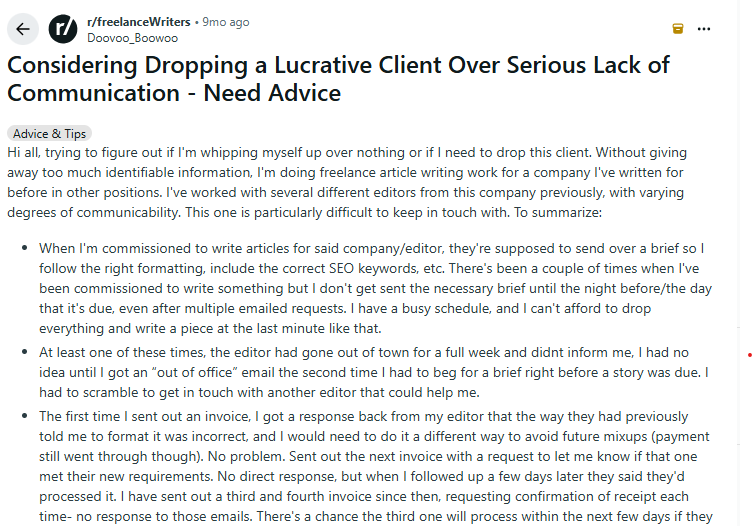
A writer on Reddit shared how they had been commissioned to write articles for a company, but the brief wouldn’t arrive until the night before the deadline, despite multiple requests. Their editor disappeared for a full week without any notice.
Invoices went unacknowledged. Days of complete radio silence followed every submission. They were considering dropping the client despite the pay being good. The comments section was full of writers who recognized the situation immediately.
The cost of poor communication is that brands lose good writers.
And yet feedback and communication are the parts most brands put the least thought into. There’s a big difference between a brand that says “this isn’t quite right” and one that says “the intro needs a stronger hook, the transition into the second point is abrupt, and the conclusion should give the reader a clear next step.”
According to Oyinkansola E., a content marketer and freelance writer for SaaS and fintech brands:
“I wish they knew just how important clear and constructive feedback is. Not subtle signals, non-verbal cues, or forgettable messages dropped in passing. Actual, specific, honest, and intentional but kind criticism.”
She speaks from experience. The most growth she experienced as a writer came from a brand that got feedback right. Here’s what that looked like in practice:
“How to structure my intros better — hook, transition, and clear thesis to set the stage for the rest of the article, the concept of chronologically ordered articles for readability and seamless flow, steps and tools for SEO optimization, and the importance of a conclusion that doesn’t merely summarize the piece but actually gives the reader a clear next step.”
Those lessons directly improved the quality and ranking of her work.
And it’s not just about the quality of feedback, it’s about the person giving it. Masroor Ahmad, a B2B SaaS writer and founder of h1copy, simply puts it:
“A kind content lead/editor who is available and responds quickly.”
It sounds basic, but the absence of it is one of the most common reasons good writers walk away.
5. Withhold strategic context
A brief tells a writer what to write. A strategy tells them why it matters, and that difference changes everything about how the content gets made.
“Experienced writers understand how content marketing works, and simply knowing which stage of the funnel a piece belongs to isn’t enough. What’s often missing is context. I’d love SaaS brands to clearly communicate their expectations for the piece — what role it plays in the broader strategy, how it will be distributed, and what success looks like.”
The questions he wishes brands would answer before work begins say it all:
“Is the goal to drive product signups or just educate the audience? Is this meant to rank for a high-intent keyword or build topical authority? Is there a specific objection this piece should help overcome? Is this targeting founders, marketers, developers, or procurement teams? How is content marketing looking for the next 6 months? Don’t just tell me about this specific content piece, give me an overview, as if you hired me as your marketer.”
That last line captures something most brands get wrong. They hire writers to execute, but withhold the strategic context that would make that execution genuinely effective. A writer who understands the full picture becomes an extension of your marketing team, and the content they produce reflects exactly that.
6. Writers are left to figure it out on their own
Throughout this article, you’ve heard from individual writers sharing their experiences. But it’s worth stepping back for a moment to acknowledge that these aren’t isolated incidents. They’re symptoms of a much wider gap between how brands think about hiring writers and what writers actually need to do their best work.
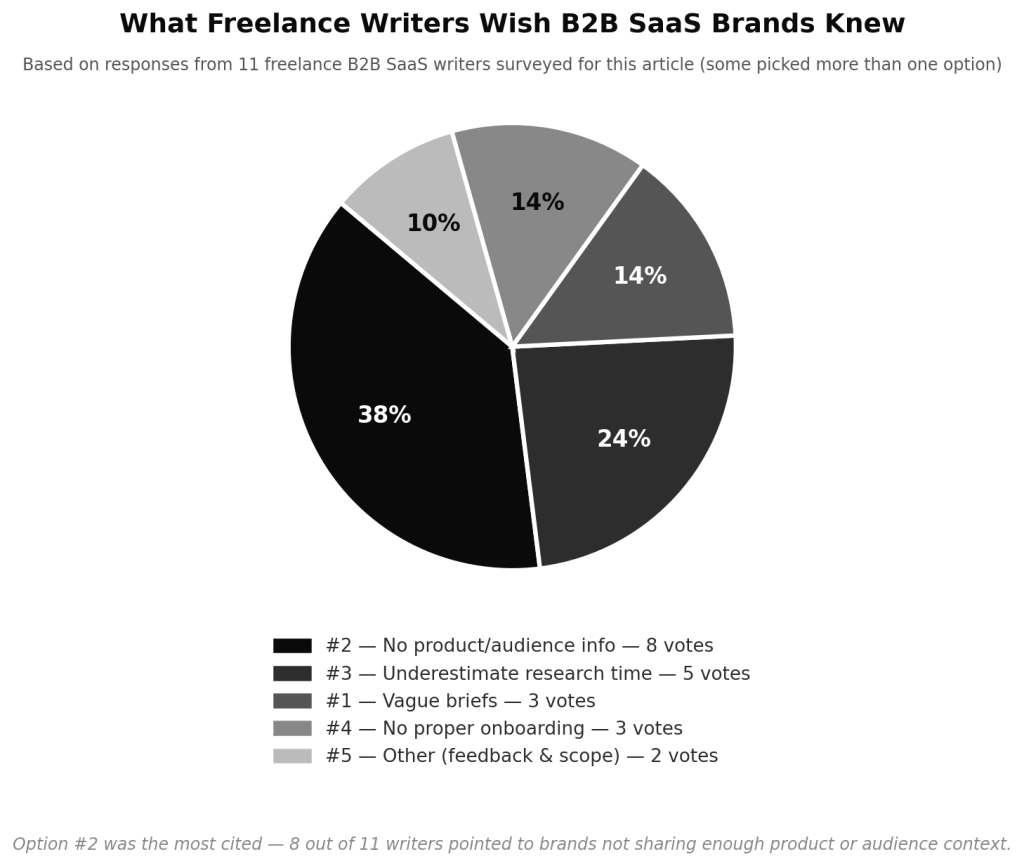
Out of 11 freelance B2B SaaS writers surveyed for this article, the pattern was impossible to ignore. 7 pointed to the same root cause — brands not sharing enough about their product or audience. According to Oluwaseun Akinlembola, a freelance SaaS content writer with experience working with several B2B SaaS brands,
“This is the everyday case of most writers.”
Peace Akinwale, a B2B SaaS content marketer, illustrates exactly what that looks like in practice.
“What feels closer to me is the lack of knowledge about their product and audience. It’s what I’ve had to figure out over time, especially when I’m onboarding a new client. I rely on their product pages and support or help docs to know how each feature works and who it’s for. Some have detailed product documentation, though, but it’s still not as straightforward for a writer who wants to ingest the most relevant use cases for an article they’re writing about.”
And when he asks brands directly for help, the response is rarely specific:
“When I ask specific questions about the product related to my article, they typically just refer to the documentation. Not specific docs or titles that tell me what I need about the article I’m writing. The way around it is to search for relevant keywords in their product docs, and I get what I need. I also find a lot of context in their help/support content.”
The fact that experienced writers have developed workarounds for gaps that brands could easily close says everything. These aren’t lazy writers looking for shortcuts; they’re skilled professionals doing extra unpaid work just to get to the starting line.
The good news is that none of this is hard to fix. It just requires brands to be intentional about how they bring writers in and what they hand them when they do.
How to be the client every writer wants to work with
Everything covered in this article points to one truth: great content doesn’t start with a great writer. It starts with a brand that sets that writer up to succeed. Here’s what that looks like:
Share more than a brief
Before work begins, give your writer the full picture, and that includes your ICP, your product positioning, what has been tried before, and where the brand has fallen short. Point them to the specific documentation, case studies, and competitor insights most relevant to the piece. If you’re not sure what a truly useful content brief looks like, Backlinko’s step-by-step guide is a great place to start.
Give them access to your product
If you want content written from a user’s perspective, give your writer the same access a user would have. A product demo, a free account, or even a recorded walkthrough goes a long way. The difference between a writer who has used your product and one who hasn’t shows up in every sentence, and it’s exactly what makes product-led content work.
Share the bigger strategy
Don’t just brief writers on individual pieces; give them an overview of where content fits in the broader marketing strategy. What are you trying to achieve in the next six months? How will this piece be distributed? What does success look like? A writer who understands the strategy produces content that serves it. If you’re making common content marketing mistakes, this is likely one of them.
Define the scope clearly and upfront
If you need keyword research, topic ideation, or positioning input in addition to writing, say so before work begins. Bundling strategy and execution into the same scope without acknowledging it creates frustration on both sides and produces worse content.
Give specific, constructive feedback
Vague feedback produces vague revisions. When something isn’t working, say exactly what and why. Be available, be responsive, and treat feedback as a conversation — not a verdict.
So what does good feedback actually look like in practice? ContentWriters article breaks it down clearly:
- Be specific and point to the exact passage that needs work
- Show rather than just tell by using track changes to demonstrate what you mean
- Keep communication timely and consistent, and always keep it professional.
Instead of “the tone is all wrong, fix it,” try “this wouldn’t resonate with our audience, let’s make it more casual. Small shifts in how feedback is delivered make an enormous difference in what comes back.
And the numbers back this up; according to a ContentWriters LinkedIn poll, 68% of freelance writers only allow 1-2 rounds of revisions.
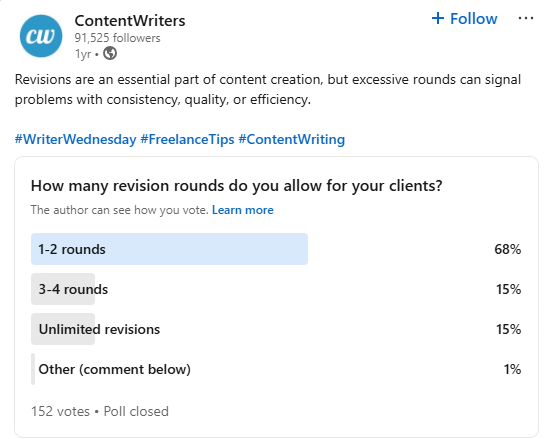
Image: ContentWriters LinkedIn poll
Vague feedback doesn’t just frustrate writers; it also burns through your revision allowance before the piece is anywhere near where it needs to be.
Build a proper onboarding process
Have a checklist ready for every new writer you bring on. Style guide, brand voice guidelines, buyer personas, product knowledge base, relevant blog posts, recorded walkthroughs, positioning documents; share everything upfront. The time you invest in onboarding pays back in every draft.
You hired the writer. Now do your part
The best freelance writers are not waiting for a perfect brief; they are resourceful, adaptable, and skilled enough to work with what they have. But resourcefulness has a ceiling, and the brands that consistently get exceptional content aren’t the ones that found exceptionally resourceful writers. They’re the ones who made it easy for any skilled writer to do exceptional work.
And if you’re a B2B SaaS brand that would rather hand this off entirely, h1copy works with B2B SaaS brands to produce product-led, conversion-focused content, and their ghostwriting services mean you get the content without having to manage the process yourself.
Frequently asked questions (FAQs)
What’s the difference between briefing a writer and briefing a marketer?
When you brief a marketer, you share the full strategy — the goals, the audience, the distribution plan, and how the piece fits into the bigger picture. When most brands brief a writer, they share only the topic, keywords, and word count. The closer your writer’s brief resembles a marketer’s brief, the better the output.
When should I hire a freelance writer vs a content agency?
How do I build a long-term relationship with a freelance writer?
Give them proper onboarding, share honest feedback, and pay on time. If the first piece goes well, tell them. Offer consistent work and include them in strategic conversations where relevant. Long-term relationships produce better content because the writer stops learning your brand and starts knowing it.
How does AI affect working with freelance writers in 2026?
The fundamentals haven’t changed. The best writers use AI to accelerate research and polish sentences, but the original thinking, the product insight, and the human judgment that make content resonate still come from the writer. A writer given proper context and clear feedback will always outperform one who isn’t, regardless of what tools they use.
What should be in a freelance writer’s contract?
A solid contract should cover the scope of work, payment terms, number of revision rounds, deadlines, content ownership, and a kill fee if the project is cancelled after work has begun. Defining these things upfront removes the ambiguity that leads to frustration on both sides.
Should I use AI to generate content instead of hiring a freelance writer?
AI can help with research, outlines, and polishing sentences, but it can’t replace the product insight, strategic thinking, and human judgment that make B2B SaaS content actually convert. The brands getting the most out of AI are using it as an accelerator, not a replacement. If you’re wondering exactly where to draw that line, this piece from h1copy breaks it down clearly through the voices of 13 SaaS marketers who shared how they use AI, and where they refuse to let it in.
How do I maintain consistency when working with multiple freelance writers?
Start with a comprehensive style guide that covers brand voice, tone, formatting preferences, and examples of content you love. Pair it with a detailed brief template so every writer starts from the same foundation. The more standardised your onboarding process, the more consistent your content will be, regardless of who writes it.