

You spend 2-3 hours every week crafting a thoughtful LinkedIn post, rewriting the hook five times, second-guessing the structure, and wondering if it’s even worth posting.
Not to mention running a 15-person team and shipping product updates weekly.
So when you do find the time, it’s rushed. The post goes out half-baked—too technical, too generic, or sounds like a sales pitch.
And more often than not, the results rarely match the effort.
Now, you’re stuck between two choices.
The pressure to show up consistently and risk losing your voice. Or stay authentic, and become invisible.
And while you’re figuring it out, other founders — sometimes with fewer insights and less experience — are showing up and gaining attention simply because they’re consistent.
This is where LinkedIn ghostwriting comes in.
Not as a shortcut, but as a system. One that helps founders turn their thinking into clear, consistent content. Build authority and drive SaaS growth without losing their voice.
But before we see how it works, let’s address the misconception people have about it.
What is LinkedIn ghostwriting (and what it’s not)
LinkedIn ghostwriting is a process where the writer — also known as a ghostwriter — captures a founder’s ideas, insights, and story to create engaging content for publication on LinkedIn under the founder’s name, reflecting their authenticity and perspective.
Here’s the picture most founders have in their heads.
They assume ghostwriting to be:
- Hire someone to put up random posts.
- Get back polished content.
- Add the founder’s name on it.
- Hit publish, and call it a day.
Some even perceive ghostwriting to be a form of deception. Calling ghostwriters scammers, and ghostwriting, a dirty job.
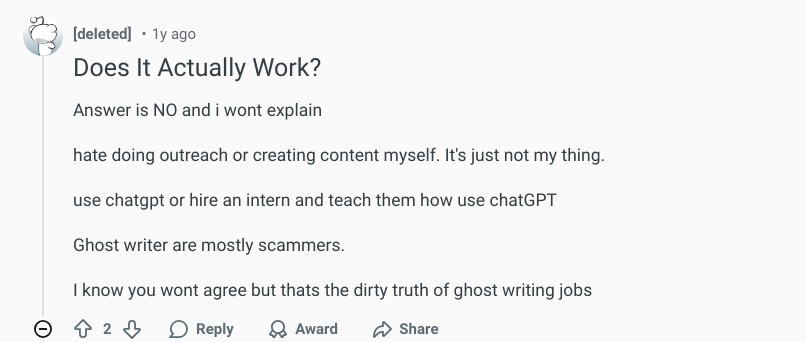
But no. Real ghostwriting is collaborative.
It’s your ideas, your voice, extracted by a ghostwriter to create clear, consistent content that builds authority over time.
To understand exactly how that works in practice, I reached out to 5 ghostwriters, including the editorial operations manager and founder at a LinkedIn ghostwriting agency, who have worked with SaaS founders to build authority and grow revenue, asking them:
“How do you capture and maintain a founder’s authentic voice at scale?”
What came back were no-fluff, repeatable systems, grounded in how founders actually think and communicate.
How ghostwriters capture and maintain your voice
Across all responses, three clear patterns kept showing up.
1. Voice capture from real conversations
Founders have lots to share, shaped by their personal experiences, motivations, and passions, aligned closely with the realities of building in the market they deeply understand.
Translating those raw insights into content will require ghostwriters to listen closely through interviews or even casual conversations.
Because that’s where the authenticity lies.
Gayathri Gopalan, a B2B SaaS writer at TripleDart who also renders ghostwriting services to founders, has built her entire process around this:
“For this, I rely mostly on WhatsApp voice notes only. I just ask both my founders to record whatever they think about a post’s core idea and ask them to record it unfiltered. With all those staccatos and fillers.”
She captures the thinking in its natural state rather than forcing structured answers.
Ghostwriters even take it up a notch, identifying patterns in tone, so the voice stays consistent.
As Neha Kaku, a B2B SaaS writer, puts it:
“You talk to them, listen closely, and over time you start noticing patterns, including the phrases they use regularly. That’s what keeps the voice consistent.”
2. Detecting the voice pattern
Having gathered raw insights from conversations or interviews, ghostwriters get to work.
They step back and begin to analyse.
Replaying the first couple of minutes of the call, listening to the founder’s voice until it gets into their head. Paying special attention to the body, tone, and language. Quizzing themselves, “When does the founder get most excited?” “When do they say something super-insightful?”
This is the exact procedure Gayathri follows.
“I observe where they get, you know, excited, where they pause, and where they think their ideas are not flowing coherently.
The excitement part is the one I usually focus on because that ideally shows what they believe, what they think, and what they want to do.
The pauses, I usually leave them.
The fillers, I ask again for their opinions.”
If there’s a particular metaphor or a certain word the founder uses, they note it.
A founder might consistently use analogies to explain ideas. Another might rely heavily on direct, no-fluff statements. Some lean into storytelling, while others default to frameworks and structured thinking.
These elements start to form a recognisable pattern, making the founder’s voice feel authentic and familiar.
3. Documentation systems for reference
“Capturing a founder’s voice is quite simple. Maintaining it is difficult. The first few batches of content, you do great because you’re referring to the source material, and you don’t know enough about the client yet, so you’re being careful. But as you keep scaling, writers just kind of drift. They start guessing, and the tone doesn’t align much anymore.”
Sakshi, an editorial operations manager at a ghostwriting agency, appears to be true in this saying.
Without going back to the source materials — transcripts, recordings, voice notes — even the best ghostwriters drift. Tone changes. Messaging becomes inconsistent. Content starts to feel less like the founder and more like the writer.
That’s why experienced ghostwriters, like Sakshi, build structured documentation systems using tools like Notion, Coda, and Claude, around the voice.
“So I keep a living reference. Mine lives on Claude. I keep updating my Claude project with call transcripts, feedback from the client, posts we’ve already done for them. And when a draft comes in, I’ll just drop it in and ask: would this person actually say this? And you just know.”
For referencing, when in doubt, just like Gayathri.
“Now, I have a coherent set, out of which I can capture the founder’s thinking. By using voice notes, I can replay them whenever I want to, which helps me to capture their exact tone. I might forget what they really spoke, while in an unrecorded video call, even if I note every single thing they say, but with a voice note, I have the data with me. I make sure to date every recording by forwarding it to me (the self-sending option on WhatsApp), so that if I need something they’ve sent before, I can easily access it.”
And for corrections, after every draft.
Those corrections aren’t treated as one-off edits; they’re fed back into the system.
So, rather than guessing, ghostwriters are continuously calibrating until the content becomes inseparable from the founder’s own thinking.
LinkedIn ghostwriting strategies that contribute to your SaaS growth
Now it’s been established that ghostwriting not only helps but is a legit way to stay consistent on LinkedIn without pulling focus from business growth or losing your voice.
Consistency, however, is just an activity if there’s no outcome.
85% of B2B decision-makers say most “thought leadership” content fails to deliver valuable insights.
In other words, buyers are flooded with generic founder-led posts proving visibility but not pipeline. Gathering likes and comments, yet don’t translate into leads or revenue.
Just like this Reddit user, who has been consistently posting on social media but hasn’t generated any leads.
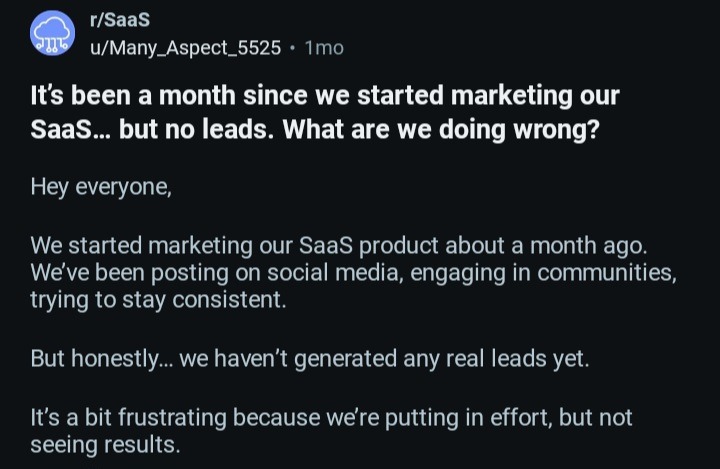
The reason? They lack a content strategy.
So, to find out what works, I went back to the ghostwriters doing this work every day and asked them:
“What specific LinkedIn content strategy have you seen directly contribute to SaaS growth or leads for a client?”
Here’s what they said…
Founder-led narratives and problem-first education are the real growth drivers
Sharing lived experiences, such as hiring mistakes, struggling with churn, and lost deals, is what people resonate with, rather than generic product updates. It builds credibility and human connection because it’s grounded in reality.
As Neha puts it:
“The strategy that consistently works is founder-led narrative + problem-first education.
Instead of posting product updates or generic tips, the founder talks about:
• Real situations with customers
• Specific problems they’re seeing in the market
• Decisions they’re making inside the company.”
When paired with insightful content that speaks directly to the pain your audience is already feeling before pitching any solution, it creates demand and drives meaningful business outcomes.
There’s no one-size-fits-all strategy for founders
No universal “LinkedIn playbook” exists for founders. What works for one can completely fail for another. So, ghostwriters’ real value lies in understanding the founder’s unique mix of personality, goals, and journey. And, building a strategy around it.
That’s the approach Gayathri follows.
“Well, I work with a martech founder and a SaaS founder, so the approaches I take are predominantly different.
With the martech founder, since she is back after her maternity leave and wants to come in with a zing, she relies more on short videos and carousels. For short videos, the ideas are her own. What I really do is sit with her on a video call, speak to her, understand what she wants or thinks, record it, and then convert it into a 3–5 minute raw script. Then the script is toned down to 1–2 minutes and handed over to her as a Word doc. For other posts like carousels and short-form content, the ideas and execution are purely mine. The same process is followed, except that for carousels, we mostly discuss the number of slides, the content within each, the CTA, etc. This strategy has gained around 2 new clients for her. But then, she is still at a nascent stage.
With my other SaaS founder, the work is a bit tricky, since he is nitpicky about the kind of content that goes on his page or his company page. With him, it is more about visibility than leads, because his main goal right now is to prove that he is a pro in the field and that his company’s core offering is strong. So, he relies more on short-form posts and carousels. They tend to perform better, since he prefers crisper content without hashtags, and carousels that are only 6–7 slides long, with the 7th slide being a demo slide.”
The strategy that succeeds will be those that follow the format, tone, and cadence that reflect the founder.
Personal content outperforms every other strategy
Studies show that personal posts get about 5x more engagement compared to posts from company pages. Why? People buy from people, not logos.
Sakshi says:
“There’s no specific content strategy that’s done outstandingly well for a particular client. But what I’ve seen is that personal content does really well. Building in public, because people resonate with that more, and it just stands out. You’re sharing your own unique experiences and that’s what we suggest as a strategy.
Apart from that, we have content pillars: industry, business, and personal. We try to mix in all three for our clients, so we’re writing diverse content and standing out.”
When your posts reflect your experiences, you’re trusted, and people take action because of you.
Intent-driven content actually moves the needle
Showing up consistently is the idea. But, without purpose, it hampers growth.
Posting intent-driven content is what results in real business outcomes.
Masroor Ahmad, founder of h1copy, a LinkedIn ghostwriting agency that has helped founders build authority and grow their pipeline, puts it plainly:
“The biggest needle-mover isn’t posting more.”
It’s positioning + consistency + intent-driven content.
- What has worked best for us:
- We treat LinkedIn like a top-of-funnel + nurturing channel, not a vanity platform
- Content is split into:
- Awareness (stories, hot takes, relatable problems)
- Authority (frameworks, breakdowns, insights)
- Conversion (soft CTAs, POVs, inbound triggers).”
Each category has a job. Awareness pulls people in. Authority keeps them engaged. Conversion turns that engagement into a demo request, a reply, or an inbound lead.
Therefore, every piece of content sits within a larger system. To turn attention into revenue.
How LinkedIn ghostwriting builds founder authority
You’ve seen how your voice is maintained, so your post sounds like you. And, the content strategy that contributes to your SaaS growth. Here’s how LinkedIn ghostwriting uses both to build your authority.
Authority starts with visibility
In a 60-90 minute interview, ghostwriters extract your ideas and convert them into multiple pieces of content.
According to Neha, she says that:
“One hour of conversation gives me enough raw material to create 20–21 posts.”
And because it’s your words, your ideas, your perspective, every time you show up, your audience gets to know how you think, what you believe, and what you stand for.
Consistency turns visibility into authority
With ghostwriting, posting no longer competes with meetings, launches, or urgent decisions.
Ghostwriters solve that by following a system, a monthly LinkedIn content plan, scheduled for when and how each post goes live.
One post introduces an idea, the next expands on it, and another reinforces it with a story or example. Each piece connects to the next, creating a consistent narrative that your audience can follow.
Positioning makes that authority stick
Ghostwriters, instead of jumping across random topics, anchor your content around a few core themes that reflect your expertise.
These themes act as content pillars, giving your message direction and structure.
If you’re a SaaS founder in the Martech space, your content pillars might centre around marketing tools, systems, or data-driven insights. So, every post connects back to one of those themes.
In the long run, prospects begin to see you as an expert in your field.
That way, trust is built, which naturally shortens the sales cycle even before the first conversation begins.
The typical workflow of a LinkedIn ghostwriter
After discussing with these ghostwriters, one thing became clear. Behind every founder who shows up consistently on LinkedIn, there’s a deliberate process that brings voice, consistency, and positioning together.
So I asked them directly: What does your ghostwriting workflow actually look like when working with a SaaS founder?
Amongst all their responses, a pattern was revealed.
The discovery call
The process begins with a call — a non-negotiable stage. Something Jescil Richard, a storyteller, calls “voice excavation”.
“Most ghostwriting starts with content, but mine starts with an interrogation.
Before anything gets written, I run them through what I call a voice excavation: a structured set of questions designed to surface how they actually process their industry, not just what their company does.”
Here, ghostwriters want to hear you. The pace at which you speak and how you process your thoughts.
Some might interview you, asking focused questions about your industry, market patterns, and customer insights.
“I run a monthly call with the founder using ~15 focused questions around customer insights, internal decisions, and market patterns.”
— Neha
Or about your journey as a founder, and your products.
“When we have a new client, we have an onboarding call where we ask them about the journey, what they’re comfortable talking about, and anything they want to share about their product. We’ll go in prepared with questions, or we’ll just let them talk about whatever they want to.”
— Sakshi
The idea is for ghostwriters to understand your personality, so the content feels like it comes directly from you.
Structured content planning
Right after the conversation, ghostwriters strategically organise those insights into content pillars, themes, and calendars.
Because every post has a purpose. To position you as an authority in your niche.
Shaping them into topics that reflect your experience and leadership style.
Translating Insights into content
Based on your insights and ideas, the drafting process begins.
“From there, I turn insights into post ideas, draft, refine with feedback, and track what drives meaningful engagement.”
— Neha
Ghostwriters ensure to create drafts that sound like something you’d write, into clear, simple posts, articles, and newsletters that are aligned with how you communicate.
Feedback refinement loop
After each draft, you review the post to see if it actually sounds like you.
“Feedback loop
• Founder reviews (async, quick edits)
• We refine tone over time”
— Masroor
If adjustments are needed, you suggest edits, and the ghostwriters implement them.
This feedback loop sharpens your voice and ensures your messaging remains authentic, clear, and effective.
Publishing & optimization
Once edits and corrections have been made, ghostwriters prepare posts to be published.
Using a content calendar, they plan the rhythm of your LinkedIn presence. By scheduling your post to either two or three posts per week. Ensuring visibility is effortless and consistent.
When the post goes live, the likes, reshares, and comments it gathers, ghostwriters use that data to analyse what worked and what went flat. To plan future content.
As the process is repeated, messaging becomes sharper, positioning becomes clearer, and content consistently attracts the right audience.
However, with tools like ChatGPT, Claude, and Gemini creating LinkedIn posts without going through the workflow…
Is hiring a LinkedIn ghostwriter still worth it with AI in the picture?
AI has come and changed the game.
With just a prompt, you can generate a grammatically correct post, article, or even newsletter in minutes.
In fact, 88% of marketers — and by extension, many founders — use AI in their daily roles to generate content.
Because it’s fast, and shockingly capable of mimicking structure, tone, and style.
Plus, you can use it for research, content expansion, or go from idea to draft faster.
But, here’s the deal: AI has a ceiling.
AI follows prompts. Ghostwriters follow your thinking.
Scrolling through LinkedIn, you’ll find posts with the same hook. The same structure. The same five lessons learned from building a startup. A strange sameness that makes one founder’s content almost indistinguishable from the next.
That’s because 50%+ of LinkedIn long-form posts are likely AI-generated. They follow a pattern, shaped by the prompt.
That’s the ceiling AI hits.
It doesn’t know your story, nor does it have an idea of the decisions you took that led to a breakthrough. And from what Sakshi, Neha, Gayathri, Jescil, and Masroor have said, content rooted in real founder thinking, real problems, and a clear goal, is what moves the needle.
Originality is your competitive advantage
Your experiences, opinions, and insights are your assets. Something AI and no competitor can replicate.
And there are results to prove it.
In 2024, Adam Robinson, CEO of RB2B, grew Retention.com, a visitor identification and email capture tool for ecommerce brands, to $22million in ARR by publishing content on the challenges of running a bootstrapped SaaS business.
Stuart Chaneuy, founder and CEO of Rivo, a retention platform built for Shopify, shared his SaaS growth process on LinkedIn. What worked, what didn’t, and what he was learning in real time. In 2024, his ARR doubled to $2.8 million.
Guillaume Moubeche showed the behind-the-scenes of building Lemlist on LinkedIn, which turned into a growth engine, built a community, and grew from $1,000 in capital to $20 million in ARR.
Three founders. Three different products. One thing in common — they showed up with something real to say. And their audiences rewarded them for it.
That’s why SaaS founders need LinkedIn ghostwriters. To turn those assets into a consistent LinkedIn presence that makes the right people stop scrolling and start paying attention.
What a ghostwriter does that AI cannot
This is where h1copy comes in.
Before a single post is written, h1copy’s team hops on a call with you. To listen. To pick your voice, the opinions you hold that make you different, and the stories you almost didn’t think were worth telling.
From there, they create a content strategy, dividing it into themes, with a weekly mix of story, insights, and authority. Into a system that produces content so unmistakably yours that your audience never once questions who wrote it.
And in a market where every founder has access to the same AI tools, your thinking is the only competitive advantage that can’t be replicated.
Book a call and see your LinkedIn profile turn into a steady pipeline without having to manage the process yourself.
Frequently asked questions (FAQs)
How do you ensure the posts sound like me and not the ghostwriter?
Ghostwriters capture your authentic voice through unfiltered conversations, interviews, and voice notes. With that, they detect patterns in your voice—metaphors, excitement cues, or no-fluff style. They build a “living reference” doc in tools like Notion or Claude with transcripts, feedback, and past posts. Every draft loops back to you for edits, refining until it feels indistinguishable from your own writing.
Isn’t ghostwriting just cheating or deceptive on LinkedIn?
No, it’s collaborative and transparent. It’s your ideas, stories, and insights that drive the content, with the ghostwriter polishing for clarity and consistency. It’s not random posts slapped with your name; it’s a system extracting your thinking via 60-minute calls or interviews.
How much time does this take from my busy schedule?
Minimal: 1-2 hours monthly for discovery calls or voice notes, plus quick async feedback on drafts (5-10 minutes per post). Ghostwriters handle planning, drafting, and scheduling (e.g., 2-3 posts/week via calendar). This frees you from 2-3 hours of weekly writing struggles, letting you focus on growing your SaaS.
Can ghostwriting actually generate leads and revenue for my SaaS?
Yes. Ghostwriters develop a content strategy to that effect. Strategies like: using founder-led narratives (e.g., churn struggles), problem-first education, and intent layers — awareness, authority, conversion CTAs.
What’s the typical workflow when hiring a ghostwriter?
Discovery call: In a 60-90-minute call, ghostwriters extract your voice, journey, and insights.
Content planning: Build content pillars/themes/calendar.
Drafting: Turn voice notes into posts.
Feedback loop: You review and suggest edits.
Publish & optimise: Schedule, track engagement, refine. Repeat for consistency—e.g., one call yields weeks of content.
Why hire a ghostwriter when AI like ChatGPT can write posts fast?
AI excels at creating posts and writing articles. But it hits a ceiling on originality—50%+ of posts feel generic (same hooks, “5 lessons”). It can’t replicate your unique decisions, stories, or market intuition. Ghostwriters extract irreplaceable founder thinking (e.g., via voice patterns), creating standout content that drives pipeline, as seen in bootstrapped SaaS hitting $22M ARR.
How do I know when to hire a LinkedIn ghostwriter?
- Your content lacks consistency
- You want to build authority in a specific niche
- You want inbound opportunities without self-promotion
- You want LinkedIn to support the growth of your SaaS
How much does LinkedIn ghostwriting cost for SaaS founders?
Typical range: $300-$1000/ month for 8-16 posts. Includes discovery calls, voice capture, content strategy, drafts + revisions. Enterprise founders pay on the higher side for premium agencies with proven revenue impact.
How many LinkedIn posts can one founder interview generate?
20-25 posts from 60-90 minutes. Ghostwriters extract insights via voice notes/calls, then repurpose them into carousels, threads, and videos. One conversation = 4-6 weeks of content.
What are LinkedIn content pillars for SaaS founders?
3 pillars: 1) Industry (martech trends, churn patterns), 2) Business (hiring fails, growth decisions), 3) Personal (bootstrapping lessons). Mix creates authority + relatability.
Why do founder-led narratives outperform SaaS product posts?
Personal stories get 5x engagement vs company pages. “Our churn spiked 27% — here’s how we fixed it” beats “New feature alert.” Buyers trust humans solving real problems.
How often should SaaS founders post on LinkedIn for authority?
2-3x/week optimal. Monday/Wednesday/Friday, 9-11 AM IST. Mix formats: 40% carousels, 30% text posts, 20% videos, 10% polls. Consistency > perfection.
Can LinkedIn ghostwriting generate SaaS demo requests?
Yes — intent-driven content works. Split: 40% awareness (problems), 40% authority (frameworks), 20% conversion (soft CTAs). Agencies report 15-25% engagement-to-lead conversion.
How do ghostwriters handle nitpicky SaaS founders?
Living reference system: Notion/Claude doc with voice notes, transcripts, feedback loops. Founders review drafts async (5-10 mins/post). Revisions sharpen voice over 4-6 weeks.
When does LinkedIn ghostwriting ROI become positive for founders?
Month 2-3: Network growth accelerates. Month 4-6: Inbound leads appear. Month 6+: Authority compounds (shorter sales cycles). Track: impressions → profile visits → connection requests → demos.